Monkey Wolf [1] ( lat. Cercopithecus wolfi ) - a species of primates from the family of monkeys . It lives in central Africa , mainly in the Democratic Republic of the Congo and Uganda . It inhabits primary and secondary rain and swamp forests.
| Monkey Wolf |
 |
| Scientific classification |
|---|
| No rank : | Bilateral symmetrical |
| Squadron : | Euarchontoglires |
| Grand detachment : | Euarchonta |
| Parvotryad : | Narrow-nosed monkey |
|
| International scientific name |
|---|
Cercopithecus wolfi ( Meyer , 1891) |
| Security status |
|---|
Least ConcernedIUCN 3.1 Least Concern : 40646 |
|
Content
The species was described in 1891 and named after Ludwig Wolf, who caught an animal for the Dresden Zoo. [2] [3] Related species are Campbell's marmoset , spongy monkey , Cercopithecus lowei , Dent 's marmoset and Mona's marmoset . The Wolf Monkey was previously considered a subspecies of the forelock monkey. [four]
It forms two subspecies living in isolated areas: [5]
- Cercopithecus wolfi wolfi - between Congo and Sankuru .
- Cercopithecus wolfi elegans - between Lomami and Lualaba .
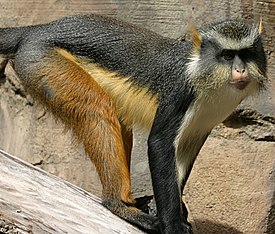
The coat is gray, reddish on the back, and Cercopithecus wolfi wolfi has a chestnut mark on the back. [5] Hands are black, legs are reddish. [5] The belly is yellow, orange on the sides. [5] The coat on the cheeks and ears is long, light yellow. [5] The back of Cercopithecus wolfi elegans is more brown closer to the sacrum. [5] The forelimbs are black, the legs are reddish. The chest is light yellow. [5] The scrotum is blue. [5] Sexual dimorphism is observed, males weigh about 4.5 kg, females about 2.5 kg. [6] Have developed cheek pouches. [7]
The diet mainly fruits, in addition to seeds and insects. Sometimes it includes young leaves and shoots in the diet. The breeding season begins in June and ends in December. Forms groups consisting of a sexually mature male, several females and young animals. Males after reaching puberty leave the group. Groups usually compete among themselves for access to resources. Both males and females are aggressive towards members of other groups, protecting their territory.
- ↑ Sokolov V.E. The pagan dictionary of animal names. Mammals Latin, Russian, English, German, French. / edited by Acad. V. E. Sokolova. - M .: Rus. lang., 1984. - S. 90. - 10,000 copies.
- ↑ Meyer, AB Cercopithecus wolfi, n. sp. (unspecified) // Notes from the Leyden Museum. - 1890. - T. 13 . - S. 63-64 .
- ↑ Meyer, AB Remarks on an African Monkey, Cercopithecus wolfi (English) // Proceedings of the Zoological Society of London: journal. - 1894. - P. 83-84 .
- ↑ Grubb, P. et al. Assessment of the Diversity of African Primates (English) // International Journal of Primatology . - Springer , 2003 .-- Vol. 24 , no. 6 . - P. 1301-1357 . - DOI : 10.1023 / B: IJOP.0000005994.86792.b9 .
- ↑ 1 2 3 4 5 6 7 8 Groves, CP Primate Taxonomy. - Washington, DC: Smithsonian Institution Press, 2001.
- ↑ Mate, C. et al. Preliminary observations on the ecology of forest cercopithecidae in the Lokofe-Ikomaloki Region (Ikela, Zaire ) // Folia Primatologica: journal. - 1995. - Vol. 64 , no. 4 . - P. 196-200 . - DOI : 10.1159 / 000156853 .
- ↑ Buzzard, Paul J. Cheek pouch use in relation to interspecific competition and predator risk for three guenon monkeys ( Cercopithecus spp.) (English) // Primates: journal. - 2006. - Vol. 47 , no. 4 . - P. 336—341 . - DOI : 10.1007 / s10329-006-0188-6 . - PMID 16645704 .
- Bearder, SK. et al. eds. Primates in Perspective. New York: Oxford University Press, 2007.
- Garber, PA. “Foraging strategies among living primates.” Annual Review of Anthropology 1987: 339-364.
- Strier, KB. Primate Behavioral Ecology. 3rd 3d. San Francisco: Allyn and Bacon, 2007.