Gus-Khrustalny (until 1926 - Gus-Maltsevsky [3] ) - a city (since 1931 [4] ) in Russia , the administrative center of the Gus-Khrustalny municipal district (not included in the district) and the urban district of the city of Gus-Khrustalny, Vladimir Region .
| City | |||||
| Goose Crystal | |||||
|---|---|---|---|---|---|
 | |||||
| A country |  Russia Russia | ||||
| Subject of the federation | Vladimir region | ||||
| City district | city of Goose-crystal | ||||
| Chapter | Sokolov Alexey Nikolaevich | ||||
| History and Geography | |||||
| Based | in 1756 | ||||
| First mention | 1756 | ||||
| Former names | Goose, Goose-Maltsevsky | ||||
| City with | 1931 | ||||
| Square | 43 km² | ||||
| Center height | 125 m | ||||
| Timezone | UTC + 3 | ||||
| Population | |||||
| Population | ↘ 54,533 [1] people ( 2018 ) | ||||
| Density | 1268.21 people / km² | ||||
| Katoykonim | Gusev residents, Gusev residents, Gusev residents [2] | ||||
| Digital identifiers | |||||
| Telephone code | +7 49241 | ||||
| Postal codes | 601501-601509 | ||||
| OKATO Code | 17420 | ||||
| OKTMO Code | |||||
| Other | |||||
| Awards |  | ||||
| gusadmin.ru | |||||


Located in Meshchera on the Gus River, 51 km south of Vladimir . The population is 54 533 [1] people. (2018).
The name of the inhabitants of the city is Gusevites (plural), Gusevchan (singular, female), Gusevchan (singular, male). Also, the local press uses the self-name of the residents as "Gusevets", "Gusevtsy".
History
Beginning of glass production
The village (Gus volost) is mentioned in documents of the 17th century. In 1756, the Maltsov merchants in the tract Shivorovo [5] on the Gus River began construction of a glass manufactory that gave rise to the famous name - Gusevsky Crystal Plant and the name of the city "Gus-Khrustalny". The construction was caused by the need to withdraw enterprises from the Moscow region , where the government banned glass factories due to deforestation. In Goose, in particular, the artisans were transported from near Mozhaisk . In 1759, Akim Maltzov launched the second plant - Nikulinsky, which consisted of two workshops ( gut ) [6] .
After the death of Akim, his widow Maria Vasilievna took over. Over the 20 years of management, Maria Maltsova founded four more glass factories and one cement. By will, Maltzova handed over all the glassworks to her youngest son, Ivan , giving the eldest, Sergei , only a monetary reward. A few years later, Sergei Maltsov bought all of Gusev’s enterprises from his younger brother and founded new factories nearby. In 1823, after the death of Sergei Maltzov, the Maltsevsky Glass District, which united the factories of Vladimir , Ryazan , Oryol , Kaluga and Smolensk provinces , reunited under the leadership of his son Ivan Sergeevich Maltzov.
Ivan Maltsov
In 1831, Ivan Maltsev , who returned from abroad, arrived in Goose and took up factory affairs. Under him, the Gusevskaya crystal plant was, as it were, reborn. Maltsev, who often visited abroad, began to introduce technical innovations that appeared in Europe at his enterprises. He also borrowed new products from other Russian glass factories that were in demand in the market. At the suggestion of master craftsmen, a “camera of samples” was created at Maltzov, where the products were stored, the best in beauty and complexity of the design. Soon, the Gusev factory was transferred to the production of expensive crystal glassware. Now the plant could rightly be called a crystal plant. The best glass craftsmen were transferred here from other factories. In Gus, running products were made from simple and colored glass with floral painting and gilding. Crystal products were famous for their diamond (brilliant) facet, decorated with engraving . Vases were produced from two- and three-layer crystal with etching . At the II All-Russian Exhibition of Manufactured Products, held in Moscow in 1831, Gusevsky crystal was awarded the "small gold medal". Two years later, Gusev’s products won the “big gold medal” at the St. Petersburg exhibition. Two years later, Maltsov products entered the world market.
In 1835, Ivan Maltsev, being abroad in the retinue of Nicholas I , studied the work of Czech factories that produced Bohemian glass , purchased production samples, and acquired manufacturing recipes. Soon, the Gusevsky plant mastered the technology of manufacturing Bohemian products.
In 1844, the construction of a paper mill began in Gus, the launch of which took place in 1847. In 1865, the paper and weaving mill began to operate, and in 1888 -cigar spinning . From the first steps, the paper spinning mill was characterized by high quality yarn. Cotton was bought in America, all equipment was English. At the All-Russian Exhibition of 1870, Gusevsky cotton products were awarded silver, and at the exhibition of 1882 - a gold medal.
Late 19th - early 20th centuries
In 1880, Ivan Maltsev died. After his death, the Gusevsky Crystal Plant was transferred to one of his nephews - Yuri Stepanovich Nechaev-Maltzov (1834-1913). During this period, the Gusevsky Crystal Plant produced about 1/4 of all glass products in the Vladimir province, in 1884 it employed 744 people. At the paper spinning mill, 3.5 thousand people worked during this period. At the beginning of the XX century, Gus-Khrustalny became a large industrial village. On the eve of World War I , 12 thousand people lived in it.
In 1914, according to the will of a childless Yu. C. Nechaev-Maltsov, his condition passed to his relative - Count P.N. Ignatiev. In 1918 the enterprise was nationalized.
Soviet period
By a resolution of the NKVD of February 25, 1919, Gus-Maltsevsky received city status. However, due to difficult material conditions, the absence of administrative buildings and any kind of public utilities, housing, and means to pay a salary to the city state, Gus-Maltsevsky could not cope with city expenses and was subsequently transferred to the position of a working village.
The decree of the All-Russian Central Executive Committee of August 23, 1926 established the Gusev district . Gus-Maltsevsky was renamed Gus-Khrustalny and became a county center [3] . In the county there were 26 fairly large industrial enterprises. With the liquidation of provinces and counties, the Gusevsky District of the Vladimir District of the Ivanovo Industrial Region was organized. The general plan and layout of the village was developed in 1927 by the architect-urban planner Alexander Ivanitsky . The village of Gus-Khrustalny from June 10, 1929 became a district center.
Decree of the All-Russian Central Executive Committee on November 20, 1931, the working village of Gus-Khrustalny was transformed into a city [7] . March 11, 1936 became part of the Ivanovo region .
The Gusevites made a great contribution to the victory during the years of World War II . There were five hospitals in the city. In the fall of 1941, a defense committee was created in the city, a fighter battalion of the people's militia was formed. In a short time, production was rebuilt in a military fashion. The crystal factory at that time produced thermoses, flasks, flasks, thermometers, etc.
On August 14, 1944, Gus-Khrustalny became part of the newly formed Vladimir Region .
Gus-Khrustalny was awarded the Order of the Badge of Honor ( 1981 ) for his successes in the development of the domestic glass industry and his contribution to the development of the national economy.
In the 1970s, a promenade was built, roads were paved with asphalt. In the Soviet period, such large enterprises as the crystal plant, textile mill, pilot plant, Dzerzhinsky glass factory, quartz factory, Shveymash, reinforcing factory, Glass Institute, creole factory, meat processing plant, dairy plant, and bakery operated in the city. Clubs, schools were built, and children's recreation camps were opened.
Post-Soviet period
Gusevsky Crystal Plant is the largest domestic enterprise for the production of art glass and crystal. In 1996, the city of Gus-Khrustalny was awarded the international prize " Golden Mercury " for preserving the historical and architectural appearance of the city.
Quartz plant, Textile mill, Shveimash, Glass Institute, Crystal factory, meat factory cease to exist ... The rest of the production is split into pieces. Part is pulled apart, part somehow continues to work.
At the end of 2010, Gus-Khrustalny’s entrepreneurs turned to the head of government, Vladimir Putin, with a letter about the prevalence of crime in their city: “More than three dozen arson, robberies, beatings and other“ exemplary ”crimes against business representatives. And these are statistics only for the last 4 months. ” [8] The situation in the city was described as "criminal terror ." [9] During the investigation, local law enforcement officials were removed from office and later resigned. [9] The head of the Investigative Committee of the Russian Federation Alexander Bastrykin came to restore order in Gus-Khrustalny. [9] But the mass purge of the ranks of the local Ministry of Internal Affairs did not occur.
Vladimir Putin commented on the criminal situation in Gus-Khrustalny as follows: “As for the terrible situation in Kushchevskaya , and in Gus-Khrustalny, this is not only a matter of the internal affairs bodies. The point here is completely different: the fact that all the authorities turned out to be insolvent. ” [ten]
Until 2010, Gus-Khrustalny had the status of a historical settlement, however, by Order of the Ministry of Culture of the Russian Federation of July 29, 2010 No. 418/339 the city was deprived of this status. [eleven]
In November 2011, the famous Crystal Factory, which gave the city its name, ceased to exist. Production at the plant was stopped on November 5, 2011 due to a power outage for debts of 11 million rubles [12] . The last employees of the enterprise were dismissed in January 2012 [13] .
In September 2012, Andrei Murtazin [14] , the leader of the then organized crime group in 2010, as well as his brother Ruslan Murtazin [15] , were detained.
On December 26, 2013, the Crystal Plant resumed operation, or rather, its 4th workshop, which specializes in the production of colored crystal. The launching event was attended by the Governor of the Vladimir Region Svetlana Orlova , Chairman of the Legislative Assembly of the Region Vladimir Kiselev, as well as the Head of the City Nikolai Balakhin.
Population
| Population | ||||||||||
|---|---|---|---|---|---|---|---|---|---|---|
| 1859 [16] | 1885 | 1897 [17] | 1920 [18] | 1923 [18] | 1926 [18] | 1931 [19] | 1939 [20] | 1959 [21] | 1970 [22] | 1973 [19] |
| 3282 | ↗ 6229 | ↗ 11 981 | ↘ 9971 | ↗ 12 191 | ↗ 17 910 | ↗ 25 500 | ↗ 40,225 | ↗ 54 158 | ↗ 64 516 | ↗ 67,000 |
| 1976 [19] | 1979 [23] | 1982 [24] | 1986 [19] | 1987 [25] | 1989 [26] | 1996 [19] | 1998 [19] | 2000 [19] | 2001 [19] | 2002 [27] |
| ↗ 69,000 | ↗ 71 598 | ↗ 73,000 | ↗ 75,000 | ↗ 76,000 | ↗ 76 360 | ↘ 75 900 | ↘ 74 800 | ↘ 73,400 | ↘ 72 300 | ↘ 67 121 |
| 2003 [19] | 2005 [19] | 2008 [19] | 2009 [28] | 2010 [29] | 2011 [19] | 2012 [30] | 2013 [31] | 2014 [32] | 2015 [33] | 2016 [34] |
| ↘ 67 100 | ↘ 64 900 | ↘ 61 900 | ↘ 61 013 | ↘ 60 784 | ↗ 60 800 | ↘ 59 653 | ↘ 58 571 | ↘ 57 616 | ↘ 56 676 | ↘ 55 973 |
| 2017 [35] | 2018 [1] | |||||||||
| ↘ 55 421 | ↘ 54 533 | |||||||||
As of January 1, 2019, in terms of population, the city was on the 306th place out of 1115 [36] cities of the Russian Federation [37] .
The population of the city decreases due to the excess of mortality over the birth rate and the outflow of part of the able-bodied population to other cities.
Climate
| Climate Goose-Crystal | |||||||||||||
|---|---|---|---|---|---|---|---|---|---|---|---|---|---|
| Indicator | Jan | Feb | March | Apr | May | June | July | Aug | Sep | Oct | Nov | Dec | Year |
| Average maximum, ° C | −6.7 | −5.3 | 0.8 | 10.1 | 18.3 | 22.4 | 24.4 | 22.3 | 15.7 | 7.9 | −0.1 | −4.6 | 8.8 |
| Average temperature, ° C | −9.8 | −9.1 | −3.3 | 5.2 | 12.6 | 16.8 | 18.9 | 16.7 | 10.7 | 4.3 | −2.5 | −7.3 | 4.4 |
| Average minimum ° C | −13.2 | −13 | −7.2 | 0.9 | 7 | 11.2 | 13.5 | 11.7 | 6.6 | 1.3 | −4.9 | −10.2 | 0.3 |
| Precipitation rate, mm | 41 | 31 | thirty | 43 | 48 | 74 | 70 | 70 | 54 | 65 | 50 | 50 | 626 |
| Source: Climate-data.org , Meteoinfo | |||||||||||||
Attractions
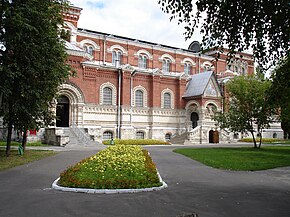
One of the attractions of the city is St. George's Cathedral , built in 1904 at the expense of Yu. S. Nechaev-Maltsov according to the project of architect L.N. Benois and consecrated in honor of St. George the Victorious . The cathedral partially preserved the paintings of V. M. Vasnetsov . Currently, the Crystal Museum is housed in the former temple building.
Holy Trinity Cathedral dates back to 1816, when a small monastery appeared in the village of Gus near the crystal factory. The temple was erected and named in honor of Saints Joachim and Anna. 35 years later, a church was built near the church and consecrated in honor of the Life-Giving Trinity . In 1936 it was closed. Restoration work began only in 1989. Almost everything in the church had to be restored from scratch, from the floors to the dome of the monastery and the bell tower, which was almost completely destroyed.
The urban artificial reservoir (popularly called the lake) is one of the most attractive places for recreation for residents and visitors of the city.
Gus-Khrustalny is one of the cities of the small Golden Ring of Russia .
Education
- Eight secondary comprehensive schools [38] , four basic secondary schools [39] and one special secondary school [40] , an Orthodox gymnasium [41] , 22 kindergartens and one kindergarten, a children's home, an orphanage;
- Gusevsky Glass College , a branch of Vladimir State University, a branch of the Vladimir College of Economics and Law, Gus-Khrustalny Technological College named after G.F. Chekhlov;
- "Center for Continuing Education of Children" Source ""; [42]
- Children's art school.
Sport
- Children and youth sports school;
- Children's recreation and educational sports center named after A. B. Paushkina;
- Children and Youth Sports Club "Kharlamovets";
- Yacht Club;
- Stadium FC Gran;
- Stadium "Central";
- Sports complex "Atlant";
- Vladimir regional public organization sports and technical club "QUARTZ" ( Karting and track racing)
- The Gran club is participating in the football championship of the region;
- Women's futsal clubs "Alpha" and "Iskra" - winners of the championships and cups of Russia in futsal and microfutsal
Culture
- City Library Information Center;
- Cinema Center "AlmaZ";
- Youth Palace "Crystal"
- Goose-Crystal Museum of History and Art
- Crystal Museum
Hotels
- Hotel "Meshchera";
- Hotel "Barinova Grove";
- Park Hotel Manor Meshcherskaya.
Monuments
- Two monuments to V.I. Ulyanov-Lenin ;
- Eternal flame;
- Monument to F.E. Dzerzhinsky
- Cenotaph;
- Monument to Akim Maltsov;
- Monument to victims of the Chernobyl disaster
- A stele installed on the site of the house in which the psychiatrist S. S. Korsakov was born.
Economics
The city is one of the centers of the glass industry, dominated by enterprises specializing in the manufacture of glass and crystal products. Among city-forming enterprises:
- Gusevsky Crystal Plant
- Gusevsky glass factory named after F.E. Dzerzhinsky
- OSV " Fiberglass "
- Gusevsky reinforcing plant "Gusar"
- Glass Research Institute
- Experienced Glass Factory
- Brickworks
- Meat processing plant
- Goose Crystal Dairy
- Enterprise "Meshchera Bread"
- Textile mill
The Gusevsky Crystal Plant, the Fiberglass Factory and the Gusevsky Glass Factory named after Dzerzhinsky in the Soviet era were city-forming enterprises of strategic importance, which occupied the majority of the city’s population. But in the 1990s, the country's poor economic situation could not but affect these plants. State orders for the production of glass at that time were practically not received. As a result, production was greatly reduced. Currently, a huge part of the production space is not used [43] .
Transport
City buses
There are 6 bus routes in the city. [44] Two of them connect the city with the nearest village of Gusevsky .
Shuttle buses
The Gus-Khrustalny bus station provides regular bus services. Directions: Vladimir, Ryazan, Moscow, Ivanovo, Voronezh.
Suburban trains
- The Gus-Khrustalny railway station of the Gorky Railway is located on a dead-end non-electrified single-track Vladimir - Tumskaya branch (two pairs of commuter trains daily). The line is served by diesel-powered trains, consisting of 2-3 general or seated cars.
- From Moscow, you can take an electric train to the Nechaevskaya station (with a change at Cherusti station), located 15 km from the city, a taxi platform is equipped at the station.
Energy
- Gas pipeline Vladimir - Velikodvorsky ;
- 2x220kV power line Vladimirskaya PMES - Fiberglass substation.
- Two 110 kV lines from Shaturskaya GRES via Roshal and through Cherusty .
Mobile Communications
- Beeline ;
- MTS ;
- MegaFon-Vladimir ;
- Tele2 ;
- Skylink
- Yota .
Media
Television
In the city there is the opportunity to watch television through cable networks, among which the "Central Region", "Genre" and others.
Broadcast TV:
- 11 TVK - NTV
- 16 TVK - TNT
- 31 TCEs - Channel Five
- 36 TVK - The first multiplex of digital television in Russia
- 39 TVK - STS
- 51 TVK - Carousel
- 58 TVK - The second multiplex of digital television in Russia
Radio
- 95.7 - Militia Wave
- 96.8 - Native Road Radio
- 98.1 - Humor FM
- 98.6 - Radio Record
- 99.1 - Retro FM
- 99.5 - Russian radio
- 101.1 - DFM
- 103.1 - Radio of Russia
- 103.6 - Europe Plus
- 104.6 - Love Radio
- 105.6 - Road Radio
- 106.6 - Radio 7 on seven hills
- 107.2 - Autoradio
- 107.6 - New Radio
- "The crystal GENRE"
- " Gusevsky news "
- "Poster" (formerly called the "New Poster")
- central region
Online Media
- Gus-Info [45]
Russian Orthodox Church
- Gusevsky Orthodox Theological College. It was founded in 1995 by Mitrophor archpriest John Kravchenko
- Gusevsky parish. Temple-chapel of the Holy Great Martyr Barbara.
City Photo Gallery
Almshouse (now City Hall)
Chapel of St. Barbara (present)
St. George's Cathedral (now the Museum of Crystal)
St. George's Cathedral (inside)
Lake in the city center, sunset
City shopping arcades
Maltsov houses (typical buildings of the city of the 19th - early 20th centuries)
Monument to Akim Maltsov (founder of the city)
Founding Fathers (Ivan and Yuri Maltsov)
City center of culture and leisure
Entertainment center "Almaz"
Famous Natives and Residents
- Gorodkov, Vasily Nikolaevich (1914–1997) - Soviet and Russian architect, Honored Architect of Russia.
- Soloukhin, Rem Ivanovich — Soviet scientist in the field of physics, corresponding member of the USSR Academy of Sciences, academician of the Academy of Sciences of the BSSR, Lenin Prize laureate.
- Chekhlov, Gennady Fedorovich - tanker, Hero of the Soviet Union , after the war - a worker at the Fiberglass plant.
Notes
- ↑ 1 2 3 The population of the Russian Federation by municipalities as of January 1, 2018 . Date of treatment July 25, 2018. Archived July 26, 2018.
- ↑ Gorodetskaya I. L., Levashov I. A. Russian names of inhabitants: Dictionary-Reference / Ed. E. A. Levashova. - M .: Russian dictionaries, 2003. - S. 91. - ISBN 5-93259-033-5 . .
- ↑ 1 2 Pospelov E. M. Geographical Names of Russia: Toponymic Dictionary. About 3000 units. - M .: Book find, 2002 .-- 352 p.
- ↑ USSR. Administrative and territorial division of the Union republics on January 1, 1980 / Comp. V.A. Dudarev, N.A. Evseeva. - M .: Izvestia, 1980 .-- 702 p. - S. 106.
- ↑ Skulov N. Fire tower . Echo of the Meshchera. (inaccessible link)
- ↑ Elena Volodina. Material science for interior designers . - T / O "Neformat". - 600 s.
- ↑ Andrey Laptev. History of geographical names of Russia . - Litres, 2017-09-05. - 642 p. - ISBN 9785457265691 .
- ↑ Crime terror Continues to emerge in Russian regions . vesti.ru. Date of treatment March 12, 2018.
- ↑ 1 2 3 Head of the Investigative Committee Alexander Bastrykin will arrive today in the Vladimir Region . Echo of Moscow. Date of treatment March 12, 2018.
- ↑ Vladimir Putin is becoming more direct and linear // Kommersant newspaper. - 2010-12-17. - S. 1 .
- ↑ List of historical settlements in the regions of the Russian Federation . Russian newspaper (September 29, 2010). Date of treatment March 12, 2018.
- ↑ Like goose crystal. What awaits the city after the closure of the famous factory. , RIA Novosti (January 26, 2012). Date of treatment March 12, 2018.
- ↑ Gusevskaya Crystal Plant dismisses all employees , RIA Novosti (January 12, 2012). Date of treatment March 12, 2018.
- ↑ The leader of the Eight from Gus-Khrustalny , Lenta.ru , was arrested (September 15, 2012). Date of treatment March 12, 2018.
- ↑ In Voronezh, the former “figure eight” Ruslan Murtazin , IA REGNUM , was detained . Date of treatment March 12, 2018.
- ↑ Lists of populated places of the Russian Empire. VI. Vladimir province. According to the information of 1859 / Art. ed. M. Raevsky . - Central Statistical Committee of the Ministry of the Interior. - SPb. , 1863. - 283 p.
- ↑ Vladimir province, the first general census of 1897. . Archived March 1, 2012.
- ↑ 1 2 3 Preliminary results of the census in the Vladimir province. Issue 2 // All-Union Population Census of 1926 / Vladimir Province Statistics Department. - Vladimir, 1927.
- ↑ 1 2 3 4 5 6 7 8 9 10 11 12 People's Encyclopedia “My City”. Goose Crystal
- ↑ 1939 All-Union Population Census. The number of urban population of the USSR by urban settlements and intracity areas . Date of treatment November 30, 2013. Archived November 30, 2013.
- ↑ 1959 All-Union Census. The number of urban population of the RSFSR, its territorial units, urban settlements and urban areas by gender . Demoscope Weekly. Date of treatment September 25, 2013. Archived on April 28, 2013.
- ↑ 1970 All-Union Population Census. The number of urban population of the RSFSR, its territorial units, urban settlements and urban areas by gender. . Demoscope Weekly. Date of treatment September 25, 2013. Archived on April 28, 2013.
- ↑ 1979 All-Union Population Census. The number of urban population of the RSFSR, its territorial units, urban settlements and urban areas by gender. . Demoscope Weekly. Date of treatment September 25, 2013. Archived on April 28, 2013.
- ↑ National Economy of the USSR 1922-1982 (Anniversary Statistical Yearbook)
- ↑ National Economy of the USSR for 70 years : anniversary statistical yearbook: [ arch. June 28, 2016 ] / USSR State Committee for Statistics . - Moscow: Finance and Statistics, 1987. - 766 p.
- ↑ 1989 All-Union Population Census. The urban population . Archived on August 22, 2011.
- ↑ 2002 All-Russian Population Census. Tom. 1, table 4. The population of Russia, federal districts, constituent entities of the Russian Federation, regions, urban settlements, rural settlements - district centers and rural settlements with a population of 3 thousand or more . Archived February 3, 2012.
- ↑ The number of permanent population of the Russian Federation by cities, urban-type settlements and districts as of January 1, 2009 . Date of treatment January 2, 2014. Archived January 2, 2014.
- ↑ 2010 All-Russian Population Census. The population of the settlements of the Vladimir region . Date of treatment July 21, 2014. Archived July 21, 2014.
- ↑ Population of the Russian Federation by municipalities. Table 35. Estimated resident population as of January 1, 2012 . Date of treatment May 31, 2014. Archived May 31, 2014.
- ↑ The population of the Russian Federation by municipalities as of January 1, 2013. - M.: Federal State Statistics Service of Rosstat, 2013. - 528 p. (Table 33. The population of urban districts, municipalities, urban and rural settlements, urban settlements, rural settlements) . Date of treatment November 16, 2013. Archived November 16, 2013.
- ↑ Table 33. The population of the Russian Federation by municipalities as of January 1, 2014 . Date of treatment August 2, 2014. Archived on August 2, 2014.
- ↑ The population of the Russian Federation by municipalities as of January 1, 2015 . Date of treatment August 6, 2015. Archived on August 6, 2015.
- ↑ Population of the Russian Federation by municipalities as of January 1, 2016
- ↑ The population of the Russian Federation by municipalities as of January 1, 2017 (July 31, 2017). Date of treatment July 31, 2017. Archived July 31, 2017.
- ↑ taking into account the cities of Crimea
- ↑ The population of the Russian Federation by municipalities as of January 1, 2019. Table "21. The population of cities and towns by federal districts and constituent entities of the Russian Federation as of January 1, 2019 ” (RAR archive (1,0 Mb)). Federal State Statistics Service .
- ↑ Secondary general education (grades 10–11) is the third, final stage of general education in Russia and some other countries, the goals of which are the development of the student’s creative abilities and the formation of independent learning skills. In accordance with the Law of the Russian Federation “On Education”, secondary general education is publicly available, but not obligatory. Secondary general education is a necessary stage for higher education. The main purpose of the senior classes is preparation for entering a higher educational institution . Pupils go to high school after drop-out exams, which end basic general education. In Russia, secondary general education implies primary, basic general education and 2 years of education in high school (grades 10 and 11). В большинстве развитых стран это не 2, а 3 года (в некоторых странах, например, в Германии, 4). По этой причине российские аттестаты признаются на Западе лишь частично, а российские абитуриенты лишаются возможности прямого зачисления в большинство зарубежных вузов. Среднее общее образование заканчивается сдачей государственных экзаменов ( ЕГЭ ), результаты которых определяют возможность поступления в вуз. Кроме средних общеобразовательных школ, среднее общее образование существует и в средних специальных учебных заведениях СПО, как и в вечерних средних школах, гимназиях и лицеях.
- ↑ Основное общее образование (5-9 классы) — вторая ступень общего образования в России и в большинстве других стран, целями которого является создание условий для становления и формирования личности обучающегося, развитие его склонностей и интересов. Основное общее образование является необходимым этапом для получения среднего (полного) общего образования и начального профессионального образования. В развитых странах основное общее образование является обязательным для всех, в большинстве развитых стран оно обязано быть общедоступным, то есть бесплатным. И то и другое прямо декларируется в конституциях . В большинстве развитых стран основное общее образование подразумевает 9-летнее обучение в средней школе. В конце последнего 9-го года школьники сдают тесты (в России — ОГЭ ), результаты которых определяют возможность каждого ученика получить либо полное среднее образование , либо среднее профессиональное . В XX веке в СССР, в период с 1920-х по 1980-е, имелся статус «неполного среднего образования» (НСО): в 1920-х — 1960-х это было полностью оконченных 7 классов из 10 классов средней школы. В 1960-х — 1980-х — это 8 классов из 10 классов средней школы. При переходе на 11-летнее среднее образование НСО соответствует 9 классам общеобразовательной школы.
- ↑ Специальная (коррекционная) общеобразовательная школа г. Гусь - Хрустальный . special-school.vld.eduru.ru. Дата обращения 12 марта 2018. (недоступная ссылка)
- ↑ Главная - ЧОУ "Православная гимназия" во имя Преподобного Сергия Радонежского . www.prav-gymnasium.ru. Date of treatment March 12, 2018.
- ↑ МБУДО "ЦДОД "Исток" . dcistok.ru. Дата обращения 12 марта 2018.
- ↑ Экономика (недоступная ссылка) (Сайт города Гусь-Хрустальный). Дата обращения 12 марта 2018. Архивировано 18 марта 2018 года.
- ↑ Пригородные автобусы . Путеводитель по Золотому кольцу .
- ↑ List of names of registered media . Роскомнадзор. Date of treatment November 29, 2018.
Literature
- Гусь-Хрустальный. Очерки истории Мещёрского края / Сост. С. Ю. Васильев. — Гусь-Хрустальный: Мещёра, 2006. — 352 с.
- Никонов В. М. Гусь-Хрустальный: [Очерки о прошлом и настоящем города]. — Ярославль: Верх.-Волж. Prince изд-во, 1982. — 144 с.
- Добровольский Е. Н. Город на речке Гусь. — М. : Политиздат, 1983. — 254 с.
Links
- Сайт администрации МО город Гусь-Хрустальный
- СМИ. Гусь-Инфо
- Достопримечательности Гусь-Хрустального
- Узкоколейная железная дорога Гусевского предприятия промышленного железнодорожного транспорта
- Гусь, село // Энциклопедический словарь Брокгауза и Ефрона : в 86 т. (82 т. и 4 доп.). - SPb. , 1890-1907.
- Список памятников культурного наследия Гусь-Хрустального в Викигиде