The Maas school (also Mez or Mozan , fr. Art mosan ) is the traditional designation for the regional exodus of Romanesque art , which took shape in the XI-XIII centuries in the basin of the Meuse , or Meuse.
A distinctive feature of this school is the direct inheritance and development of the Carolingian art traditions, which was guided by ancient and Byzantine examples. Even during the mature Middle Ages, local architects were impressed by the chapel of Charlemagne . Such continuity is due to the fact that the Meuse Valley was located in the heart of the Frankish Empire ; here was the capital of Charlemagne - the city of Aachen with the attendant concentration of works of art.
The main centers of Maasan art are the cities and monasteries of the Liege diocese , as well as Namur , Maastricht , Aachen, and partly Cologne (where the famous reliquary of the three kings is stored). Now this territory is located within the borders of Belgium , the Netherlands and the German state of North Rhine-Westphalia , between which the main monuments of the Maas school are distributed.
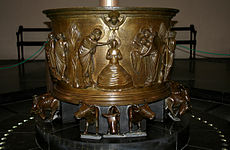 |  |  | ||
| Liege font of the work of Rainier from Yui ( Church of St. Bartholomew , 1107-18) | Basilica of the Virgin Mary (Maastricht) | Gift guard from Cologne, approx. 1180 g |