Independence Day ( Philippine. Araw ng Kasarinlan ; also Araw ng Kalayaan ) is a Philippine national holiday celebrated annually on June 12 in honor of the adoption of on June 12, 1898 [1] . Since 1962 it is a national holiday of the Philippines.
| Philippines Independence Day | |
|---|---|
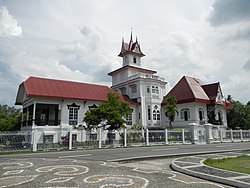 Aginaldo House Museum, in which Emilio Aginaldo proclaimed the country's independence from Spain | |
| Otherwise | Araw ng Kasarinlan Araw ng kalayaan Twelfth of June |
| Value | Declaration of independence of the Philippines from Spain |
| Is celebrated | Citizens of the philippines |
| date | 12 June |
| Celebration | fireworks, family gatherings, parades, ceremonies |
| Traditions | flag deployment in the Aguinaldo House Museum, Luneta National Park and other places |
| Associated with | |
Content
History
The holiday has repeatedly changed throughout the history of the country. The first mention of it is connected with Andres Bonifasio , who, together with Emilio Jacinto, Restituto Gavier, Guillermo Manangkai, Aurelio Tolentino, Faustino Manalak, Pedro Sabala and others went to the cave of Pamitinan in to accept new members to the Katipunan organization. Bonifacio wrote on the walls of the cave “Long live Philippine independence!” ( Spanish Viva la independencedencia Filipina! ) To express the purpose of his secret society. Bonifasio also led the initial phase of the Philippine revolution . Members of Katipunan, led by Andres Bonifacio, tore their tax certificates (cédulas personales) in protest against the Spanish conquest, but they were not officially recognized or marked.
In 1896, the Philippine revolution spread throughout the country, and in December 1897, when signed - an agreement between the Spanish colonial government and the revolutionaries - a truce was established. Under the terms of the agreement, Emilio Aguinaldo and other revolutionary leaders were exiled to Hong Kong [2] .
At the start of the Spanish-American War, Commodore George Dewey sailed from Hong Kong to Manila Bay , leading the Asian Navy squadron. On May 1, 1898, Dewey defeated the Spaniards at the Battle of Cavite , effectively establishing US control over the Spanish colonial government. Subsequently, in the same month, the American fleet brought Aguinaldo back to the Philippines [3] . Aginaldo arrived in Cavite on May 19, 1898, uniting the forces of the revolutionaries. Arriving in Cavite on May 19, 1898, Aguinaldo united revolutionary forces. In June of that year, Aginaldo believed that the declaration of independence would inspire people to fight the Spaniards and at the same time encourage other countries to recognize the independence of the Philippines.
On June 5, 1982, Aguinaldo issued a decree stipulating June 12, 1898 as the day of independence. This event, led by Aguinaldo, took place at the Aguinaldo House, located in , formerly known as Cavite El Viejo ( Spanish: Cavite El Viejo ). was solemnly read by the author, Ambrosio Rianzares Bautista, special delegate and military adviser to Aginaldo. A 21-page declaration was signed by 98 Filipinos appointed by Aguinaldo and a retired American artillery officer, Colonel L. M. Johnson [4] . The flag was first officially unfolded at 16:20 local time, while the band San Francisco de Malabon sang the hymn of the Philippines [5] [6] .
The proclamation was first ratified on August 1, 1898 by one hundred and ninety presidents of municipalities from 16 provinces controlled by the revolutionary army. On September 29 of the same year, it was re-ratified [7] .
The Philippines failed to achieve international recognition of their independence, including from the United States and Spain. Later, the Spanish government ceded the Philippine archipelago to the United States under the terms of the Paris Treaty of 1898 [8] . The Philippine revolutionary government did not recognize the treaty; subsequently, both sides took part in the Philippine-American war [9] [10] .
On July 4, 1946, the United States signed the Manila Treaty , by which independence was granted to the Philippines [11] . The date was chosen by the United States because it coincided with US Independence Day ; in the Philippines, this day was celebrated as Independence Day until 1962. On May 12, 1962, President Diosdado Macapagal signed Presidential Decree No. 28, according to which June 12 is a special public holiday throughout the Philippines “... to commemorate our people’s declaration of their natural and inalienable right to freedom and independence” [12] . On August 4, 1964, in accordance with Republic Law No. 4166, July 4 was renamed the Republic of the Philippines Day, and June 12 was declared Independence Day of the Philippines; all citizens of the Philippines were ordered to observe the latter with proper ceremonies. [13]
Flag Day
Until 1964, June 12th was celebrated in the Philippines as Flag Day. In 1965, President Diosdado Macapagal issued Decree No. 374, according to which National Flag Day was postponed to May 28 (in honor of the date when the Philippines flag was first used in the ). In 1994, President Fidel Ramos issued Decree No. 179, which provides for an extension of the celebration period, which began from May 28 until the Independence Day of the Philippines, celebrated on June 12. Also, state institutions, government departments, local governments, private organizations, etc. during this period were ordered to fly the state flag in all public knowledge and government institutions. The Ministry of Education was instructed, in conjunction with the private sector, non-governmental organizations and civic groups, to call for the state flag to be hung in all squares and, as far as possible, in private buildings to mark Independence Day [14] [15] .
See also
- independence Day
- Holidays Philippines
Notes
- ↑ Declaring the regular holidays, special (non-working) days, and special holiday (for all schools) for the year 2013 . Proclamation No. 459 . Official Gazzette, Philippine National Government. Date of treatment August 9, 2017. Archived on August 5, 2013.
- ↑ Halstead, Murat. The Story of the Philippines and Our New Possessions, Including the Ladrones, Hawaii, Cuba and Porto Rico . - 1898 .-- P. 126 .
- ↑ Agoncillo ,, Teodor A. History of the Filipino people. - 8th ed. - Quezon City : Garotech, 1990 .-- P. 157. - ISBN 978-9718711064 .
- ↑ Rodel Rodis. The historical irony of Independence Day . Inquirer.net (January 13, 2012). Date of treatment August 12, 2017.
- ↑ The Philippine National Anthem: Lupang Hinirang . Filipino.biz.ph. Date of treatment August 12, 2017.
- ↑ Maria Eleanor E. Valeros. 15 things on ID . The Freeman (12 January 2013). Date of treatment August 12, 2017.
- ↑ Ratification of Philippine Independence by the Municipal Presidents (August 1, 1898) . Date of treatment August 12, 2017. Archived March 4, 2016.
- ↑ Treaty of Peace Between the United States and Spain; December 10, 1898 Avalon Project - Documents in Law, History and Diplomacy. Date of treatment August 12, 2017. Archived July 2, 2012.
- ↑ De Ojeda, Jaime. "The Spanish – American War of 1898: A Spanish View" Library of Congress: Hispanic Division.
- ↑ Koenig, Louis W. (1982). "The Presidency of William McKinley" by Lewis L. Gould: Review. Presidential Studies Quarterly , Vol. 12, No. 3: p. 448.
- ↑ Treaty of general relations between the United States of America and the Republic of the Philippines. Signed at Manila, on 4 July 1946 (PDF). UN. Date of treatment August 12, 2017. Archived July 23, 2011.
- ↑ Proclamation No. 28, s. 1962 . Official Gazette of the Government of the Philippines (May 12, 1962). Date of treatment August 12, 2017. Archived on September 14, 2013.
- ↑ An Act changing the date of Philippine Independence Day from July Four to June Twelve, and declaring July Four as the Philippine Republic Day, further amending for the purpose section twenty-nine of the Revised Administrative Code . Chanrobles Law Library (August 4, 1964). Date of treatment August 12, 2017.
- ↑ The Flag Days: May 28 to June 12 . The National Government Portal (May 27, 2014). Date of treatment August 12, 2017. Archived on August 12, 2014.
- ↑ Executive Order No. 179, s. 1994 (English) . The National Government Portal . Date of treatment August 12, 2017. Archived February 22, 2017.