"Tosa" ( Jap. 土 佐 ) - unrealized type of battleships of the Japanese imperial fleet . In total, the construction of two ships of this type “Tosa” and “Kaga” was planned. The design of the Tosa-type ships served as the basis for the Amagi-type battle cruisers.
| Battleships like "Tosa" | |
|---|---|
| Tosa-class battleship | |
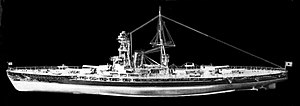 Model of the battleship "Kaga" | |
| Project | |
| A country |
|
| Manufacturers |
|
| Previous type | type "Nagato" |
| Subsequent type | type "Kii" |
| Scheduled | 2 |
| Built by | order cancelled |
| Canceled | 2 ( "Tosa" Construction canceled February 5, 1922; Flooded February 9, 1925, "Kaga" rebuilt into an aircraft carrier, sunk on June 4, 1942). |
| Losses | "Kaga" (aircraft carrier) sunk on June 4, 1942 in the battle of Midway |
| Main characteristics | |
| Displacement | standard 39 990 t complete 44,200 t |
| Length | 234.1 m |
| Width | 30.5 m |
| Draft | 9.4 m |
| Booking | deck - 100 mm, bulkheads 230–280 mm, armor belt 250–280 mm, the bridge is 250–360 mm, barbettes 230–300 mm, conning tower 360 mm. |
| Engines | 4 Brown Brown Curtis, 12 Kampon water-tube boilers (8 with oil heating, 4 coal) |
| Power | 91,000 l. with. (60.5 MW ) |
| Travel speed | 26.5 knots (49.1 km / h ) |
| Navigation range | 5500 nautical miles 16 knots |
| Crew | 1333 people |
| Armament | |
| Artillery | 5 × 2 - 410 mm / 45, 18 × 1 - 140/50 |
| Flak | 20-140 mm / 50, 4 × 2 - 76 mm AA guns |
| Mine-torpedo armament | 8 × 610 mm TA |

Construction of the lead ship "Tosa", was canceled under the terms of the Washington Naval Agreement. The hull was used to test the effectiveness of its reservation scheme, after which it was flooded in the Bungo Strait. The hull of the second battleship, the Kaga, was rebuilt into the aircraft carrier of the same name. In the late 1930s, Kaga supported Japanese troops in China during the Second Sino-Japanese War and took part in the attack on Pearl Harbor on December 7, 1941. In January 1942, the aircraft carrier participated in the invasion of Rabaul in the southwestern Pacific Ocean. During the Dutch campaign in the East Indies, airplanes from the Kaga participated in a combined air raid on Darwin, Australia. Kaga was sunk on June 4, 1942 in the battle of Midway .
Content
History
The command of the Japanese Imperial fleet believed that to protect Japan, a modern fleet of eight battleships and eight battle cruisers was needed. In 1907 the government ratified this program. The construction program of the navy, called "8-8", involved the construction of sixteen large high-speed warships in less than eight years. In 1911, Fuso class battleships and Congo-class battlecruisers were ordered. By 1915, the Japanese fleet wanted to order four more battleships, but in the budget of 1916 funds were allocated only for the construction of the battleship Nagato and two battlecruisers. Later that year, American President Woodrow Wilson announced plans to build ten battleships and six battlecruisers. In response, Japan in 1916 ordered the construction of three battleships: the second battleship of the type “Nagato” - “ Mutsu ” - and two battleships of the new type, “Tosa” and “Kaga”.
Tosa-type battleships were developed in the early 20s under the leadership of Yuzuru Hiraga , known as the Eight by Four, as part of the Japanese program for building a military fleet. Under this program, it was planned to build eight battleships and four battlecruisers. She replaced the program "8-8". The ships were enlarged versions of the previous type of Nagato and carried an additional one two GK gun turret with 410 mm guns. Battleships of the Tosa type were to become the second, after the Battleships of the Nagato type, the type of high-speed battleships of the Japanese fleet. In total, it was planned to build 2 battleships of this type - “Tosa” and “Kaga”. The construction of the battleships was approved on July 14, 1917. In 1919, Japanese naval engineers completed work on a technical project. It took into account the British experience gained in the Battle of Jutland. The ships had to have new design features, based on the experience of previous projects, including inclined armor and higher speed, despite the increased tonnage.
Class Representatives
| Title | Place of construction | Bookmark | Launching | Entry into service | Fate |
|---|---|---|---|---|---|
| "Tosa" (土 佐) | Mitsubishi Shipyard, in Nagasaki | February 16, 1920 | December 18, 1921 | March 1923 (plan) | Construction canceled February 5, 1922 , flooded , February 9, 1922 |
| "Kaga" (加 賀) | Kawasaki Shipyard , in Kobe | July 19, 1920 | November 17, 1921 | December 25, 1922 ( plan ); November 1, 1929 - commissioned as an aircraft carrier | Sunk on June 4, 1942 in the battle of Midway |
History
The construction of both ships began in 1920, but on February 5, 1922, according to the Washington Maritime Agreement, construction was canceled. After that, on April 1, 1924, the unfinished building of the Tosa was used to test naval armament. After completing the tests, the ship was scuttled on February 9, 1925 at a depth of 650 meters in the Bungo Channel.
Amagi, a liner cruiser rebuilt into an aircraft carrier in accordance with the terms of the agreement, was destroyed by an earthquake. As a result, Kaga replaced Amagi and was rebuilt by the aircraft carrier project in 1925. The ship was put into operation on March 31, 1928, on November 30, 1929, the aircraft carrier entered the combined fleet.
Kaga was equipped with a two-tiered flight deck, which in theory allowed the plane to take off straight from the hangars while other planes landed on top. In the 1930s, airplanes became larger and heavier, they required a greater distance to take off and the lower flight deck became useless. In 1935, as a result of the reconstruction of the Kaga, the two lower decks were removed and the upper flight deck was extended to the bow. Upon completion of the reconstruction, the ship had two main hangars and a third auxiliary hangar, with a total capacity of 60 aircraft.
At Kaga , heavy cannon armament was installed in case it was detected by enemy cruisers and forced to join the battle. The ship was armed with ten 20 cm guns: one gun turret on each side, six guns were located in the casemates at the stern. During the reconstruction, the Kaga armored belt was reduced from 280 to 152 mm, the deck booking was reduced from 102 to 38 mm. The aircraft carrier's displacement was 26,900 long tons with a standard load, and 33,693 long tons at full load, almost 6,000 long tons less than the initial displacement of the battleship. By reducing the displacement, it was possible to increase the speed to 27.5 knots and the range to 8000 nautical miles (15.000 km; 9,200 miles) at an economical speed of 14 knots (26 km / h).
In the years 1933-1935, the aircraft carrier Kaga was modernized, the speed of the ship was increased and its exhaust system was improved. The flight deck was adapted by more modern and heavy aircraft. After reconstruction, the ship’s displacement was 38,200 long tons with a standard load. Thanks to improved boilers, the maximum speed was 28.3 knots, the cruising range at 15 nodal speeds increased to 10,000 nautical miles (about 19,000 km; 12,000 miles). The upgraded aircraft carrier could hold up to 90 aircraft and ten to 20 cm of guns in dungeons.
During the Shanghai Incident in 1932, Kaga supported Japanese troops in China. In the late 1930s, the aircraft carrier took part in the Second Sino-Japanese War . With five other fleet aircraft carriers, he participated in the attack on Pearl Harbor and the invasion of Rabaul in the South-West Pacific in January 1942. The following month, his aircraft struck an airstrike on Darwin , Australia, during an operation in the Dutch East Indies. He returned to Japan for repair after hitting the reef. After repair, Kaga returned to the 1st Air Fleet. In June 1942, he participated in the attack on Midway.
As a result of the unexpected appearance of three American aircraft carriers and due to the large dispersal of Japanese ships, Kaga was sunk on June 4 by aircraft from the aircraft carriers Enterprise , Hornet and Yorktown .