The 33rd Virginia Infantry Regiment ( The 33rd Virginia Volunteer Infantry Regiment ) is an infantry regiment recruited in Virginia for the Confederate Army during the US Civil War . He fought mainly as part of the North Virginia Army, in the " Stone Wall Brigade ."
| 33rd Virginia Volunteer Infantry Regiment | |
|---|---|
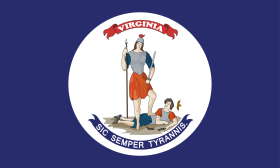 virginia flag 1861 | |
| Years of existence | 1861 - 1865 |
| A country |  KSA KSA |
| Type of | Infantry |
| Number | 450 people (1861) 200 people (1862) |
| Commanders | |
| Famous commanders |
|
Content
Formation
The regiment was formed on July 27, 1861 at Camp Smith camp at Hollingworth Mill, a kilometer southwest of Winchester. It consisted of ten companies that were recruited in Hampshire counties ( Shenandoah , Frederick , Hardy , Page and Rockingham . Hampshire and Hardy counties subsequently ended up in West Virginia. These companies were recruited into the Confederate Army for 1 year Company E was received on June 1, company F and G were received on June 15, company A on June 17, company N on June 19, company B on July 8, company I was received on July 11, and company D on July 26. Colonel Arthur Cummings became the first commander of the regiment ( appointed May 16).
Even before the formation, on June 12, 1861, two companies under the command of Cummings participated in a shootout with 6 companies of the 11th Indian Regiment, Colonel Lew Wallace at Cemetery Hill, near Romney, Hampshire County.
Company composition
In the summer of 1861, there were 10 companies in the regiment, each about 40 people:
- Rota A - Potomac Guards (Hampshire County)
- Rota B - Toms Brook Guard ( Shenandoah County )
- Rota C - Shenandoah Riflemen ( Shenandoah County )
- Rota D - Mountain Rangers (Winchester) - Captain Frederick Halliday
- Rota E - Emerald Guard (Shenandoah County)
- Rota F - Hardy Greys (Hardy County)
- Rota G - Mount Jackson Rifles ( Shenandoah County )
- Rota H - Page Grays (Page District)
- Rota I - Rockingham Confederates (Rockingham County) - Captain John Robert Jones
- Rota J - Shenandoah Riflemen ( Shenandoah County )
Battle Path
On July 15, 1861, the regiment was included in the 1st Brigade of the Shenandoah Army , commanded by a former professor at the Virginia Military Institute, Thomas Jackson . On July 17, Captain William Henry Fitzhugh Lee (a relative of General Lee) was appointed major regiment and acting lieutenant colonel. At that time, the regiment had not yet been assigned numbering and it was called the "Cummings Regiment".
Manassas
On July 18, at 3 a.m., the regiment was sent by water and rail to Manassas (leaving companies D and I in Winchester) where it arrived on the morning of July 20. When the first Bull Run battle began, Jackson placed the brigade on Henry Hill, where the 33rd Virginia stood on the far left flank of the brigade. On this day, the regiment totaled 400 people in 8 companies. Jackson built a brigade on Henry Hill, where she was attacked by the federal army. During the battle, Federal General Griffin moved two howitzers so as to open flanking fire on Jackson's guns and at the same time was almost 200 meters from Cummings's regiment. Cummings realized that his regiment could not withstand the fire of howitzers, and decided to attack. At this moment, 450 people appeared near the 49th Virgin Regiment , whom General Beauregard ordered to cover the left flank of the 33rd [1] . The 49th approached the battery at 70 meters and fired a salvo at the gunners. “It was all over for us,” Griffin said at the investigation, “we all mowed down with fire.” At that very moment, the Cummings Regiment launched an attack. “It was an attack that the previous regular army had not seen,” Cummings later recalled, “albeit not in a very regular style.” Federal artillery fled, the remnants of the Zouaves also retreated. The Virginians captured the guns, having achieved their first apparent success that day. Subsequently, historians often called this attack the turning point of the entire battle. However, John Hennessey wrote that this was only the first success, which could very well become temporary [2] .
The 33rd and 49th were completely disorganized by the attack. Cummings tried to put the battle line in order, but at this moment 14th Brooklyn approached from the side of the Sadley Road. Approaching 100 meters, the New Yorkers opened fire, which immediately forced the Virginians to retreat. The 14th Brooklyn rushed forward and repulsed Griffin's howitzer. The retreating Virginians of the 33rd and 49th Regiments upset the ranks of the 2nd Virginia Regiment, which also began to withdraw. The entire left flank of Jackson's defense was now crumbling, but he was saved by a counterattack of the 4th and 27th regiments [3] .
The End of 1861
On July 25, the regiment received its numbering, and companies D and I were returned to it. The next day, Captain Edwin Lee from Jackson's headquarters was appointed major of the regiment. On August 2, the regiment moved to Camp Harmon camp near Centerville, where on August 21 the captain of company I, Jones received the rank of lieutenant colonel. On September 16, the regiment was transferred to a camp near Fairfax.
On November 4, General Jackson led the Shenandoah Valley Department and requested a stone wall brigade. On November 7, the regiment went to Winchester: first on foot to Manassas, where it waited for the whole day in the rain for trains, and then by rail to Winchester, where it arrived on November 8. At that time, Company E found a barrel of whiskey and a drunken brawl occurred, during which several people were injured. The regiment arrived at Kernstown, marched through Winchester on November 13, and camped 5 miles north of the Stevensons Depot. The next day, General Garnett took command of the brigade.
On December 16, the regiment participated in a sortie to destroy the dam of Channel 5 of the Chesapeake Ohio. On December 18-21, the sortie was repeated, and on December 21 the regiment returned to Winchester.
1862
On January 1, 1862, Jackson's expedition to Romney began . At 5 a.m. the regiment left Winchester and after three days of march it became a camp near the city of Bath. On January 4, the brigade entered Bath and remained in the city, while the rest of the brigades continued their offensive on Hancock. On January 7, the brigade left Bath and camped at Ungers Stor under heavy snow. Having stayed in the camp for a week, the brigade launched an attack on Romney on January 13 and was the first to enter the city on January 14. On January 19, Jackson decided to return the brigade to Winchester and she left Romney on January 19, and on January 26 came to Winchester.
In early March, a campaign began in the Shenandoah Valley. On March 11, the brigade entered from Winchester towards the Banks army, but as a result, on March 12–13, it began to retreat south to Strastberg, where it stood in Camp Buquinen camp from March 14–21. March 22, it became known about the retreat of part of the federal army and the brigade was sent to Winchester. On March 23, the brigade began to advance to Kernstown, where it met the federal army and the battle of Kernstown began . The regiment was in the center of the position, behind a stone wall, where it repelled enemy attacks until it ran out of ammunition. General Garnett ordered a retreat. In this battle, the regiment lost 18 people killed, 27 wounded and 14 missing out of a total of 275 people. On March 24, the brigade returned to Mont Jackson.
Notes
- ↑ Hennessy, 2015 , p. 100-101.
- ↑ Hennessy, 2015 , p. 101-102.
- ↑ Hennessy, 2015 , p. 103-104.
Literature
- Hennessy, John J. The First Battle of Manassas: An End to Innocence, July 18-21, 1861. - Stackpole Books, 2015 .-- 224 p. - ISBN 978-0811715911 .