Caps of the Jericho Russian tsars - six [1] ceremonial helmets- shishaks of the Jericho type, stored in the Armory of the Moscow Kremlin.
These helmets were used "at the Moscow court during the ceremonial military shows as the royal head" [2] . They are noteworthy because they are redone from oriental armor and decorated with Arabic Quranic inscriptions.
Feature
“In the inventories of the weapons of Russian tsars and aristocrats of the 17th century, warheads, called“ caps of the Jericho “or“ little Erichons “, are especially distinguished. The domes of these helmets are different in shape (hemispherical, conical, and spheroconic are known), however, in each of these cases, the headphone, headpiece and visor with a detached arrow were attached to the dome. Another important difference between little little girls and other heads is their decor, which is clearly formal in character ” [1] .
List
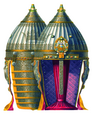
No. 1. Mikhail Fedorovich

No. 2. Alexey Mikhailovich
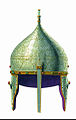
Number 3. Kuchumovskaya

Number 4. Mstislavsky
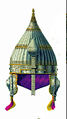
No. 5. Lviv
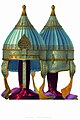
6. Pronchishchev


The most complete description was left by F. G. Solntsev in his book “ Antiquities of the Russian State, ” creating, however, some confusion in the name of the caps.
Tsar Mikhail Fedorovich
"Big Little Girl", helmet of Alexander Nevsky. Judging by the documents, made in 1621 by the master Nikita Davydov .
“Among the imperial hats of Jericho, a helmet by Davydov occupied a special place. In the Mural of the Campaign Treasury in 1654 it was called the “Big Little Girl”, and in the Census Book of the Armory Treasury in 1687 it was estimated at a huge amount - 1175 rubles (this is slightly less than the total price of the five following Jericho hats) ” [1] .
Placed on the coat of arms of the Russian Empire.
The Arabic inscription on the helmet reads:
| Rejoice the faithful with the promise of help from Allah and the speedy victory [3] (13th ayah of the 61st sura of the Qur'an) |
Tsar Alexei Mikhailovich
Helmet - “cap of Jericho” of Tsar Alexei Mikhailovich - Turkey, 17th century Silver, damask steel, silk fabric. Carving, forging, chasing, notching with gold, gilding [4] .
The Arabic inscription on the helmet reads:
| Allah - there is no deity except Him, eternally living, eternally existing. Neither slumber nor sleep have power over him ... |
Solntsev has no description.
Kuchumovskaya
Kuchumovsky little hat-hat [5]
This cap of Jericho, as can be seen from the census book of 1687, hit the forehead with Tsar Alexei Mikhailovich the boyar and the butler Boris Petrovich Sheremetev . According to the same census book, it is called Kuchumovskaya and, judging by this legend, if it belonged not to the Siberian ruler (Saltan) Kuchum, then perhaps to his nephew, but according to the Stroganov Chronicle, his son Mametkul, taken in 1582 in captured and served subsequently in Russian militias. This hat of Jericho (in the inventory of the Armory - No. 3) of red damask steel, incised along the crown and along the top in a pattern of golden herbs; down along the rim there is an edge of minted gold, in which greases or glass with lining are inserted. The top of the hat is decorated with a golden tube with a small apple, covered with multi-colored enamel. Damask nose and earphones with a notch; the damask rear, consisting of one plate without a notch; on a hat in a crown against the earphones are two small lalas in golden nests. At the edge of the red there are six more smears, and one blue, and ten empty spots. In rumors in each one lal; on the same headphones on the edge of the sparks of turquoise and lava in ten; six empty places; on the nose above one Burmese grain. The whole hat is lined with red satin on cotton paper.
In the census book of the royal Armory treasury of 1687:
“The cap of Erichon damask red, the damask along the damask and the ears were cut into golden grass, the edge was embossed with gold on the rim under the crown, eight stones were worn in the crown and eight azure stones were smudged, and in the crown over the ears were lakelike; the ears are notched, on the ears on the notch along the lala; the edge around the ears is silver, in the edge in both ears there are two turquoises and six sparks of yachting and lalik; in the ears, on a little ring tied with gold; at the nape of the rim, about wound up with gold leaf; at the back of the head there are three silver gilded chains; in the nape of the neck, on the edges, seven nails of silver gilded strong nails, which strengthened the lining; cheadaysky herbs were cut on the nose by cutting with gold, burmitsky grain was above; the underside of the grass is a small Cheadai brought in gold by cutting; the golden town brought pink enamels on the fry affair; lining worm; the ties of the hat are yellow; on the back of the head it was gilded with gold leaf; in the golden crown there are six places of overgrown weeping reeds; in previous census books, under that article, it was written according to the tale of the masters: “there was that cap Kuchumovskaya, Boris Petrovich Sheremetev hit the forehead with the brow”.
And according to the current census of the Russian Federation of the year (1687) and upon inspection, that cap against the previous census books came together, there are no ties, the price is two hundred and twenty rubles; and in the previous book of descriptions the second is written ” [6] .
Prince F.I. Mstislavsky
Hat Erichonskaya (helmet) of Prince Fedor Ivanovich Mstislavsky - Turkey, XVI century. Damask steel, silver, rubies, turquoise, fabric; forging, chasing, gold notching, carving. “The cap is relatively low, faceted. A notch with gold with a special taste is made on the visor and headpiece: in the “carpet”, gold on a dark damask background, floral patterns are introduced curly marks with a “reverse” coloristic solution - this is a dark ornament on a golden background. The Erikhon cap is listed in the “Mural that was taken to the Sovereign’s Treasury after the death of Prince Ivan Fedorovich Mstislavsky on April 3 (April 2222) on the 3rd day”. In the arms treasury of Russian sovereigns, she had a very high status. In the Census Book of 1686/87, it was valued at 330 rubles and among all the Jericho hats it was placed in third position, and it was immediately noted that in the “former described book” it was “written first”. In 1654-1656 the little girl accompanied Tsar Alexei Mikhailovich in the Smolensk and Riga campaigns ” [7] .
Note. The old labels that were on the cap of Jericho of Prince F.I. Mstislavsky, boyar Pronchishchev and Alexei Mikhailovich Lvov were probably mixed up, and therefore the signature drawings, according to verification with the described books of 1687 and 1701, turned out to be erroneous: Jericho the cap of the removal of Pronchishchev is called the cap of Prince F.I. Mstislavsky, and the cap of Mstislavsky is the helmet of Tsar Alexei Mikhailovich.
Depicted in figures No. 10, 11, the Jericho hat, according to the inventory of the Armory of 1835, is indicated by No. 6; it is made of red damask steel, from the crown to the top it is frayed with longitudinal flat faces, across which three narrow bands are made in the form of hoops: one at the top of the crown, the other in the middle of the tulle, the third divides the tulle into two parts between the facet decorating the top with the bump and the middle rim. The top and the edges of the crown, also in places a shield, headphones and a nape, consisting of one plate, are induced by gold. At the top of the nose and in the middle of the crown is a golden signature, consisting of Arabic letters. On the top and the shield of silver nails with ribbed heads there are ten, and small pea-sized forty-two. On the headphones and the back of the head there are ten nails with track heads, gilded peas and not gilded - two hundred forty-two. The back of the head consists of a single curved plate attached by three silver chains. The whole hat is lined with red satin quilted on cotton paper. With her, for the garter, four satin blades are the same, of which two are red and two are yellow.
According to the census books of 1687 and 1701, its description is as follows:
“The cap of Yerichon damask red, frayed to the brink, the cutting crown is pointed with gold, between the tip of the word is Arabic, and over the crown are targets and four large targets; the underside and the bullseye, the ears and the shelf, and the back of the head are inverted with gold, the Arabic word in between, there are one hundred forty nails on the ears, and in the shelf and in the crown, and in the ears in the binding of twenty nails, on the crown and on the shelf and on on the back of the head and on the ears, the silver road is gilded, and in it there are thirty small cloves of small clumps in the binding; the edge of the road and near the crown and shelf, and the nape of the neck and ears, the nape of the neck three silver gilded, the slotted nose is inverted with gold of grass, the worms are laid apart, and the two hearts are wound away. And in the previous census books, under that article it was written according to the tale of the masters: that hat of Afanasyevsko’s export of Pronchishchev.
And according to the current census of the year, and upon inspection, that hat against the previous census books came together; the price of that hat is three hundred and fifty rubles;
and in the previous book of descriptions the fourth is written ” [6] .
Prince A. M. Lvov
The little cap of the little girl Aleksei Mikhailovich Lvov is the only helmet whose photo was not found on the website of the Kremlin Museums.
Damask helmet, stored in the Armory at number 5, according to the inventory of 1687, compiled from the "former census books", means "Prince Alexei Mikhailovich Lvov," deceitful under Tsar Mikhail Fedorovich. The underfloor, crown, shield, nose, baitsa and earpads are engraved in gold in a pattern with Arabic sayings from the Koran similar to those depicted on the helmet of the blessed Grand Duke Alexander Nevsky.
In the inventory of 1687, sheets 462-463, it is designated fourth and is described as follows:
“The cap of Yerichon was long, the damask red, the crown and in the crown in the wound the word Arabic, on the top of the rim of the border and under the upper rim of the rim and over the rim there is a gold crown on the top, and the apple is gilded over; the road on the back of the head and on the ears and on the shelf is round smooth gold; on the ears there are one hundred and sixty nails of raspberries and ten burdock silver gilded; there are ten burdock nails on the crown and on the shelf; the ears and the back of the head and the shelf are inverted with gold; the words Arabic are in between; at the back of the head are three chains of silver with piercers gilded; the slotted nose is pointed by the gold of grass; lined with worms flax and two ties; flax yellow and worms. In previous census books, under that article it is written, according to the tale of the masters: that cap of Prince Alekseevskaya Mikhailovich Lvov.
And according to the current census of the year of the year (1687) and upon inspection, that hat against the previous census books converged; the price of that hat is three hundred rubles; and in the previous book of descriptions the third is written ” [6] .
Boyarina A.O. Pronchishcheva
Helmet-hat "Jericho" - Turkey, the 30s. XVII century Damask steel, silver, silk fabric, forging, chasing, carving. Belonged to Tsar Mikhail Fedorovich. Brought from Constantinople by Ambassador Athanasius Osipovich Pronchishchev [2] .
“The front helmet - the“ hat of Jericho ”- is forged from damask steel. The head cap is attached to the crown by three silver chains. The nose arrow with a slotted inscription is fixed on the visor. Almost the entire surface of the helmet is covered by the “lace” of a stylized ornament engraved in gold and inscriptions - sayings from the Koran ” [8] .
“The helmet was brought to Russia in 1633 by Afanasy Pronchishchev, who was at the head of the Russian embassy in Istanbul. The embassy was received with great honors, but on the way back the ship fell into a storm, and the inhabitants of Kafa (Feodosia) almost killed the ambassadors. Despite everything, Pronchishchev managed to save and deliver to the sovereign valuables, among which was a ceremonial helmet ” [8] .
When describing the cap for the export of the boyar Afanasy Pronchishchev (Fig. No. 10, 11), we explained the reason for the erroneous signature made on the drawings of the Jericho hats by Alexei Mikhailovich Lvov, Pronchishchev and Mstislavsky. The helmet, depicted in figures No. 16 and 17, signed: “Tsar Alexei Mikhailovich”, belonged, as it turned out now, after considering the ancient inventories of 1687 and 1701, to the boyar Prince Fedor Ivanovich Mstislavsky.
In the described book of the sovereign Armory treasury of 1687, it is designated third among the Jericho hats:
“The cap of Yerichon damask red, hovering over gold, the nose and ears are slotted; the crown and rim over the crown, and the back of the head, and the shelf are pointed in gold, and in the ears in the fastener there are ninety-six nests of silver, silver-plated, and in the crown and in the shelf and in the ears there are twenty nails of silver gilt, onion; the top and the apple and the cloaks are minted gold with stone, stone turquoise and vinisek fifty eight; near the cap and shelf and nape and ears the road is silver gilded; on the upper cloaks, the rim is pointed by cutting with gold; on the nose in the nest there is a stone yazont lazorev with a hole; on the nose and on the back in the fastening are two Burmese grains, lined with worms; on the ears there are two eye-catching strings on the worm, and on the yellow; at the nape three chains of silver are gilded; and in previous census books under that article it was written according to a fairy tale of the masters: that cap was Prince Fedor Ivanovich Mstislavskago.
And according to the current census of the year, and upon inspection, that hat against the previous census books came together; red cloth cover; upon inspection, there is no carnation on the nape of the cap. The price of that hat is three hundred and thirty rubles, and in the previous book described it was written first ” [6] .
See also
- Caps of the Russian kingdom
- Crowns of the Russian Empire
Notes
- ↑ 1 2 3 On the website of the Moscow Kremlin Museums
- ↑ 1 2 Kings and East
- ↑ Russian armor and weapons
- ↑ Romanovs. The beginning of the dynasty
- ↑ Tsar Alexei Mikhailovich and Patriarch Nikon. The wise duality
- ↑ 1 2 3 4 F. Solntsev. Antiquities of the Russian state
- ↑ Art of the brilliant Porta
- ↑ 1 2 Turkish weapons of the 16-17th centuries.