BARBARA OF AUSTRIAN ( German Barbara von Österreich , Italian. Barbara d'Austria ; April 30, 1539, Vienna , archduchy Austria - September 19, 1572, Ferrara , Duchy of Ferrara ) - German princess from the house of Hapsburgs , the archduke of the Duchy of Austria, the German princess from the House of Hapsburgs , the Austrian goddess, the Austrian duchy of the Duchy of Austria, from the Hapsburg house, the Austrian dragon, and the Austrian engraving of the Austrian goddess, from the Hapsburgs , the Austrian goddess of the Duchy of Ferrara , from the House of Habsburg , the Austrian, Austrian, Austrian, from the house of the Hapsburgs , the Austrian dragon of the Duchy of Ferrara ; Roman empire . The second wife of Duke Alfonso II ; in marriage - the Duchess of Ferrara , the Duchess of Modena and Reggio .
| Barbara of Austria | |||||||
|---|---|---|---|---|---|---|---|
| ital Barbara d'ustria him Barbara von Österreich | |||||||
 Portrait of Tertii (1565). Museum of Art History , Vienna | |||||||
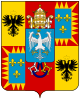 Coat of arms of Este from 1535 to 1741 | |||||||
| |||||||
| Predecessor | Lucretia Tuscan | ||||||
| Successor | Margarita Mantuanskaya | ||||||
| |||||||
| Predecessor | Lucretia Tuscan | ||||||
| Successor | Margarita Mantuanskaya | ||||||
| Birth | April 30, 1539 Vienna , Archduchy of Austria | ||||||
| Death | September 19, 1572 (33 years) Ferrara , Duchy of Ferrara | ||||||
| Burial place | , Ferrara | ||||||
| Rod | Habsburg | ||||||
| Father | Ferdinand I , Holy Roman Emperor | ||||||
| Mother | Anna Bohemian and Hungarian | ||||||
| Spouse | Alfonso II , Duke of Ferrara, Modena and Reggio | ||||||
| Religion | Catholicism | ||||||

Raised by the Jesuits in the spirit of Catholic piety, gave them a special patronage. Having become a duchess, she paid great attention to charity, which earned the love and respect of her subjects. The marriage of the Duchess was happy, but childless. She died at a young age from tuberculosis.
Biography
Early years
Barbara was born on April 30, 1539 in Vienna [1] . She was the eleventh child and eighth daughter of the large family of Ferdinand, Archduke of Austria , King of the Czech Republic and Germany, the future Holy Roman Emperor under the name of Ferdinand I, and Anna of Bohemian and Hungarian from the house of Jagiellon . On his father’s side, he was the granddaughter of Philip IV , the Duke of Burgundy and the King of Castile under the name Philip I, and Queen Juan I , who went down in history under the nickname Insane. On the mother’s side, she was the granddaughter of Władysław II , king of Bohemia and Hungary, and Anne de Foy of the house of Foie Grai , who was related to the kings of Navarre and Aragon [2] [3] .
In the winter of 1547, the widowed emperor entrusted all the unmarried daughters to the care of the nuns at the monastery in Innsbruck, where Barbara lived before marriage. Only once, in 1552, during the invasion of the Tyrolean county of the army of Protestants under the command of the Saxon Elector Moritz , she, together with her sisters, the Archduchess Magdalene , , and Johanna , spent some time outside the monastery in [1] .
Barbara was raised in a Catholic religion . Characteristic features of her education, based on the writings of the Jesuits Peter Canisia and Diego Laines , were religiosity and charity. The archduchess confessors were also Jesuits [1] .
On the appearance of Barbara among contemporaries there were different opinions. The papal nuncio at the imperial court in Vienna, Cardinal , considered her to be ugly. The Florentine diplomat Antonio degli Albiztsi in correspondence described the appearance of Barbara as mediocre. He also pointed out that she had prognathism , a characteristic anatomical feature for most of the representatives of the house of Habsburg . The Venetian diplomat Alvise Contarini, on the contrary, considered Barbara to be the most beautiful of unmarried Archduchees [1] .
Marriage
In 1560, Barbara’s candidacy was considered the wife of Duke Guglielmo of Mantua , who later became married to Eleonora , the eldest sister of the Archduchess. In 1562 several applicants to the hand of his youngest daughter Johanna turned to the emperor Ferdinad I. Among the wooing ones to the Archduchess were the Transylvanian prince Janos , the Florentine crown prince Francesco and the Duke of Ferrara Alfonso . The latter began negotiations on marriage in November 1563 [1] [4] .
A dynastic marriage with the head of the house Este was beneficial to the house of the Hapsburgs, who sought to reduce the traditional influence of the French kings on the Dukes of Ferrara. However, in order to avoid the aggravation of the conflict between the Medici and Este houses, the emperor proposed Barbara as the wife of Alfonso II. The decision of Ferdinand I was supported by his relative, the Spanish king Philip II , an ally of the Duke of Florence [1] [5] .
In July 1565, Barbara first saw Alfonso II, who visited Innsbruck to explore her. In November of the same year, she and Johann arrived in Trento , where Pope Pius IV sent his legates to conduct a joint marriage ceremony. But because of the renewed conflict between the fiancés, the brides had to go to the capitals of the estates of the future spouses [1] [4] .
On December 1, 1565, Barbara arrived in Ferrara, and on December 5 she was married to Alfonso II, Duke of Ferrara, Modena and Reggio. Wedding celebrations, during which the “temple of love” was built and a grand tournament took place, lasted until December 9 [1] [6] . Among the guests at the wedding were present the former bridegroom of Barbara, the Mantuan duke with his wife, her elder sister [4] . Witness of the entrance of the bride cortege to Ferrara and subsequent wedding celebrations - Torquato Tasso , while the court poet of the Dukes of Ferrara, later described what he saw in his pastoral drama “Aminta”, in which he dedicated several Barbara memory sites. Celebrations were short due to the death of Pope Pius IV [7] [8] .
Becoming a duchess, Barbara won the love of her subjects thanks to the mercy with which she treated all the people who needed it. Despite the fact that she did not speak Italian, there was complete mutual understanding between her and her spouse. Their marriage, which turned out to be childless, was happy. When, a year after the wedding, Alfonso II participated in the war against the Ottoman Turks , Barbara genuinely worried about her husband. Experiences negatively affected her health; since that time, the duchess was constantly ill [1] .
A pious Catholic, she was able to forge a wonderful relationship with a Protestant monkey Renata French . The confessors of the duchess in Ferrara, as well as in Innsbruck, were the Jesuits, whom Barbara had a special patronage. After the devastating earthquakes of 1570 and 1571 in the duchy, she accepted for the maintenance of girls and girls left without parents. To this end, she founded the orphanage of St. Barbara in Ferrara. In the period between earthquakes, the duchess had to live in a tent, which aggravated her health problems [1] [9] .
Premature death
Barbara of Austria died of tuberculosis in Ferrara on September 19, 1572. The duchess's premature death caused grief to her subjects. The Jesuits grieved the most. The leadership of the order allowed the widowed Alfonso II to bury his wife in the altar in Ferrara. Seven years later, the duke married for the third time the Mantuan princess Margarita , Barbara's niece [1] [6] .
Genealogy
In culture
Torquato Tasso dedicated several sonnets , canzone, tombstone and dialogue to Barbara of Austria. Another Italian poet, Giovan Battista Guarini, also dedicated her to the canzon [1] . The collection of the Museum of Art History in Vienna contains two portraits of Barbara. At the earliest, she is depicted during the period of the matchmaking of Alfonso II in her 1563-1564 year. The portrait belongs to the brush by Giuseppe Archimboldo and presumably depicts the future Duchess of Ferrara [10] . In another portrait of 1565, already after marriage, she is depicted in full growth. This Barbara image belongs to the brush by [11] .
Notes
- ↑ 1 2 3 4 5 6 7 8 9 10 11 12 Rill, Gerhard. Barbara d'Asburgo, duchessa di Ferrara (ital.) . Dizionario Biografico degli Italiani - Volume 6 . www.treccani.it (1964). The date of appeal is January 9, 2017.
- ↑ Behr C. von. Genealogie der in Europa regierenden Fürstenhäuser: nebst der Reihenfolge sämmtlicher Päpste und einem Anhange umfassend die Häuser Capet, Habsburg, Romanow und Eine Übersicht der Kaiser und Könige von Italien und Deutschland . - Leipzig: Tauchnitz, 1870. - P. 207. - 280 p.
- ↑ Wurzbach C. von. Biographisches Lexikon des Kaiserthums Oesterreich . - Wien: Theil, 1860. - Vol. Vi. - P. 156. - 475 p.
- ↑ 1 2 3 Muratori L. An. Annali d'Italia dal principio dell'era volgare sino all'anno 1750 compilati da Ludovico Antonio Muratori e continuati sino a giorni nostri . - Venezia: G. Antonelli, 1846. - Vol. Vi. - P. 713-714. - 1274 p.
- ↑ Duchhardt H. Jahrbuch für Europäische Geschichte . - München: R. Oldenbourg Verlag, 2007. - Vol. Viii. - P. 45. - 256 p. - ISBN 978-3-48-684268-5 .
- 2 1 2 Melanchthon Ph., Scheible H. Melanchthons Briefwechsel . - Stuttgart - Bad Cannstatt: Frommann-Holzboog, 2003. - Vol. Xi. - P. 420. - 426 p. - ISBN 3-7728-2257-6 .
- ↑ Holmes Wiffen J. Life of Torquato Tasso . - New Yourk: Delisser and Procter, 1859. - P. 33. - 280 p.
- ↑ Tasso T. Opere di Torquato Tasso . - Milano: Societa tipografica de classici italiani, 1824. - Vol. Iv. - P. 526, 546. - 628 p.
- ↑ Barbara d'Austria vittima del sisma (ital.) . www.lanuovaferrara.it. The date of appeal is January 9, 2017.
- ↑ Arcimboldo, Giuseppe. Bust of a Daughter of Ferdinand I (German) . www.wga.hu. The date of circulation is January 10, 2017.
- ↑ Terzio, Francesco. Erzherzogin Barbara (1539–1572), Herzogin von Ferrara in ganzer Figur (German) . www.khm.at. Date of treatment January 10, 2017. (unavailable link)
Links
- Gruber, Stephan. Töchter und Schwestern, verheiratet euch. Kaiser Maximilian II. verheiratete eine Vielzahl seiner weiblichen Familienmitglieder in die Länder Europas . www.habsburger.net. - An article by Stefan Gruber “Daughters and sisters are getting married” on the site “The World of Habsburg”. The date of circulation is January 10, 2017. (him.)