Julia Teresa Salome von Gauke ( Polish Julia Teresa Salomea von Hauke ), or Julia Mavrikievna Gauke , aka Julia von Battenberg ( German Julia von Battenberg ; November 12 ( November 24 ), 1825 , Warsaw , Kingdom of Poland , Russian Empire - September 19 1895, Heiligenberg Castle near Jugenheim, Hesse-Darmstadt ) - daughter of the infantry general Mauritsia Gauke , Count of the Kingdom of Poland. In an organic marriage with Prince Alexander of Hesse-Darmstadt on October 14, 1851 she received the title of Countess von Battenberg (from December 26, 1858, Princess Von Battenberg ).
| Julia Battenberg | |
|---|---|
| him. Julia von Battenberg | |
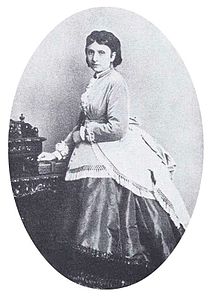 Photo taken in the 1860s | |
| Birth name | Julia Teresa Salome von Gauke |
| Date of Birth | November 12 ( November 24 ) 1825 [1] |
| Place of Birth | Warsaw , Kingdom of Poland , Russian Empire |
| Date of death | September 19, 1895 [1] |
| Place of death | Zeheim-Jugenheim , Grand Duchy of Hesse |
| A country | |
| Occupation | Princess von Battenberg |
| Father | Hans Moritz Gauke |
| Mother | Sofia Lafontaine |
| Spouse | Alexander Hesse-Darmstadt |
| Children | Maria Ludwig Alexander Henry ; Franz Joseph |
| Awards and prizes |
|


Content
Biography
Julia Teresa Salome von Gauke (or von Hauke) was born on November 24, 1825 in Warsaw, in the Kingdom of Poland, in the Russian Empire. She was the daughter of Hans Moritz von Gauke and Sofia, nee Lafontaine [2] . Her father, a German by birth, was a professional military man. After serving in the French and Polish armies, in 1814 he joined the Russian army. In 1828 he was granted the nobility of the Russian Empire. In 1829, Emperor Nicholas I appointed him Deputy Minister of Defense of the Kingdom of Poland and elevated him to count dignity.
During the November uprising of 1830, he helped Grand Duke Konstantin Pavlovich , the governor of Poland, to avoid reprisals from the rebels, but was shot dead. His widow was chopped up and hanged during the rebellion in Warsaw in August 1831. Remaining orphans, their children were identified under the care of the emperor’s family [3] [4] . Julia was assigned to the Catherine Institute in St. Petersburg , after which she was appointed maid of honor Tsarevna Maria Alexandrovna , nee Princess Maximiliana-Wilhelmina of Hesse-Darmstadt, wife of Tsarevich Alexander Nikolayevich , future emperor Alexander II. With her future husband, Prince Alexander of Hesse-Darmstadt, she met while fulfilling her duties at the imperial court in St. Petersburg. He was the brother of Maria Alexandrovna and served in the Russian army with the rank of cavalry general [3] [4] .
According to A.F. Tyutcheva , maid of honor Gauke was never beautiful, but she liked her due to the inherent Polish elegance and piquancy. According to the scandalous chronicle, Prince Alexander was immersed in deep melancholy due to an unsuccessful affair with the very beautiful daughter of Countess T. I. Shuvalova , since the emperor imposed a ban on his intention to marry her. Maid of honor Gauke, a girl not of her first youth, decided to console and amuse the prince in love and did so with such success that she had to rush at the feet of the princess and announce the need to leave her place [5] . Having learned about the connection between the relative and the maid of honor Gauke, the emperor suggested that the handsome P.P. Albedinsky marry her, but was refused, because of which the latter almost damaged his career.
Prince Alexander, as a man of honor, announced that he would marry Julia. Emperor Nicholas I looked very unfavorably at this union and forbade any communication between them. For refusing to obey his will, he sent Alexander and Julia outside the Russian Empire, depriving them of their salaries and pensions. Lovers married on October 28, 1851 in Breslau , in the kingdom of Prussia . By this time, Julia was six months pregnant and soon gave birth to her first child [6] [7] [8] .
Their marriage was recognized as morganatic . In 1851, Ludwig III , the Grand Duke of Hesse, bestowed on his daughter-in-law the title of Countess von Battenberg with the appeal “Your Highness,” First, the Countess was accepted into the Darmstadt family very coldly, since this marriage of Prince Alexander broke his entire career in Russia. But she turned out to be a wonderful wife and mother and kept herself so modest and dignified that the whole family soon appreciated and fell in love with her. In 1858, the Duke awarded her the title of Princess Von Battenberg with the appeal "Your Grace." The children of Julia and Alexander also received the titles of princes and princesses von Battenberg with the same appeal. Thus, the von Battenberg clan acquired the status of a side branch of the house of the Grand Dukes of Hesse [9] . For this reason, on May 12, 1875, Julia converted from Catholicism to Lutheranism .
During the reign of Alexander II, Countess Battenberg was granted (10.10.1864) the Order of St. Catherine (Grand Cross) and secretly, from the sums of the sovereign, received a benefit of 3 thousand rubles a year. She died on September 19, 1895 at Heiligenberg Castle near Jugenheim in southern Hessen [10] [11] .
Family
In the family of Julia and Alexander, five children were born, one daughter and four sons [10] .
- Princess Maria Battenberg (15.7.1852-29.4.1923), wife of Count Gustav von Erbach-Schoenberg (1840-1908).
- Prince Ludwig of Battenberg (24.5.1854-11.9.1921), since 1917, Prince Mountbatten and the Marquis of Milford-Haven, married the Princess Victoria of Hesse (5.4.1863-24.9.1950) on 30.4.1884.
- Prince Alexander Battenberg (5.4.1857-17.11.1893), from 1879 to 1886 the prince-ruler of Bulgaria, from 1889 count von Hartenau, 6.2.1889 married Johann Loisinger (18.4.1865-20.7.1951).
- Prince Henry of Battenberg (5.10.1858-20.1.1896), 07.7.1885 married Princess Beatrice of Britain (14.4.1857-26.10.1944).
- Prince Franz Joseph of Battenberg (09.24.1861–31.7.1924), 6.5.1897 married Princess Anna of Montenegro (6.8.1874–22.4.1971).
Genealogy
Notes
- ↑ 1 2 Semenov, 2002 , p. 71.
- ↑ The Hauke Family from Wetzlar . Wargs.com.
- ↑ 1 2 Fedorchenko, 2003 , p. 84-85.
- ↑ 1 2 Bounces, 2012 , p. 76.
- ↑ A.F. Tyutchev. At the court of two emperors. - M .: "Zakharov", 2008. - 592 p.
- ↑ Fedorchenko, 2003 , p. 85.
- ↑ Upstarts, 2012 , p. 76-77.
- ↑ Grossherzoglich Hessisches Regierungsblatt - 1851 (German) . Wiki-de.genealogy.net.
- ↑ Fedorchenko, 2003 , p. 86.
- ↑ 1 2 Semenov, 2002 , p. 78.
- ↑ Franz, 2005 , p. 164-170.
Literature
- Vysochkov L.V. Weekdays and holidays of the imperial court : [ Russian ] . - Krasnoyarsk: Publishing House "Peter", 2012. - 493 p. - ISBN 9785459003888 .
- Semenov I.S. Christian dynasties of Europe : [ Russian ] . - Krasnoyarsk: OLMA Media Group, 2002. - 492 p. - ISBN 9785224025169 .
- Fedorchenko V.I. House of Romanov: encyclopedia of biographies : [ Russian ] . - Krasnoyarsk: OLMA Media Group, 2003. - 382 p. - ISBN 9785786700979 .
- Eckhart G. Franz. Das Haus Hessen: eine europäische Familie : [ him. ] . - Stuttgart: Kohlhammer, 2005 .-- 253 p. - ISBN 9783170189195 .
Links
- The Hauke Family from Wetzlar (Italian) . Wargs.com. - Family tree of the Gauke family from Wetzlar. (eng.)