Red-bellied lemur ( Latin: Eulemur rubriventer ) is a primate from the lemur family . Endemic of Madagascar . [1] [2]
| Red-bellied lemur |
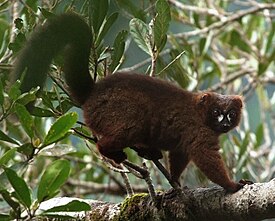
Red-bellied lemur |
| Scientific classification |
|---|
| No rank : | Bilateral symmetrical |
| Squadron : | Euarchontoglires |
| Grand detachment : | Euarchonta |
| Infrastructure : | Lemur-like |
|
| International scientific name |
|---|
Eulemur rubriventer ( I. Geoffroy , 1850) |
| Synonyms |
|---|
- Eulemur flaviventer I. Geoffroy, 1850
- Eulemur rufipes Gray, 1871
- Eulemur rufiventer Gray, 1870
|
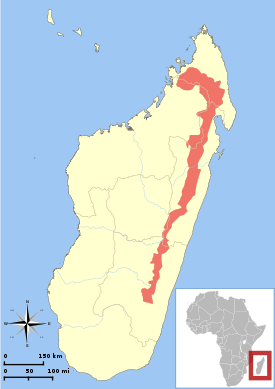
| Range of red-bellied lemur |
|---|
|
| Security status |
|---|
Vulnerable speciesIUCN 3.1 Vulnerable : 8203 |
|
The coat color of males and females is different. The coat on the back of males is of medium length, thick, dark brown. The belly is lighter with a reddish tint. The tail and muzzle are black. Females also have a brown back and black tail, but the belly is light cream in color.
An adult animal is 34 to 40 cm long (not counting the tail), the tail is 20% longer than the body. Weight is from 1.6 to 2.4 kg. [3] Males carry odorous glands on their heads.
Red-bellied lemurs are found in the eastern part of Madagascar; in the north, the range is limited to the Tsaratanan massif, where it is found at an altitude of up to 2400 m above sea level; to the south, the range extends to the Manampatrana River. [four]
