Epaulette feline shark [1] ( lat. Hemiscyllium hallstromi ) is a species of the family of Asian feline sharks of the Wobbegong -like order . They live in the western part of the Pacific Ocean at a depth of up to 15 m. The maximum recorded size is 77 cm. These sharks have an elongated body of yellow-brown color, covered with numerous dark spots. Above the pectoral fins there are characteristic round marks in the form of an “ epaulet ”. They breed by laying eggs. Not of interest for commercial fishing [2] .
| Epaulette cat shark |
|---|
|
|
| No rank : | Bilateral symmetrical |
| Gender: | Indo-Australian Cat Sharks |
|
|
Hemiscyllium hallstromi whitley , 1967 |
|
|
|
Vulnerable speciesIUCN 3.1 Vulnerable : 41875 |
|
The species was first scientifically described in 1967 [3] . Syntypes : males 73 cm and 76.5 cm long [2] . The species is named after Edward Hallstrom, sponsor and chairman of the Tharong Zoo , Australia [4] . .
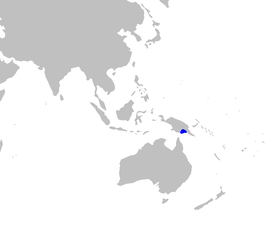
Epaulette cat sharks are endemic to Papua Bay . These sharks are found in coastal tropical waters on coral reefs to a depth of 15 m [5] .
There is no hood on the head from the snout to the gills. The ventral surface of the head in adult sharks is of even light color. Snout to the eyes without markings. The black “epaulettes” above the pectoral fins are large, clearly defined, in the form of “eyes” edged with white, the back half of the main mark is surrounded by two or three additional round or oval dark spots. There are no white spots on the fins and body. The body and unpaired fins are covered with small and large marks, sometimes comparable in size to the main "epaulettes". These spots do not form a complex dark network on a light background. The peripheral part of the pectoral and ventral fins in young sharks is almost black, and in adults it is darker than the main background, along the edge there is a thin white border. In young sharks, the tail is covered with saddle marks intersecting on the ventral part of the body [2] .
These sharks have a rather elongated thin body with a short snout; the pre-oral distance is less than 3% of the body length. The nostrils are located at the tip of the snout. They are framed by short antennae, the length of which is less than 1.3% of the body length. The mouth is located in front of the eyes and shifted closer to the tip of the snout. The lower labial folds do not connect on the chin with a skin fold. The pre-gill distance is less than 13% of the body length. Behind the eyes there are splashes . The distance between the anus and the beginning of the base of the anal fin is over 38% of the body length. The pectoral and ventral fins are thick and muscular. There are no spines at the base of the dorsal fins. Dorsal fins of the same size, shifted back. The base of the first dorsal fin is located behind the base of the ventral fins. The caudal peduncle is very long. The long anal fin is located directly in front of the caudal fin. The caudal fin is asymmetric, elongated, at the edge of the upper lobe there is a ventral notch, the lower lobe is undeveloped [2] .
Epaulette cat sharks breed by laying eggs. The maximum recorded length is 77 cm. Males reach puberty with a length of 48–64 cm. The smallest living specimen was 18.8 cm long [2] .
The species is not subject to commercial fishing. The limited range makes these sharks susceptible to environmental degradation. The International Union for Conservation of Nature has assigned this species the status of conservation “Vulnerable” [6] .
