Pine ( lat. Pínus ) - a typical genus of conifers , shrubs or elfins of the family Pine ( Pinaceae ).
| Pine | |||||||||||||||||
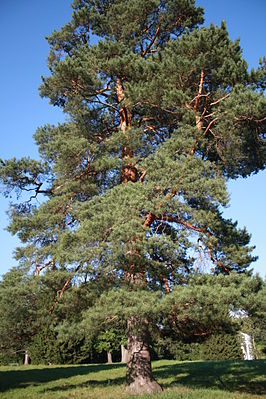 Pine ordinary . General view of a free-standing tree | |||||||||||||||||
| Scientific classification | |||||||||||||||||
|---|---|---|---|---|---|---|---|---|---|---|---|---|---|---|---|---|---|
| |||||||||||||||||
| International scientific name | |||||||||||||||||
Pinus L. , 1753 | |||||||||||||||||
| Type view | |||||||||||||||||
Pinus sylvestris [1] - Scots Pine | |||||||||||||||||
| Subgenies | |||||||||||||||||
See text | |||||||||||||||||
| Area | |||||||||||||||||
| |||||||||||||||||

Pines - plants with strictly whorled branching and shoots of two types - elongated and shortened. The needles are located only on shortened shoots. According to the number of needles on a shortened shoot, the pines are divided into double, three-coniferous and five-coniferous.
According to modern data, there are about 130 species [2] of pine trees, which are naturally scattered throughout the Northern Hemisphere from the equator to the Arctic . In temperate and subarctic climates, they form forests both on the plains and in the mountains , and in the subtropics , tropics and near the equator they grow mainly in the mountains , although they also grow on the plains, such as Caribbean pine .
Title
One of the two versions produces the Latin name of the tree from the Celtic word pin , which means rock , mountain , that is, growing on rocks , the other from the Latin words pix , picis , which means resin , that is, resinous tree .
Species of pine, giving edible nuts, are conditionally combined under the name cedar pine . However, it must be remembered that Cedrus is a different genus of trees of the same family, and pine seeds are not nuts in the botanical sense.
Biological characteristics
Pines are evergreen , resin- rich trees, usually very large, less often small, sometimes almost shrubs .
Pine shoots , like cedars , larch , false larch , are of two types: long and shortened. Leaves on long shoots are brown and scaly. Leaves on shortened shoots 5-9 cm long, needle-like, sit in bunches of 2-5 pieces and are surrounded at the base by membranous sheaths . According to the number of leaves in a bunch, pine species are called bipartite, triple coniferous and five coniferous. So, ordinary pine ( Pinus sylvestris ) and seaside pine ( Pinus pinaster ) are double-faced, Siberian pine ( Pinus sibirica ) and Japanese white pine ( Pinus parviflora ) are five-coniferous, Bunge pine ( Pinus bungeana ) is three-coniferous [3] . Leaves are kept on shoots for several years. Sometimes, most often as a result of damage caused by insects , rosette shoots develop on the pine. Such shoots are extremely short and have bundles of short and wide needles.
Male strobiles are collected by an ear at the base of young twigs. Pollen sacs reveal a longitudinal crack. Female strobils in cones located at the top of a tree.
Cones are ovoid or oblong, usually drooping, and when mature, they fall entirely. They consist of a skull-folded fruit scales, woody or leathery, thickened at the end in the form of a faceted shield. These scales are initially tightly closed, but at full maturity they diverge, exposing the seeds, which are 2 against each scale. Seeds are mostly winged, less often without a wing, with a hard shell in the form of a nut . The embryo can have from 4 to 15 cotyledons .
Distribution
The range extends from the Arctic to the equatorial regions. Pine is considered the most common tree on the planet, although inferior (the number of trees) is inferior to larch . In Russia, the genus is represented by 16 wild and 73 pine species introduced in the open ground [4] .
Of the species growing wildly in Russia and neighboring countries, the most deserving of attention is Scots Pine ( Pinus sylvestris L. ). This is a large tree up to 40 m high with a crown - in the youth of the pyramidal, in the same old umbrella-like. Needles needles sit 2 together, from below dark green, from above bluish-green color, mostly 4-5 cm in length. The bark is reddish brown. Cones (young) are conical in shape, their flap is rhombic in shape. Seeds with a long wing.
Pine is extremely widespread throughout the north of Russia and most of Siberia and forms both clean forests and forests mixed with spruce and other species. Pine forests are especially typical of sandy soil and rocky substrate. To the south of the line through Kiev , then along the Oka River to the mouth of the Tsna River , then through Kazan and along the Kama and Belaya Rivers to Ufa, pine is very rare and sporadic, forming small groves on calcareous and chalky slopes, as well as on sands. It is believed that in this area, once the pine was more widespread than now, but then began to die out due to centuries-old climate changes. To the south of the cities of Kamenetz-Podolsky , Dnieper , Saratov and Orenburg , pine does not occur in the steppes, but appears again in the Caucasus , where it grows in many places. It also occurs sporadically in northern Turkestan , in the mountains of Kokshetau , Karkaraly and others, and to the east in Siberia reaches almost the Pacific Ocean . In the Krasnoyarsk Territory, ordinary pine is represented by three subspecies: Kulundinsky (Minusinsky pine forests); Siberian (most regions of the region) and Lapland (north of 62 ° N).
Another species of pine, distributed mainly in Siberia, is Siberian cedar ( Pinus sibirica Du Tour ). In the Amur Region , a third species of pine appears, close to the previous one - Korean cedar ( Pinus koraiensis Siebold & Zucc. ), With more elongated cones and seeds.
In Eastern Siberia , from Transbaikalia to Kamchatka , from Yakutia and Kolyma to the Amur Region, the Khabarovsk and Primorsky Territories, one small species of pine is extremely widespread, representing, as it were, a “cedar in miniature”. This is the Cedar elfin ( Pinus pumila Regel ). It is very close to the Siberian cedar, but all its organs are much smaller. In particularly adverse conditions, its growth is sometimes not higher than a meter. The population forms huge thickets in the mountains and plains of eastern Siberia and grows so dense that travelers walk and ride deer along the crowns of this tree, merging into one dense mass. In the highlands of East Sayan and Altai, there is a dwarf form of Siberian cedar, which is often confused with cedar dwarf.
One of the southern species of pine is the Crimean Pine ( Pinus nigra JFArnold ), which forms groves in the mountains of Crimea and is found in the Caucasus in some places. Both wild and cultivated pine grows in the Crimea (many artificial plantings). Its seeds are eaten as a treat.
Italian pinia ( Pinus pinea L. ), very peculiar in shape of its crown, lives in the Mediterranean Sea from Madeira to the Caucasus .
Mountain pine ( Pinus mugo Turra ) grows in the subalpine region of the mountains from the Pyrenees to the Caucasus.
Yellow pine ( Pinus ponderosa Douglas ) is widespread in the western part of North America . It is the most widespread and common pine of North America. This is one of the tallest pines in the world, with trees more than 81 meters high.
Lambert pine ( Pinus lambertiana Douglas ), characterized by huge cones (an average of 25-50 cm, in rare cases up to 66 cm long), is also common in western North America. It is also the highest of all pines, reaching 82 meters in height. The resin of this species is rich in sugar, so it is called sugar pine in America.
In the same region (mountains of the states of Colorado, Arizona and New Mexico), there is an Alpine pine ( Pinus longaeva DKBailey ), a tree with a record life expectancy: there are trees up to 5000 years or more.
In the eastern part of North America, the Weymouth pine ( Pinus strobus L. ) grows, similar to Siberian cedar, but more slender and with more tender needles. This tree reaches 50 m in height. It grows from Canada to Allegan .
Characteristic species of America are also Culter Pine ( Pinus coulteri D.Don ), Gray Pine ( Pinus sabiniana Douglas ) Twisted Pine ( Pinus contorta Douglas ) and others.
The natural range not only of the Pine genus, but of the entire Pine family (including spruce, fir, larch, cedar, pseudolarch, tsugi, pseudotseug) does not completely capture South America and Australia and occupies only a relatively small territory in the far north of Africa. Therefore, in these regions of the world, pines are known only in artificial stands. For example, there are a lot of California radiant pines ( Pinus radiata ) introduced in the 19th century in Australia and New Zealand [3] .
Pine forest (Yakutia)
Young bumps
Cones on the branches
Pine branch
Italian pine during flowering. South Culture Park , Sochi
Korean cedar
Eldar pine ( Pinus brutia var. Eldarica , Azerbaijan
Taxonomy
Pinus L. , 1753, Species Plantarum 2: 1000 [5] .
Synonyms
Heterotypic Synonyms [6]
- Pinea Wolf , Gen. Pl .: 156 (1776).
- Cembra Opiz , Seznam: 27 (1852).
- Strobus Opiz , Lotos 4: 94 (1854).
- Caryopitys Small , Fl. SEUS: 29 (1903).
- Apinus Neck. ex Rydb. , Bull. Torrey Bot. Club 32: 597 (1905).
- Leucopitys Nieuwl. , Amer. Midl. Naturalist 3: 69 (1913), nom. superfl.
- Ducampopinus A. Chev . Rev. Bot. Appl. Agric. Trop. 24:30 (1944).
Subgens and species
The genus has 130 species [2] . The systematics between species and genus is not stable, the relationship between species and sections is still being investigated, different sources can use different compositions of subsection sections and the distribution of species in them. According to one of the latest versions of intrageneric taxonomy, species are distributed in two subgenera, divided into two sections each, with their own subsections [7] [8] .
Subgenus Pinus
Section Trifoliae Duhamel
| Subgenus Strobus Lemmon
Section Parrya Mayr
|
Some types:
| Subgenus | Section | Subsection | kinds |
|---|---|---|---|
| Pinus | Pinus | Pinus | Mostly representatives of the old world, needles with paired needles: Pinus densata , Pinus densiflora , Pinus hwangshanensis , Pinus kesiya , Pinus lasti , Pinus luchuensis , Pinus massoniana , Pinus merkusii , Pinus mugo , Pinus nigra , Pinus resinosa , Pinus sylvestris , Pinus tab taiwanensis , Pinus thunbergii , Pinus tropicalis (from the Caribbean), Pinus uncinata , Pinus yunnanensis . |
| Pinus | Pinus | Pinaster | Mostly Mediterranean species: Pinus brutia , Pinus canariensis , Pinus halepensis , Pinus heldreichii , Pinus pinaster , Pinus pinea and Pinus roxburghii (from the Himalayas). |
| Pinus | Trifoliae | Attenuatae | California species: Pinus attenuata , Pinus muricata , Pinus radiata and Pinus glabra . |
| Pinus | Trifoliae | Australes | Mexican species Pinus herrerae , Pinus lumholtzii , Pinus patula , Pinus tecunumanii , Pinus teocote ; species from the east of the USA: Pinus pungens , Pinus rigida , Pinus serotina , Pinus taeda ; species from the Caribbean: Pinus caribaea , Pinus cubensis , Pinus elliottii , Pinus echinata , Pinus occidentalis , Pinus palustris ; other species of Pinus lawsonii , Pinus pringlei and Pinus jaliscana , Pinus oocarpa , Pinus praetermissa , Pinus leiophylla , Pinus greggii . |
| Pinus | Trifoliae | Ponderosae | Views from the western United States and Mexico: Pinus coulteri , Pinus sabiniana , and Pinus torreyana additionally Pinus arizonica , Pinus engelmannii , Pinus jeffreyi , Pinus ponderosa , Pinus washoensis , and Pinus yecorensis ; Pinus devoniana , Pinus douglasiana , Pinus durangensis , Pinus hartwegii , Pinus maximinoi , Pinus montezumae , Pinus pseudostrobus . |
| Pinus | Trifoliae | Contortae | North American species: Pinus clausa , Pinus virginiana and a complex of species Pinus banksiana - Pinus contorta . |
| Strobus | Quinquefoliae | Gerardianae | East Asian species: Pinus bungeana , Pinus gerardiana , Pinus squamata . |
| Strobus | Quinquefoliae | Krempfianae | Unique Vietnamese species Pinus krempfii . |
| Strobus | Quinquefoliae | Strobus | White North American species: Pinus ayacahuite , Pinus chiapensis , Pinus lambertiana , Pinus monticola , Pinus strobus ; optionally Pinus flexilis , Pinus strobiformis , Pinus stylesii ; white East Asian species: Pinus amamiana , Pinus armandii , Pinus bhutanica , Pinus dalatensis , Pinus fenzeliana , Pinus koraiensis , Pinus kwangtungensis , Pinus morrisonicola , Pinus parviflora , Pinus pumila , Pinus sibirica , Pinus wallichii and themus ; additionally Pinus albicaulis and Pinus cembra . |
| Strobus | Parrya | Nelsoniae | Unique Mexican view of Pinus nelsonii . |
| Strobus | Parrya | Balfourianae | Ancient species from the Northwest of the USA: Pinus aristata , Pinus balfouriana , Pinus longaeva . |
| Strobus | Parrya | Rzedowskiae | "Primitive" species, piñon groups: Pinus maximartinezii , Pinus pinceana , Pinus rzedowskii . |
| Strobus | Parrya | Cembroides | Pignon ( piñon ) species: Pinus cembroides , Pinus edulis , Pinus monophylla , Pinus quadrifolia , Pinus remota ; and Pinus culminicola , Pinus discolor , Pinus johannis , Pinus orizabensis . |
Meaning and Application
Industrial Use
Common pine ( Pinus sylvestris L. ) - in the forests of Russia, it is by far the most important and most widespread, both geographically and by the amount of timber delivered by the tree species: judging by the forests for which statistics are available, it turns out that it delivers more than a third of all wood produced by forests and more than half of ornamental, more valuable, forest. [9] A part of this last goes round, in the form of logs , for buildings, a part is trimmed into boards , mainly for overseas holidays, a part is sawn on boards .
Today, at the beginning of the XXI century, pine wood is used as:
- Sawing log for lumber production
- Shipbuilding range
- Deck range for the production of deck and boat lumber
- Pencil Ridge
- Aviation Range
- Riveting ridge for the production of barrel packaging parts (for filling, dry barrels and boxes)
- Packing range
- Sleeper
- Plywood Ridge
- Pulp balances
- Mast and hydro construction log
- Mine longitude and mine stand
Pine wood is distinguished by resinousness, strength and hardness, in particular, these qualities are inherent in the central parts of the trunk, turning into the so-called core. This core differs from the outer layers of sapwood with a more intense color, which varies over a fairly wide range, depending on the growth conditions of the tree.
The color of the core in northern Russia is usually distinguished by the condo pine, which has a meat-red or yellowish-red core, and a mantle pine , the core of which is painted a pale yellowish color. Kondovaya pine grows in more elevated places, is characterized by small layers and is valued much higher than mead, whose wood is sometimes regarded on a par with spruce.
Кроме древесины, сосна служит для добывания смол, которые получаются или посредством сухой перегонки древесины, главным образом пнёвой, так называемого осмола , или посредством подсечки, дающей так называемую живицу . Живица собирается промышленным способом с массивов, предназначенных к вырубке через год-два после подсечки. После выпаривания воды и скипидара из живицы остаётся твёрдая смола — канифоль . Канифоль имеет вид хрупких прозрачных кусков желтоватого цвета, практически без запаха и горьких на вкус. Своё название она получила по имени греческой колонии Колофон в Малой Азии, откуда в древности её вывозили в больших количествах. Аристотель посвятил сосне раздел своего трактата «Исследования о растениях»: « Если зима умеренная, смолы будет много и хорошей, если зима сурова, смолы меньше и она хуже. Самую лучшую и чистую смолу получают с мест, залитых солнцем, смола из тенистых мест темна и горька ». Применяют канифоль для изготовления лаков, сургуча, в быту — при паяльных работах. Музыканты натирают канифолью смычки струнных инструментов.
Древняя окаменевшая смола (живица) — это янтарь .
Предел прочности :
- при сжатии вдоль волокон: 50 МПа ,
- при растяжении вдоль волокон: 90-95 МПа,
- при растяжении поперек волокон (при раскалывании): 6-8 МПа,
- при изгибе : 80-85 МПа.
Плотность : 450—500 кг/м³.
Лекарственное использование
Сосновые почки, экстракты, эфирное масло, смола (живица) используются при бронхитах, при заболеваниях лёгких. Хвоя сосны используется для профилактики и лечения гипо- и авитаминоза витамина С . Сосновый дёготь применяют наружно в виде мазей от некоторых кожных заболеваний ( псориаз , экзема и др.).
Cultivation
Сосна принадлежит к числу весьма светолюбивых древесных пород, но, тем не менее, часто образует чистые насаждения. Причина этого заключается в том, что она является одной из наименее требовательных к почве древесных пород, и потому может расти на таких малоплодородных почвах, на которых рост других деревьев оказывается почти невозможным.
Это связано с тем, что у сосны поверхностный тип корневой системы, который может развиваться в тонком (1—2 м) слое плодородной почвы, лежащей на песках. Например, в Карелии сосны могут иметь обширную корневую систему (имея отдельные корневые побеги длиной до 20 метров у взрослых деревьев), расположенную в слое всего 1 м толщиной. Такими типичными для чистых сосновых насаждений почвами являются сухие песчаные, на которых и заселяются сосновые боры. Характерной особенностью таких боров является их одновозрастность, объясняемая тем, что даже в наименее населённых местностях они сильно страдают от лесных пожаров и, легко обсеменяясь после каждого из них, вырастают вновь в виде одновозрастных насаждений.
На типичных боровых местах к сосне изредка подмешивается берёза , белая ольха , некоторые ивы ; на более низких местах, с более свежей почвой, является более значительная примесь различных лиственных пород, при ещё большей влажности почвы к сосне примешивается, часто в весьма значительных количествах, ель , а в северных лесах и другие хвойные породы. Наконец, сосна встречается и на моховых болотах, где она, однако, растёт крайне медленно и в столетнем возрасте представляет небольшое деревцо, со стволиком всего в какой-нибудь вершок толщиной. На более плодородных почвах, из которых для сосны лучшими являются свежие пески и супеси, она растёт весьма быстро, являясь одной из быстро растущих хвойных пород.
Pine, like coniferous species, is renewed only by seeds, and therefore is suitable only for high-trunk farming; most often, cutting stands from 80 to 120 years are used in its stands, only occasionally lowering them to 60 or increasing to 150 years.
Renewal occurs naturally or artificially. Cutting in a seed year is not wide, up to 30 meters, the cutting areas are usually well seeded, and their renewal is provided if there is no damping of the emerged shoots with grass; the danger of such drowning is especially great on more recent soils, but can be mitigated by reducing the width of the cutting area and protecting it with the wall of the old forest on the south side. If the cutting season does not coincide with the seed yield, the cutting area often has time to overgrow with grass, after which the emergence of pine shoots is difficult, even if, as is often done, seed trees were left in sufficient quantity. In typical pine forests, the dense grassy cover does not last long: it soon thins and, eventually, turns out to be composed of low perennial cereals, which no longer present obstacles for the emergence of pine, if its seeds can reach this area.
If the logged felling is not protected from grazing, then the appearance of strong turf on them is impossible, and such areas easily turn into loose sands, afforestation of which is a known difficulty. On fresher soils, the grassy cover of timely non-seeded cuttings lasts longer and usually gives way to various hardwoods, among which birch predominates. Under the shadow of these hardwoods, the settlement of pine again becomes possible, and it usually appears after a more or less significant period of time.
Significant deforestation in pine forests, in addition to harm from cattle grazing, often experience significant harm from the May beetle larvae, which are especially eager to lay eggs in bright places with sandy soil. The presence of this uninvited guest can also lead to the formation of loose sand. On narrow shaded cutting areas, this enemy rarely appears. Conducting gradual logging in pine plantations is practiced in some places, but relatively rarely. Selective farming in pine plantations cannot lead to good results, due to the significant photophilia of this breed.
Therefore, it is very often resorted to the renewal and cultivation of pine through planting, for which usually annual or biennial seedlings are used: planting larger plants is inconvenient due to the fact that the young pine tree develops a long core root, which is difficult to remove without damage, and this damage to the root the breed, like other conifers, is quite sensitive. Pine seedlings are usually planted “under the sword” (it is a crowbar with a tip in the shape of a sword weighing 5-7 kg), in the amount of 1 piece per 6 sq.m.
Cambium pine is used in the production of vanillin .
Pines in the arts
Rye
I.I.Shishkin .
1878.
Oil, canvas, 107x187 cm.
State Tretyakov Gallery .The edge of the forest.
I.I.Shishkin. Canvas, oil.Pine in the sand.
I.I.Shishkin.
1884.Morning in a pine forest .
I.I.Shishkin.
1886.
Oil on canvas.
State Tretyakov Gallery.Evening.
I.I.Shishkin.
Donetsk Regional Art Museum .At the edge of a pine forest.
I.I.Shishkin.
1882.
Lviv Art Gallery .After the storm in Mary Howie.
I.I.Shishkin.
1891.
Lviv Art Gallery.Big pine tree.
Paul Cezanne
1890-1896.
Oil on canvas. 89x70 cm.
Museum of Art in Sao Paulo .Big pine and red fields.
Paul Cezanne
OK. 1895.
State Hermitage Museum . St. Petersburg.Misimago Pass in Kosyu Province.
Katsushika Hokusai .
OK. 1830.
Color woodcut .Walking area, Tokaido tract.
Katsushika Hokusai.
OK. 1830.
Color woodcut.From the series “36 Views of Mount Fuji” (4).
Hiroshige . 1832.
Color woodcut.Pine tree with hanging arms at Sendzoku Pond. From the series “100 Types of Edo”.
Hiroshige. 1832.
Color woodcut .Forest road to Ville d'Avray.
Camille Corot
The second third of the XIX century.
Oil on canvas. 46 × 35 cm.
National Gallery of Scotland .In the Crimean mountains .
F.A. Vasiliev .
1873.
Oil on canvas.
State Tretyakov Gallery.Pine. Saint Tropez.
Paul Signac .
1892-1893.
Butter.
State Hermitage Museum, St. Petersburg.
Notes
- ↑ Pinus genus information in the Index Nominum Genericorum database of the International Association for Plant Taxonomy (IAPT) .
- ↑ 1 2 Species of the genus Pinus according to The Plant List
- ↑ 1 2 Plant Life, 1978 .
- ↑ Orlova, 2005 .
- ↑ Sp. Pl. 2: 1000.1753
- ↑ Synonyms Pinus
- ↑ See the GRIN link in the plant card.
- ↑ The Gymnosperm Database .
- ↑ Dobrovlyansky, 1900 .
Literature
- Dobrovlyansky V. Ya. Pine // Encyclopedic Dictionary of Brockhaus and Efron : 86 volumes (82 volumes and 4 additional). - SPb. , 1900. - T. XXXa.
- Pine (a genus of trees) // Great Soviet Encyclopedia : [in 30 vol.] / Ch. ed. A.M. Prokhorov . - 3rd ed. - M .: Soviet Encyclopedia, 1969-1978.
- Plant life : in 6 tons / hl ed. Al A. Fedorov . - M .: Enlightenment , 1978. - T. 4: Mosses. The crowns. Horsetail. Ferns. Gymnosperms / Ed. I.V. Grushvitsky and S. G. Zhilin. - S. 369-374. - 447 p. - 300,000 copies.
- Beketov A. N. About the influence of climate on the growth of pine and spruce // Transactions of the 1st Congress of Naturalists in St. Petersburg. Department of Botany. 1868.S. 111-163.
- Orlova L.V. Dissertation: Pines of Russia (Pinus L., Pinaceae): systematics and geography . - SPb. , 2005.
- Pinus // Flora of China : [ eng. ] = 中国 植物 志 : in 25 vol. / ed. by Z. Wu , PH Raven , . - Beijing: Science Press; St. Louis: Missouri Botanical Garden Press, 1999 .-- Vol. 4: Cycadaceae through Fagaceae. - P. 12. - 453 p. - ISBN 978-0-915279-34-0 . - ISBN 978-0-915279-70-8 (vol. 4).
- Miglinsky. Pine tree culture. M.:, 1896.
- Wheels. Planting pine on sandy soils. Kharkov, 1893; 2nd ed., 1900.
- Pravdin L.F. Pine ordinary. Variability, intraspecific taxonomy and selection. M .: Nauka, 1964.190 s.
- Timofeev V.P. The oldest experience of geographical cultures of Scots pine // Forestry, No. 8. 1974, p. 35-39
- Tullus Kh. Kh. Life expectancy of pine needles in Estonia // Forest Science, 1991. No. 4. P. 89-92.
- Novitskaya G. Pine trees for a small garden. // Floriculture, No. 1, 2008, p. 48-52
- S. Ya. Sokolov, I.P. Zamotaev. Chapter 9. Medicinal plants with expectorant and vomiting properties // Reference on medicinal plants. - 1991 .-- S. 187-189. - 414 p. - 50,000 copies. - ISBN 5-615-00780-X , BBK 53.52.
- Critchfield WB, Liftle EL Geographic distribution of the pines of the world // US Department of Agriculture, Forest Service, Misc. Publ. 991. - Washington, 1966
- Jalkanen R., Aalto T., Kurkela T. Development of needle retention in Scots pine (Pinus sylvestris) in 1957-1991 in northern and southern Finland // Trees, 1995. No. 10. P. 125-133.
- Jalkanen R., Aalto T., Kurkela T. Revealing past needle density in Pinus spp. // Scand. J. Forest Res., 1998. No. 13. P. 292-296.
- Kurkela T., Jalkanen R. Reveling past needle retention in Pinus spp. // Scand. J. Forest Res., 1990. No. 5. P. 481-485.
- Opiz FM Seznam Rostlin Kveteny Ceske. Mala Encyklopedie Nauk. - Praha, 1852. - Dil. 10 (Czech)
- Mirov NT The genus Pinus. - N.-Y .: Ronald Press, 1967
- Gernandt, DS et al. 2005. Phylogeny and classification of Pinus. Taxon 54: 29-42. (eng.)
Links
- Pinus : Tropicos taxon information.
- Pinus (pine) description / Christopher J. Earle (ed.) // The Gymnosperm Database. - Date of appeal: 05/15/2018.
- Pinus on the USDA NRCS website (English) (Retrieved September 15, 2009)