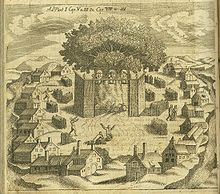
The Christianization of Lithuania ( lit. Lietuvos krikštas ) - the conversion to Christianity of the nobility and the population of the Grand Duchy of Lithuania . The pinnacle of this long and complex process was the conversion of Catholicism in 1386 to the Grand Duke of Lithuania Jagiello and his cousin Vitovt , and the entry of Jagiello on the throne of the King of Poland .
Content
History
Early contacts with Orthodoxy
The first mention of Lithuania in the Quedlinburg Annals (1009) refers to the Roman Catholic missionaries led by Bruno Kverfurtsky , who baptized several rulers of Yatvyagi , a neighboring Baltic tribe to Lithuanians. Lithuanians had more active contacts with Kievan Rus and the subsequent Eastern Slavic states, which adopted Orthodoxy after the Christianization of Kievan Rus in 988. When the princes of Lithuania extended their power to the east, the cultural influence of the Slavic states increased. The population borrowed Eastern Slavic versions of Christian names in the XI-XII centuries. This borrowing is becoming more common among the pagan population in Aukshiteitia , to a much lesser extent in Samogitia . The influence of Orthodoxy on the pagan Lithuanian culture is evidenced by the fact that about a third of modern Lithuanian surnames are of Old Slavic origin [1] . In addition, the Lithuanian words “church”, “baptism”, “Christmas” and “post” are classified as “borrowed from Russia, not Poland” [2] .
Baptism of Mindovg
The emergence of the state of the Livonian Order at the Lithuanian borders made the choice of the state religion relevant. Mindovg became the first Lithuanian Grand Duke to adopt Western Christianity, although his nephew and rival Tovtivev did it before, in 1250. During the reign of Mindovg, the first translations of Catholic prayers were made from German [3] .
In 1249, Tovtivill, an ally of Danylo Galitsky , attacked Novogrudok , and in 1250 another ally of Tovtivilla, the Livonian Order, organized a major campaign against Lithuania. Mindovg found himself in an extremely difficult position between attackers from the south and north, but managed to exploit the contradictions between the Livonian Order and the Archbishop of Riga . He agreed to be baptized and give up some lands in the west of Lithuania. In exchange, he was promised a crown. On July 17, 1251, Pope Innocent IV issued a bullet declaring Lithuania to be the Kingdom and jurisdiction of the Roman bishop over him. Mindovg and his family were baptized according to the Catholic rite in 1251.
Mindovg and his wife Martha were crowned in the summer of 1253. Having formally become a Christian kingdom, Lithuania has not yet become truly Christian. No effort was made to baptize the population. Lithuanians and Samogits firmly stood for the faith of their ancestors. Even becoming a Catholic, King Mindovg did not stop offering sacrifices to the pagan gods [4] . In 1261, Mindovg renounced Christianity and expelled all Christians from Lithuania. The Grand Duchy of Lithuania lost its status as a Catholic kingdom.
Oscillations between East and West
Mindovg's successors did not express enough interest in his endeavors. There have been decades of oscillation between Catholicism and Orthodoxy [5] . "For Gediminas and Olgerd, the preservation of paganism served as a useful diplomatic tool, ... allowing them to use the promises of transformation in order to preserve their power and independence" [6] . Grand Duke Olgerd (1345–1377) maintained a “dynamic equilibrium,” balancing between the pope and Constantinople during his reign [7] [8] . To avoid further clashes with the Teutonic Order , in 1349, Olgerd’s brother and co-ruler, Keistut, began negotiations with Pope Clement VI . And this time, the royal crown was promised to the Lithuanian prince and his heirs in exchange for Lithuanian conversion to Catholicism. Olgerd remained on the sidelines and dealt with the “ Ruthenian ” population of the principality. The mediator in the negotiations, the Polish king Casimir III , unexpectedly attacked Volyn and Brest in October 1349, which disrupted Keistut's plans. During the Polish-Lithuanian War of Volyn, King of Hungary Louis I proposed a peace agreement with Keistut (August 15, 1351), in accordance with which Keistut pledges to adopt Christianity and provide Hungary with military aid in exchange for the royal crown. Keistut accepted the offer by performing a pagan ritual [9] . In fact, Keistut had no intention of complying with the treaty, and he fled along the road to Buda [10] . In the XIV century, the Grand Duchy of Lithuania was recognized as the successor of Kievan Rus in the western part of its possessions [11] . Although the Lithuanian princes were pagans, the majority of the population were Slavs and Orthodox. To legitimize their power in these areas, the Lithuanian princes often intermarried with the Rurikovich . As a result, part of the Lithuanian nobility was baptized into Orthodoxy. The first of them was Voyshelk , the son and heir of Mindovg, who took the veil in the Orthodox Lavrishevsky monastery [12] near Grodno , and then he founded a monastery there [13] .
Christianization under Jagiel and Vitovt
The final Christianization of Lithuania was undertaken by Jagiello . Russian mother Yagailo urged him to marry Sophia, daughter of Prince Dmitry Donskoy of Moscow . For this, Jagiello needed to adopt Orthodoxy and turn Lithuania into a vassal possession of the Grand Duchy of Moscow [14] . This would hardly have stopped the crusades of the Teutonic Order against Lithuania. Jagiello chose the Polish proposal to become a Catholic and marry Queen Jadwiga . On August 14, 1385, at Krevo Castle, Jagiello agreed to convert to Christianity and signed the Union of Krevo .
Jagiello was baptized according to the Catholic rite in the Cathedral of Saints Stanislav and Wenceslas in Krakow on February 15, 1386, and became king of Poland. For the royal baptism was followed by the baptism of the court and the knights of Jagiello, the king's brothers were also baptized: Karigailo , Wigand , Svidrigailo and cousin Vitovt . Jagiello sent Dobrogost, Bishop of Poznan , as ambassador to Pope Urban VI with a petition for the establishment of a bishopric in Vilnius and the appointment of Andrei Yastrzhembtsa as bishop of Vilnius .
Jagiello returned to Lithuania in February 1387. The baptism of the nobility and their peasants was first carried out in the capital Vilna and its surroundings. The nobility and peasants in Aukštaitija were baptized in the spring, and then the rest of the Lithuanian nobility were baptized. Parishes were created in ethnic Lithuania, and the Vilnius Cathedral was built on the site of a ruined pagan temple. According to the controversial information from the source of Jan Dlugosh , the first parish churches were built in the Lithuanian pagan cities of Vilkamir , Mayshagol , Lida , Nemencine, Medniki, Krevo , Hayna and Oboltsy . They all belonged to the birthplace of Jagiello - the Principality of Lithuania . On April 19, 1389, Pope Urban VI recognized the status of Lithuania as a Catholic state.
Емemaitija was the last province of Lithuania converted to Christianity in 1413, after the defeat of the Teutonic Order in the Battle of Grunwald and the First Peace of Torun and the return of Samogitia to Lithuanian control. In November 1413, Vitovt himself baptized the first groups of Samhite [15] . In 1416, construction began on eight parish churches. The Diocese of Samogitia was established on October 23, 1417, and Matei became the first bishop of Samogitia. Around 1464 a cathedral was built in Värnäe .
Implications
The Lithuanian nobility converted to Catholicism, but pagan customs prevailed for a long time and were secretly practiced among ordinary people of Lithuania. There was no persecution of the pagan priests and adherents of the old faith. However, in the 17th century, after the Counter-Reformation (1545 - 1648), the Catholic faith prevailed over paganism. Christianization and its political consequences left a significant mark in the history of Lithuania. The majority of the population of the Grand Duchy of Lithuania outside the borders of ethnic Lithuania was Orthodox. The elite gradually converted to Catholicism, and religious tensions increased. Some of the Orthodox Gediminas left Lithuania and left for the Moscow principality, where they gave birth to princely families like the Golitsyn and Trubetskoy . The Orthodox population of modern Ukraine and eastern Belarus often sympathized with the Moscow princes, who portrayed themselves as defenders of Orthodoxy. These processes led to the Moscow-Lithuanian wars . The defeat of the Lithuanians in the Vedrosh battle undermined the position of Lithuania as the dominant force in Eastern Europe . According to the results of the Russian-Lithuanian war of 1500-1503, a third of the territory of the Grand Duchy of Lithuania was ceded to the Russian state . On the other hand, the transition to Catholicism contributed to the integration of Lithuania into the culture of Western Europe. A path was laid to the political union of Lithuania and Poland, in its final form as the Lublin Union of 1569.
Notes
- ↑ (lit.) Z. Zinkevičius . Krikščionybės ištakos Lietuvoje (inaccessible link)
- ↑ SC Rowell. Lithuania Ascending: A Pagan Empire Within East-central Europe, 1295–1345 . Cambridge University Press, 1994. Page 149.
- ↑ A.Butkus: Mindaugas ir latgaliai - DELFI .
- ↑ SC Rowell Page 120
- ↑ Davies, Norman. Europe: A history . Oxford University Press. Page 430.
- ↑ Muldoon, James. Varieties of Religious Conversion in the Middle Ages . University Press of Florida, 1997. Page 140.
- ↑ Davies, Page 430
- ↑ Muldon, Page 137
- Killing a bull by throwing a knife at it
- Лит (lit.) Kęstutis: he was a proponent or opponent of the Christianization , accessed on 01-07-2007
- ↑ Daniel Z. Stone. The Polish-Lithuanian State, 1386-1795 . University of Washington Press, 2001. ISBN 0-295-98093-1 . Page 3;
Paul Robert Magocsi . A History of Ukraine . University of Toronto Press, 1996. Page 67. - ↑ Following the Tracks of Myth , Edvardas Gudavičius
- ↑ SC Rowell. Page 149.
- ↑ A. Thomas Lane. Lithuania: Stepping Westward . Routledge, 2001. Page XXI.
- Лит (lit.) Dualistinis lietuvių tautybės susidarymas ir trialistinis Lietuvos krikšto pobūdis Archived May 2, 2003. Dr. Aleksandras Vitkus