Asian cat shark , or Indian cat shark [1] ( lat. Chiloscyllium indicum ) - a species of shark, a genus of Asian cat sharks of the same family of the Wobbegong -like order . These sharks live in the Indian and Pacific Ocean to a depth of 20 m. The maximum recorded size is 65 cm. These sharks have an elongated body of light brown color, covered with numerous spots. The diet consists of invertebrates . They breed by laying eggs. Of little interest for commercial fisheries [2] .
| Asian cat shark |
 |
| Scientific classification |
|---|
| No rank : | Bilateral symmetrical |
|
| International scientific name |
|---|
Chiloscyllium arabicum (JF Gmelin, 1789) |
| Synonyms |
|---|
Chiloscyllium colax (Meuschen, 1781)
Chiloscyllium indicum phymatodes Bleeker, 1852
Chiloscyllium indicum var. phymatodes Bleeker, 1852
Chiloscyllium phymatodes Bleeker, 1852
Chiloscyllium tuberculatus (Bloch & Schneider, 1801)
Chilosycylum indicum (Gmelin, 1789)
Chyloscyllium indicum (Gmelin, 1789)
Hemiscyllium colax (Meuschen, 1781)
Scyliorhinus dentatus Blainville, 1816
Scyliorhinus tuberculatus (Bloch & Schneider, 1801)
Scyliorhinus variegatus Blainville, 1816
Squalus caudatus Gronow, 1854
Squalus colax Meuschen, 1781
Squalus dentatus Blainville, 1816
Squalus gronovianus Shaw, 1804
Squalus indicus gmelin, 1789
Squalus tuberculatus bloch & schneider, 1801 |
| Area |
|---|
|
| Security status |
|---|
Close to vulnerableIUCN 3.1 Near Threatened : 41791 |
|
The species was first scientifically described in 1789 [3] . The holotype is a female 27.4 cm long (only dried skin is preserved) [2] .
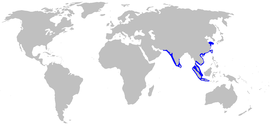
Asian cat sharks live in the Indian and Pacific Ocean off the coast of India , Sri Lanka , Singapore , Thailand , Malaysia , Indonesia , Vietnam , Taiwan , China , Korea , Japan , the Philippines , the Solomon Islands , and also, possibly, in the Arabian Sea .
These sharks prefer to stay in shallow water no deeper than 12 m. Perhaps they off the coast of Malaysia they go into freshwater estuaries of rivers.
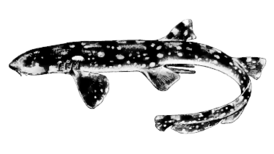
Asian feline sharks have a thin cylindrical body with lateral and dorsal protrusions located in front of and behind the first dorsal fin. The head is devoid of lateral folds of the skin. The snout is rounded. The eyes are dorsolateral. Around the eyes there are slightly raised crests. There is no mobile upper eyelid and periorbital hollows. The eyes are quite large, their length is 1.4-1.9% of the body length. Behind the eyes there are large splashes . The gill slits are small, the fifth and fourth gill slits are located close to each other. The nostrils are framed by antennae. The outer edge of the nasal outlet is surrounded by folds and grooves. A small, almost transverse mouth is located in front of the eyes. The lower and upper teeth have no clear differences, are equipped with a central tip and several lateral teeth [2] .
The distance from the tip of the snout to the pectoral fins is 15.2-18% of the body length. The pectoral and ventral fins are small and rounded. Dorsal fins about the same size. Spikes at their base are absent. The distance between their bases is relatively large, 2 times the base length of the first dorsal fin and equal to 10-12% of the body length. The base of the first dorsal fin is located behind the base of the ventral fins and is slightly longer than the base of the second dorsal fin. The height of the first and second dorsal fins is 3.9-5.4% and 3.9-5.1% of the body length, respectively. The base of a long, short, and keel-shaped anal fin is located behind the base of the second dorsal fin. The base length of the anal fin is 6 times its height. The distance from the tip of the snout to the anus is 32.4–35.1% of the body length. The distance between the anus and the tip of the caudal fin is 62.3–67% of the body length. The caudal fin is asymmetric, the upper lobe does not rise above the apex of the trunk, and there is a ventral notch at its edge. The lower lobe is undeveloped. Lateral carinae and precaudal fossa on caudal peduncle absent. The total number of vertebrae is 166-170. The number of turns of the intestinal valve ranges from 14 to 15. The color is light brown in color with numerous brown and black spots, young sharks have saddle marks. The maximum registered size is 65 cm [2] .
Asian cat shark (top view)
Asian cat sharks breed by laying eggs. The diet consists of invertebrates. Males and females reach puberty with a length of 39–42 and 43 cm. The smallest living individual was 13 cm long [2] .
Asian cat sharks are of little interest to commercial fishing. They are mined in the waters of Thailand, Sri Lanka and India. The meat is eaten. The species is sensitive to overfishing and suffers from deterioration of environmental conditions (destruction of coral reefs). The International Union for Conservation of Nature has assigned this species a conservation status of “Close to Vulnerability” [4] .