Chiloscyllium hasseltii - a species of sharks, a genus of Asian feline sharks of the same family of the Wobbegong -like order . These sharks live in the Indian and Pacific Ocean to a depth of 12 m. The maximum recorded size is 60 cm. These sharks have an elongated body of even brown color. The diet consists of invertebrates . They breed by laying eggs. Of little interest for commercial fisheries [1] .
| Chiloscyllium hasseltii |
| Scientific classification |
|---|
| No rank : | Bilateral symmetrical |
| Rod: | Chiloscyllium hasseltii |
|
| International Scientific Name |
|---|
Chiloscyllium hasseltii Bleeker, 1852 |
| Synonyms |
|---|
Chiloscyllium dolganovi Kharin , 1987
Chiloscyllium hasselti Bleeker, 1852 |
| Area |
|---|
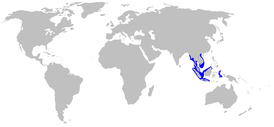
|
|
Content
The species was first scientifically described in 1852 [2] . Syntypes - 5 samples 48–59 cm long, collected in the waters of Java , Sumatra and the Moluccas [1] . The species is named after the Danish zoologist Johan Conrad van Hasselt , who studied the fauna of Indonesia [3] .
Chiloscyllium hasseltii live in the western Indian Ocean and in the eastern Pacific. They are common off the coast of Burma , Thailand , Malaysia , Singapore , Indonesia , Borneo and Vietnam . These sharks prefer to stay near coral reefs in shallow water no deeper than 12 m [4] .
Chiloscyllium hasseltii has a thin cylindrical body without lateral protrusions. The head is devoid of lateral skin folds. The snout is rounded in front. The eyes are dorsolateral. Around the eyes there are slightly raised crests. The movable upper eyelid and peri-orbital depressions are absent. The eyes are rather large, their length is 1.5-2.4% of the body length. Behind the eyes there are large squiggles . The gill slits are small, the fifth and fourth gill slits are located close to each other. The nostrils are framed by antennae. The outer edge of the nasal outlets is surrounded by folds and grooves. A small, almost transverse mouth is located in front of the eyes and shifted to the tip of the snout. The lower lip folds are connected to the chin by means of skin folds. The lower and upper teeth do not have clear differences, they are equipped with a central tip and several lateral teeth.
The distance from the tip of the snout to the pectoral fins is 16.5-20.3% of the body length. The pectoral and ventral fins are large, wide, and rounded. There are no spikes at their base. The distance between their bases is small, slightly exceeds the base length of the first dorsal fin and is equal to 6.6-11.1% of the body length. The base of the first dorsal fin begins at the midpoint of the base of the ventral fins. The base of the first dorsal fin is slightly longer than the base of the second. The height of the first and second dorsal fins is 4.8–8.1% and 7.4–9.1% of the body length, respectively. The base of the long, low and keel-shaped anal fin is located behind the base of the second dorsal fin. The length of the base of the anal fin exceeds its height by 6 times. The distance from the tip of the snout to the anus is 33.2–37.7% of the body length. The distance between the anus and the tip of the caudal fin is 58.9–64.3% of the body length. The tail fin is asymmetrical, the upper lobe does not rise above the apex of the body, at its edge there is a ventral notch. Lower lobe undeveloped. Lateral carinae and precaudal fossa on caudal stem absent. The total number of vertebrae is 156-175. The number of turns of the intestinal valve is 15. The color is even and even, the young sharks are painted very effectively: they have a dark, almost black body, covered with transverse light stripes and spots [1] .
Chiloscyllium hasseltii multiply by laying eggs. The size of newborns is 9.4-12 cm. Males reach puberty with a length of 44-54 cm [1] . The diet consists of invertebrates [5] .
Chiloscyllium hasseltii are of little interest to commercial fishing. Meat is eaten. The International Union for Conservation of Nature has not yet assessed the conservation status of this species.
- ↑ 1 2 3 4 Compagno, Leonard JV Volume 2. Bullhead, mackerel and carpet sharks (Heterodontiformes, Lamniformes and Orectolobiformes) // FAO species catalog. Sharks of the World: An Annotated and Illustrated Catalog of Shark Species Known to Date. - Rome: Food and Agricultural Organization of the United Nations, 2002. - P. 171–172. - ISBN 92-5-104543-7 .
- ↑ Bleeker, P. (1851) Bijdrage tot de kennis der Plagiostomen van den Indischen Archipel. Verhandelingen van het Bataviaasch Genootschap van Kunsten en Wettenschappen, 24 (art. 12): 1-92, Pls. 1-4
- ↑ Christopher Scharpf and Kenneth J. Lazara. Fish Name Etymology Database (Unreferenced) . The appeal date is December 13, 2013.
- ↑ Allen, GR and MV Erdmann. Volumes I-III. // Reef fishes of the East Indies. Perth, Australia :. - Universitiy of Hawai'i Press: Tropical Reef Research., 2012.
- ↑ Compagno, LJV and VH Niem ,. Hemiscylliidae. Longtail carpetsharks. p. 1249-1259. In KE Carpenter and VH Niem (eds.) FAO identification guide for fishery purposes. The Living Marine Resources of the Western Central Pacific. - Rome: FAO, 1998.
