The Battle of Queenston Heights is one of the battles of the Anglo-American War of 1812-1815 that took place on October 13, 1812 on Hill, the current province of Ontario between US regular forces under command both regular troops in the United Kingdom and Canadian volunteers under the command of Isaac Brock and , who took over when Isaac Brock was killed. It happened as a result of an attempt by American forces to gain a foothold on the Canadian bank of the Niagara River and ended in the defeat of the Americans, who were subsequently forced to retreat from Canada. It is also the first major land battle of the . Despite the numerical advantage of the defenders, the Americans attacked British positions on the Queenston Heights and, after several hours of fierce battle, could not defeat the British armed forces. A significant role in the victory of the British was played by the assistance provided to them by the Allies of the Indians , as well as by the units of the 41st Infantry Regiment under the command of and artillery who arrived in time for the battle. The losses of the Americans in this battle were about 100 killed, 170 wounded and 835 prisoners, while the total losses of the British and Allied Indians, according to some reports, were about 21 killed, 85 wounded and 22 prisoners.
| Battle of Quinston Heights | |||
|---|---|---|---|
| Main Conflict: Anglo-American War | |||
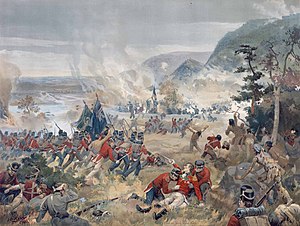 The Battle of Queenston Heights, by D. D. Kelly, 1896. | |||
| date | October 13, 1812 | ||
| A place | Queenston Heights , Ontario | ||
| Total | The victory of the British [1] | ||
| Opponents | |||
| |||
| Commanders | |||
| |||
| Forces of the parties | |||
| |||
| Losses | |||
| |||


Content
Background
The American invasion of the Niagara River was originally planned as part of a four-sided attack on the border points of Upper Canada. Moving from west to east, Brigadier General William Hull advancing through Detroit attacked Amertsberg , Major General Van Rensselaer attacked through Niagara, the city of Kingston was the target of the attack across the St. Lawrence River , and the main area of attack was the capture of Lake Montreal from Lake Canada Champlain by the commander of the US Army - Major General Henry Dearborn . [8] By these actions it was planned to seize the British colony and achieve the signing of a quick peace.
However, four attacks on Upper Canada failed, or were not even launched. Hull was besieged in Detroit, and because of the threat of possible massacre by the Indian Allies of Great Britain, he surrendered the city and the existing army. Dearborn showed no activity in the Albany area.
Van Rensselaer also could not launch an immediate attack on the shores of Niagara due to a lack of troops and supplies. Despite the rank of Major General of the New York State Police, he did not have experience in commanding troops in battles and military experience, in exchange being the main federalist candidate for the post of governor of this state. The Governor of New York, Daniel Tompkins, nominated his possible rival to the post of commander of the Niagara army, an official transfer of powers took place on July 13. Van Rensselaer secured the support of his second cousin Solomon van Rensselaer , who was his adjutant . The latter was an experienced military man who was wounded at the Battle of Fallen Timbers in 1794 .
Preparation
British
Major General Isaac Brock was simultaneously the civilian administrator of Upper Canada and the commander of the armed forces of this region. He was distinguished by aggressive methods of warfare, the successful capture of Detroit gave him massive public support, a reputation as the "savior of Upper Canada" and a knighthood, which the population of Upper Canada learned only after his death. But his superior in Quebec, Lieutenant General Sir George Prevost , adhered to a more cautious strategy, which inevitably led to disputes between them.
Brock hastened to leave Detroit, having the following plan of action - to cross Niagara, defeat Van Rensselaer to gain new strength, and occupy the upper part of New York. Prevost vetoed this plan, ordering Brock to act more defensively. [9] He was worried not only with such active actions, he was also aware of the lifting by the British government of a number of measures against American merchant ships, depriving the current war of a number of reasons. He did not want to harm the ongoing peace talks, the success of which he continued to believe. [10] Negotiations began with General Dearborn, and a truce was organized at the local level. The US government rejected Prevost's offer, ordering Dearborn to “show maximum activity in your operations,” before notifying the British military about the resumption of hostilities. [11] At the same time, it took several weeks for the exchange of messages between the capital and the battle line.
While Brock was in Detroit, Major General Sheaffe commanded troops on Niagara. Acting according to the orders of Prevost, on August 20 he concluded a ceasefire with Van Renseler, and then went further, voluntarily restricting the movement of regular troops. [12] On August 22, Blok returned to Niagara to discover a cease-fire functioning. Under its terms, both sides could use the river for transportation, and Brock helplessly watched the arrival of reinforcements and supplies in the American army. The contract expired on September 8, by which time Van Rensselaer had improved his material security.
US Army Position
Even with Hall’s defeat and Birborn’s inaction, Van Rensselaer’s position looked confident. On September 1, he had only 691 people, but subsequent reinforcements seriously strengthened him. In addition to the 6,000 soldiers, volunteers and police officers at his disposal, Major General Alexander Smith with 1,700 soldiers was subordinate to the Major General. As a career officer, Smith, at the same time working as a lawyer, refused to obey the orders and requirements of Van Rensseler. [13] Upon arriving at the front line, Smith deployed his forces near Buffalo by the Niagara River.
Van Rensselaer planned to throw the main forces from Lewiston along the Niagara River to occupy heights near Queenston, while Smith crossed the river at Fort Niagara and attacked Fort George from the rear. However, Smith did not react in any way to his commander’s plan, to the invitation to participate in the officers' council in early October, or to the direct order to arrive as quickly as possible. An experienced politician, Van Rensseller decided not to send the rebellious officer to a military tribunal and postpone the battle, but to launch an attack from Lewiston. His goal was to create a fortified bridgehead around Queenston, in the winter apartments in which his army could prepare for the spring campaign. [13] Colonel Van Rensselaer visited the British side, accompanied by Colonel-Lieutenant John McDonell of the army of Isaac Brock, thanks to which he had a good idea of the area.
On October 9, American gunners, volunteers, and sailors, under the command of Lieutenant Jesse Elliot, successfully attacked the Detroit and Caledonia brig crews at Fort Erie in Niagara’s bend. Both ships were captured, although the first ship later ran aground and was burned to avoid re-capture. Brock was afraid that after this, an attack from Buffalo could begin, because of which he galloped off to the fort. Although he soon realized that Smith in Buffalo posed no threat, he returned to his headquarters in Niagara-on-the-Lake . However, Van Renessealer was mistakenly informed that Brock went to Detroit, which Major General William Harrison considered a retreat. [14] Van Renesseler decided to launch the attack at 3 a.m. on October 11, despite his relative's illness.
On October 10, Van Rensseller sent Smith an order to advance with his brigade to Lewiston in order to prepare for the attack at any possible opportunity [15] . After receiving the letter, the brigadier-general started the campaign, but the route he chose in inclement weather turned out to be so bad that abandoned carts could be seen “stuck in the road” [16] Major General’s troops fell under the same bad weather, waiting for heavy rain queues for boarding ships. At that moment, one of the boat managers, Lieutenant Sims, deserted troops from his location on his ship and took most of the oars with him. By the time their deficit was recovered, the attack was decided to be postponed until October 13th. [17]
On October 11, Smith received a message that the attack was postponed to 10 a.m. But instead of being promoted to Llyston, he returned to his camp near Buffalo in Black Rock. On October 12, he wrote to Major General that his troops would be able to start moving on October 14, a day after the start of the delayed attack.
Brock's Actions
Brock was aware of the failed attempt to cross the river on October 11, but he did not know if it was an attempt to divert attention from the main American attack elsewhere. On October 12, Major Thomas Evans (Brigadier Major at Fort George) [18] crossed Niagara under the ceasefire flag, requesting an immediate exchange of prisoners captured by Elliot three days ago during an attack on British brig. He also wanted to see Colonel Solomon Van Rensselaer, but he was informed about the illness of his potential interlocutor. Instead, a British officer met with a man who called himself Secretary of Stephen Van Rensselaer Took. Probably under this guise was hiding Van Rensseler’s personal secretary of war, Major John Lovett, who repeatedly declared the impossibility of exchanging “the day after tomorrow”.
Evans was surprised by the repeated repetition of this phrase, and also noticed several boats hidden in the bushes near the shore. Based on this, he decided that the Americans would cross the river on October 13th. At the officer’s council, his theory was accepted with ridicule and mistrust, after the end of the event, Brock spoke privately with Evans, believing in the possibility of the future outcome of the events described by them. That evening, he sent out several orders to police units to collect.
On October 13, Brock was at his headquarters in Niagara, Major General Schiff with the main forces was at Fort George. British units also resided in Kingston, Fort Erie and Chippewa.
Battle
British disposition
The village of Quinston consisted of stone huts and twenty houses surrounded by orchards and peach orchards. [14] Several farmhouses were scattered in neighboring fields and pastures. The village lay at the mouth of the Niagara River Gorge. Immediately south of the village, the land rose 300 feet (100 meters) to the Queenston Heights. The slope from the heights to the river bank was very steep, but overgrown with trees and shrubs, making it easy to overcome. Lewiston was on the American side of the river, the land rose to the south side to the Lewiston heights. The river was very fleeting and had a width of 200 yards, but was not a problem for inexperienced swimmers. [14] In peacetime, water links operated between Queenston and Lewiston. [19]
The British presence in Queenston was provided by the grenadier company of the 49th Infantry Regiment (which Brock had previously commanded) under the command of Captain James Dennis, the flanking company of the 2nd Regiment of the York Police (York Volunteers) under the command of Captain George Chisholm, and a detachment of the 41st Infantry Grasshopper 3-pound gun. The light company of the 49th regiment, along with Captain John Williams, was on the peaks. An 18-pound cannon and mortar [20] [21] were placed in a redoubt halfway to the heights, a 24-pound gun and carronade were in a barbet near Cape Vrumana, a mile north of the village, guarded by Captain Samuel the Hutt Company of the 5th Lincoln Police Regiment . Two more companies of the York police captain Cameron and Heward were in Cape Brown, three miles to the north. [22] The remaining Lincoln police units were not busy with anything, but could very quickly be put on alert. [23]
First American Landing
"The large buckshot and musket bullets that spilled onto them at close range as they approached the shore created incredible chaos. One discharge from a field gun under the command of Captain Dennis himself (captain of the grenadiers of the 49th Regiment) killed fifteen people in one boat." - Lt. John Beverly Robinson of the 2nd Regiment of York Volunteers [24] |
The 6th, 13th and 23rd Infantry Regiment took part in the upcoming battle, the artillery service was also listed in the infantry, as well as the 16th, 17th, 18th, 19th and 20th Regiments of the New York police along with a volunteer rifle battalion [22] . The total number of Americans was 900 soldiers of regular troops and 2 650 police officers. [25] Due to the substantial increase in the size of the US Army, most of the professional soldiers in Lewiston were recruits, and Van Rensselaer counted on a higher level of discipline and professionalism of the police. The fleet consisted of fourteen ships, twelve of which could carry 30 people each, and two large - 80 soldiers each, along with field artillery and carts placed on special platforms. At the last minute, there was a quarrel in the leadership of the Americans over seniority and priority of command, because of which their troops received separate commanders: police - Colonel Van Rensselaer, regulars - Colonel John Christie from the 13th Infantry Regiment
The Americans began to cross the river at 4 a.m. on October 13. Three ships, along with Christie, were forced to move downstream due to an inability to resist the movement of the river. One ship was able to arrange a landing slightly below the designated location, while Christie with the remaining two ships returned to the American riverbank. Ten minutes later, they again began to cross Niagara, the remaining ten ships, led by Van Rensselep, began landing at Queenston. [22] Noticing their sentry, instead of a warning shot, ran to Dennis headquarters. After waiting a few minutes to observe the enemy’s landing, the British captain’s troops fired gully at the Americans in the middle of Niagara, firing low to inflict heavy wounds. [26] Colonel Van Rensseler, who landed on the Canadian coast, was injured by a musket in the thigh, while in a further attempt to organize the soldiers, he was also injured in the heel, thigh, and lower leg. Although the officer survived, he spent most of the battle outside the battlefield, being weakened from the loss of blood. [26] Captain John Wool of the 13th Infantry Regiment took command.
At this time, British artillery opened fire on the pier in Lewiston. Two 18-pound guns were fired at the Queenston Heights from the Lewistons from the Fort Gray earthen fortification; two 6-pound guns and two 5.5-mm mortars were fired from the marina on the Queenston village. [22] Dennis troops were forced to return to the village, but continued to fire under cover of houses.
With the advent of more light, British artillery delivered more accurate strikes. When the second wave of six American boats began to cross the river, the crew of three of them (including the two largest ships, one of which was carrying Lieutenant Colonel Christie) panicked due to being hit by shelling. The officer tried unsuccessfully to prevent the helmsman from turning the ship back. Later, the captain of the ship following the ship, Captain Lawrence, will accuse Christie of the fact that he ordered him to retreat. [27] One of the four remaining ships was sunk by the fire of a 3-pound gun of Grasshopper's system, the remaining flotilla carrying Colonel John Fenwick (former commandant of Fort Niagar) and 80 men drifted downstream. The landing took place in Hamilton Bay, 800 yards downstream, where Lincoln and York police quickly surrounded the landing. They started shooting at the Americans, Fenwick himself was wounded in the face with a pistol and in the leg with a musket, his cloak contained holes from nine bullets. [28] Musket fire damaged the hull of American ships, most of the crew was killed or wounded in a minute, for this reason the survivors of the Fenwick group quickly surrendered. [29] [24] Only three people were able to escape in a boat that had already sunk on the American side of the river. The crew of the last ship surrendered itself, since it was in the reach of guns from Cape Vrumana.
Isaac Brock's death
At Fort George, Brock awoke from the sound of artillery volleys at Queenston. Considering the incident as an attempt by the Americans to divert attention from the main attack, he ordered only a few detachments to go to the village, where he, however, galloped along with several assistants. The officer entered the village at dawn, where he was warmly received by the soldiers of the 49th regiment, after which he headed for the redoubt for a better viewing point. [thirty]
The British 18-pound cannon and mortar inflicted severe damage on the enemy flotilla [20] . An hour and a half passed since the landing, but American forces were chained along the river [31] . On the advice of the artillery lieutenant Gansevoort, who knew the area well, the wounded Van Rensselaer instructed captains Vulu and Ogilvi to take command of the unit located upstream of the river "and ascend to the top of the cliff to storm the battery." [32] Redoubt had a small guard, a light company by order of Brock descended from the heights to help the grenadiers in the battle at Queenston. [33] The Vul soldiers attacked immediately after Brock arrived, forcing his small detachment and gunners to flee into the village, after which the British guns were riveted. Brock sent a message to Schiff at Fort George, ordering him to send as many soldiers as possible to Queenston. The British major general decided to immediately repel the redoubt, without waiting for the arrival of reinforcements. [34]
Two detachments of the 49th regiment of Dennis and Williams, as well as two detachments of policemen, participated in the British attack. [29] The assault was stopped by heavy American fire, and, seeing the soldiers not retreating behind the rear, Brock angrily exclaimed: “This is the first time I see the 49th turning their backs! [35] [36] Of course, the heroes of Egmont will not stain their chronicle! ” [36] After this rebuke, the ranks closed, and two squads of York policemen Cameron and Heward joined the attackers. Brock noticed that the police were starting to lag behind at the foot of the hill, and ordered one of his provincial adjutants, Lt. Col. John McDonell, “Speed up York volunteers.” At this time, he led the right flank, apparently intending to connect with a unit of Williams, successfully operating in this part of the battlefield. [35]
Brock was struck in the wrist of his sword arm by a musket ball but pressed home the attack he was directing. Tall growth and vigorous gestures, together with officer clothes and a bright belt donated by Tecums eight weeks earlier after the capture of Detroit, [34] made the British Major General an ideal target. He was shot dead by an unknown American who emerged from the undergrowth and fired from a distance of less than 50 yards. The bullet hit Brock's chest, killing almost instantly. [37] His body was carried away from the battlefield and hidden in a house at the intersection of Queenston Street and Partitison Street, diagonally across from Laura Secord's residence. [38]
Having no great military experience and practicing law, McDonell, along with Williams, was able to recapture the redoubt. [39] Taking into account the forces of Williams from the 49th on the right flank and MacDonella on the left, 70–80 people (more than half of which were police officers) were moving directly to the redoubt. Vul also received reinforcements, the total size of the forces of the Americans was 400 people.
Despite the difference in number and geographical convenience, a small British detachment was able to reach the redoubt located on the edge of the gorge and be on the verge of success even before the enemy could regroup and strike back. The course of the battle changed after a musket bullet hit MacDonell’s head, causing him to bounce and turn, the next shot fell to his lower back and threw him off his horse. [40] The officer was carried away from the battlefield; the next day he died from his wounds. Captain Williams was wounded in the head, Dennis was seriously wounded in the thigh (although he continued to command the troops for the remainder of the battle). [41] Carrying Brock and MacDonell's bodies from the battlefield, the British retreated through Queenston to Darham Farm, a mile north of Cape Wruman. [42]
According to legend, Brock's last words were "Push, brave York volunteers." But this is very unlikely, because the officer at the time of his death was not next to them with them when he fell. Moreover, the place of the wounded (remaining on his uniform, which is on display at the Canadian military museum ) confirms the almost instant death of Brock, who did not have time to talk. According to historian J. Mackay Hitsman, Brock’s team to accelerate York volunteers who just arrived from Queenston was transformed into a later legend [34] .
Maneuvers (10 AM - 2 AM)
By 10 o’clock in the morning, the Americans were confronted by only a 24-pound cannon at Cape Vruman, who shot at boats from a very long distance. The Americans managed to transfer several hundred additional soldiers and a 6-foot field cannon through Niagara. They removed the 18-pound gun from the redoubt and started firing at Queenston, but the gun had limited ability to shoot across the river. Some American soldiers entered the village and plundered several houses, simultaneously freeing Fenwick and those who survived from his unit. However, they did not try to drive Dennis out of position at Cape Vruman. [43]
Colonel Christie briefly took command of troops in Canadian territory, but soon returned to Lewiston for reinforcements and trench tools. Around noon, General Van Rensselaer and Christy crossed the river, ordering them to strengthen their positions on the Queenston Heights, as the engineer lieutenant Joseph Gilbert Totten watched. Van Rensselaer appointed Lieutenant Winfield Scott of the 2nd Artillery Regiment as commander of the regular forces at Queenston Heights. Brigadier General William Wadsworth , nominally a volunteer [43] and renouncing the right to general command, took over the police. At that time there were very few fully formed units, the rest were a collection of unorganized units, sometimes even without their own officers, some officers crossed the water border without subordinates. In total, a little more than a thousand soldiers of General Van Rensselaer crossed the Niagara River.
Meanwhile, British reinforcements from Fort George began to appear. A detachment of the 41st regiment with captain Derenzy and a royal artillery regiment (a "mobile brigade" with a detachment of horses and coachmen from Canadian farmers and police officers) [44] subordinate to captain William Holcroft with two 6-pound guns entered the village of Queenston. Police captain Alexander Hamilton brought their firing position in the courtyard of his own house. At one in the morning they opened fire, making it difficult for American boats to navigate Niagara. Two ships sank and scouts, shrapnel forced silencing batteries several times in Lewiston [45]
At this time, 300 Mohawk warriors [44] under the command of Captain John Norton and John Brent climbed to the top of the heights and suddenly attacked Scott's outposts. No one was killed, the Indians were thrown into the forest, but the morale of the Americans fell due to fear of Native Americans. The battle cry could be heard in Lewiston, and the police preparing for the river crossing refused this step [46]
Schiff Attack
Schiff arrived at Queenston at 2 a.m. and took command of the British forces. Having ordered new reinforcements to join him, he led them to the heights through a 3-kilometer detour for the sake of protection from American artillery. Here he was joined by a convoy from Chippawa led by Captain Richard Bullock of the 41st Regiment. At this point, Schiff had 800 people: in addition to the remnants participating in the morning battle with Brock, there were also five detachments of the 41st Regiment and seven detachments of police officers (including the Company of Colored People of Captain Ranchi ), two 3-pound cannons belonging to the police ( Provincial Artillery Swayze) under the command of Lieutenant Crowther of the 41st Regiment.
At this point, General Van Rensselaer decided to move to Lewiston to receive reinforcements and ammunition. Refugees and lagging soldiers climbed into his boat, almost flooding it. [47] Arriving in the city, the officer dissolving the troops into a promiscuous crowd [48] , he could no longer persuade the police to cross the river. He then tried to force civilian boaters to cross Niagara and remove regular troops from the Canadian side, but they refused to comply with his request. The next day, Rensselaer said that “... to my deep amazement, I found that at the very moment when we had a complete victory in our hands, the ardor of the uninvolved troops completely disappeared. I darted in all directions - convinced people to cross over with each discussion - but in vain. ” [49] He sent a message to Brigadier General Wadsworth, where he left to his will the decision of the following dilemma: to fight or cross Niagara, promising to provide him with boats in case of retreat [50] ] .
Scott and Wadsworth received the message when Schiffle launched the offensive. According to Scott, 125 regular infantrymen, 14 artillerymen and 296 police officers were ready for battle at the heights. [50] The Americans decided to abandon further fortification work and leave. Scott decided to retreat to the top of the mountain, where he tried to create a barricade of fences and shrubs in order to cover the retreat of regular troops. There, he set a 6-pound cannon in the direction and placed several shooters on the right at the huts in which the light detachment of the 49th regiment lived.
Schiff did not rush into the battle, arranging his people in order and preparing them for an attack at 4 p.m., 12 hours after the start of the assault on Van Rensseler. The first attack involved a light detachment of the 41st regiment, 35 police officers and several Indians, who were opposed by Scott's arrows on the right flank. Shot in one gulp, the attackers launched a bayonet attack, forcing the shooters to retreat in confusion. [51] After this, the British Major General launched a general offensive, which began after a general salvo and was accompanied by a battle Indian cry. Hearing the Mohawks, American policemen considered themselves doomed to certain death, after which they massively retreated without any order. Cursing people who did not cross the river, Woodsworth surrendered with 300 people on the very edge of the abyss. Scott, Totten, and several other people tried to go down a steep bank at the edge of the river. Having never received the promised boats for evacuation, Scott surrendered to the British for fear of encountering an angry Iroquois who lost two leaders in battle. The first two American officers who tried to surrender were still killed by the Indians, who shot the Americans for several minutes from the height despite Scott waving a white flag (in fact it was a Totten tie) [50] . After surrender, Scott was shocked to see 500 police officers hiding in the mountains preparing to surrender.
Losses
Official British data estimated losses in the form of 14 killed 77 wounded and 21 missing; losses among the Indians were not taken into account. [52] Historian Robert Malcomson found a mistake in these calculations, according to him, the loss of the British and Canadians amounted to 16 killed, 83 wounded and 21 captured, the Indians lost 5 killed, 2 wounded and 1 captured. [2] Thus, the total losses amounted to 21 killed, 85 wounded and 22 prisoners. Among the wounded Canadians was James Secord, the husband of Laura Secord .
The number of killed Americans, according to various estimates, was 60, [3] 90 [53] and 100 people. [4] 82 heavily wounded Americans were evacuated along Niagara before being captured, two of them soon died. [5] Subsequently, the British captured 955 Americans, of which 120 soldiers and officers were seriously injured. The local hospital could not accept such a number, which is why some of the wounded were placed in the courthouse and in the nearest churches. We are talking about seriously wounded and in need of hospitalization, there are no records of Americans who had slightly wounded. In the future, 30 seriously wounded were killed, [6] in the October 15 report on prisoners, 19 officers and 417 members of the US regular forces were mentioned, as well as 54 officers and 435 soldiers of the New York police. [7] 80 survivors of the wounded in the American hospital and 90 in captivity gave Van Rensselnru the basis in a letter to Dearborn on October 20, the total number of Americans injured in the battle in the amount of 170 people. [3] Thus, the losses of the Americans amounted to 60-100 killed, 80 wounded, 90 wounded prisoners and 835 captured. 6 officers (4 regular and 2 police) were among those killed; 11 officers (6 and 5) - among the wounded who managed to escape captivity, 8 officers (4 and 4) were wounded and taken prisoner. The captives also turned out to be Brigadier General William Wadsworth of the New York Police, Lieutenant Colonel Scott and his four other colleagues. [54] A 6-pound gun and the banner of a New York police regiment were also captured.
Consequences
Schiff immediately proposed a temporary truce, also inviting Van Rensselaer to send British surgeons to help treat the wounded. After accepting this proposal, after the battle, Van Rensselaer immediately resigned, in this post he was replaced by the oldest officer on Niagara - Alexander Smith. In Buffalo, he had regulars under his leadership, but did not intend to launch an attack before expanding his army to 3 thousand people. He carried out a successful raid to organize a full-scale invasion at the Battle of French Creek , but then failed twice to cross the river at Fort Erie, causing his own soldiers to hate. Criticized for his refusal of assistance and amid rumors of a possible rebellion, Smith returned to his home state of Virginia without staying at his post.
In Albany, the news of the American defeat only reinforced Henry Dearborn's reluctance to engage in active hostilities. He did not intend to lead the third army, while two US armies were already defeated. He launched an indecisive offensive at Odeltown , where his police officers refused to advance. After repulsing the attack of his regular troops by the British garrison at the outpost at Lacolle Mills , Dearborn returned to US territory. Not having achieved significant success in the future, the next year he was replaced.
The question of those responsible for the defeat has not been resolved. The popularity of Stephen Van Rensselaer remained high enough for further participation in the gubernatorial elections in New York and a long stay in the House of Representatives . U.S. Secretary of War John Armstrong , who held this post for most of the war, accused General Van Rensselaer of defeating Queenston in his book Notices of the War of 1812 , which was released after the end of hostilities. This caused an emotional reaction of Solomon Van Rensselaer, comparing Armstrong with Benedict Arnold and blaming Christy for his death in July 1813, who accused him of cowardice and declared: “all our disasters can be attributed to his failure.” [ 27]
The death of General Brock was a serious loss for the British. With his confidence and activity, he inspired his troops, police and civilian authorities in Upper Canada. Schiff, who inherited him, received baronetry for the battle, could not achieve such respect. He was known in many British divisions of the region as a stern disciple. The success achieved in Queenston could not help him escape criticism for the lack of an attack on Fort Niagara, whose American garrison that day almost completely left the fortifications due to the bombing of the British fleet [55] . The following April, Schiff was defeated numerically superior to the American army at the Battle of York , after which he was deprived of his appointment in Upper Canada.
Memory
The 41st and 49th British regiments, whose heirs are currently the Royal Welshmen and Strelki , received the title of Queenstown.
In the Canadian Army, the Lincoln and Wellland Regiment , the 56th Field Artillery Regiment , the Royal York Rangers , the Royal Hamilton Light Infantry Regiment and the Lorne Scots pay tribute to the history and legacy of the Canadian militia participating in this battle. These units also bear the military honor of the Queenston Hills.
Many songs were dedicated to the battle: “The Battle of Queenston Heights” (as the answer of the American “ The Battle of New orleans ”), musician Stan Rogers wrote the song “MacDonell on the Heights”.
In the Canadian province of Ontario, many streets, avenues and roads are named after Major General Brock, and the city of Brockville also exists.
At the Queenston Heights, a 56-meter column, known as the Brock Monument , was erected in memory of the battle and Brock .
Notes
- ↑ Brian Jenkins. Henry Goulburn, 1784–1856: A Political Biography . - McGill-Queen's Press - MQUP, March 14, 1996. - P. 76. - ISBN 978-0-7735-1371-6 .
- ↑ 1 2 Malcomson, A Very Brilliant Affair , p. 297
- ↑ 1 2 3 Cruikshank, Documentary History , p. 143
- ↑ 1 2 Cruikshank, Documentary History , p. 92
- ↑ 1 2 Cruikshank, Documentary History , p. 121
- ↑ 1 2 Cruikshank, in Zaslow, p. 44
- ↑ 1 2 Cruikshank, Documentary History , p. 74
- ↑ Elting, p. nineteen
- ↑ Cruikshank, in Zaslow, p. 24
- ↑ Hitsman, p. 83
- ↑ Hitsman, p. 87
- ↑ Hitsman, p. 86
- ↑ 1 2 Cruikshank, in Zaslow, p. 26
- ↑ 1 2 3 Cruikshank, in Zaslow, p. 28
- ↑ Malcomson, A Very Brilliant Affair , p. 118
- ↑ Malcomson, A Very Brilliant Affair , p. 120
- ↑ Van Rensselaer, pp. 21-22
- ↑ Malcomson, Lords of the Lake , p. 66
- ↑ Elting, p. 41
- ↑ 1 2 Malcomson, A Very Brilliant Affair , p. 136
- ↑ Cruikshank, in Lundy's Lane Historical Society, p. eight
- ↑ 1 2 3 4 Cruikshank, in Zaslow, p. thirty
- ↑ Cruikshank, in Zaslow, p. 27
- ↑ 1 2 Robinson, CW Life of Sir John Beverley Robinson, Bart., Chief-Justice of Upper Canada. (1904). Date of treatment March 19, 2017.
- ↑ Error in footnotes ? : Invalid
<ref>; no text forHitsman92footnotes - ↑ 1 2 Berton (1980), pp. 233-234
- ↑ 1 2 Van Rensselaer, p. 28
- ↑ Berton (1980), p. 235
- ↑ 1 2 Cruikshank, in Zaslow, p. 33
- ↑ Elting, p. 45
- ↑ Malcomson, A Very Brilliant Affair , p. 141
- ↑ Malcomson, A Very Brilliant Affair , p. 142
- ↑ Hitsman, p. 95. Cruikshank insists that Dennis, with a signal from the forge, ordered the light company to enter the battle before Brock arrived.
- ↑ 1 2 3 Hitsman, p. 96
- ↑ 1 2 Cruikshank, in Lundy's Lane Historical Society, p. 9
- ↑ 1 2 Nursey, “The Story of Isaac Brock (General Sir Isaac Brock, KB): Hero, Defender and Savior of Upper Canada 1812”, p. 177
- ↑ Cruikshank, in Zaslow, p. 36
- ↑ Battle re-enactment, Brock funeral parade weekend highlights (link not available) . niagaraadvance.ca (October 3, 2012). Date of treatment November 6, 2012. Archived October 29, 2013.
- ↑ Malcomson, A Very Brilliant Affair , p. 154
- ↑ Malcomson, A Very Brilliant Affair , p. 155
- ↑ Cruikshank, in Lundy's Lane Historical Society, p. ten
- ↑ Cruikshank, in Zaslow, p. 38
- ↑ 1 2 Elting, p. 46
- ↑ 1 2 Hitsman, p. 98
- ↑ Cruikshank, in Zaslow, pp. 39-40
- ↑ Cruikshank, in Zaslow, p. 40
- ↑ Cruikshank, in Zaslow, p. 42
- ↑ Elting, p. 47
- ↑ New York Herald, 4 Nov. 1812, front page
- ↑ 1 2 3 Elting, p. 48
- ↑ Cruikshank, in Zaslow, p. 43
- ↑ Cruikshank, Documentary History, p. 73
- ↑ Quimby, p. 73
- ↑ Cruikshank, Documentary History , pp. 76 and 166
- ↑ Cruikshank, in Lundy's Lane Historical Society, p. 13
Literature
- . The Invasion of Canada, 1812–1813. - Toronto: McClelland & Stewart, 1980 .-- ISBN 0-7710-1235-7 .
- . 1812: The War That Forged a Nation. - New York: Harper Perennial, 2004 .-- ISBN 978-0-06-053112-6 .
- . The Documentary History of the Campaign upon the Niagara Frontier. Part IV . - New York: Arno Press Inc., 1971. - ISBN 0-405-02838-5 .
- Cruikshank EA The Battle of Queenston Heights // The Defended Border / Ed. Morris Zaslow. - Toronto: Macmillan of Canada, 1964 .-- ISBN 0-7705-1242-9 .
- EltingJ. R. Amateurs to Arms: A Military History of the War of 1812. - New York: Da Capo Press, 1995 .-- ISBN 0-306-80653-3 .
- Hitsman J. M and . The Incredible War of 1812: A Military History . - Toronto: Robin Brass Studio, 1999 .-- ISBN 1-896941-13-3 .
- 1812: War with America. - Cambridge, MA: Harvard University Press, 2007. - ISBN 0-674-02584-9 .
- A Very Brilliant Affair: The Battle of Queenston Heights, 1812. - Toronto: Robin Brass Studio, 2003. - ISBN 1-896941-33-8 .
- Malcomson R. Lords of the Lake: The Naval War of Lake Ontario, 1812–14. - Toronto: Robin Brass Studio, 1998 .-- ISBN 978-1-896941-08-0 .
- Quimby R. S. The US Army in the War of 1812: An Operational and Command Study. - East Lansing, MI: Michigan State University Press, 1997. - ISBN 0-87013-441-8 .
- . A Narrative of the Affair of Queenstown in the War of 1812. - New York: Leavitt, Lord & Co, 1836. - ISBN 0-665-21524-X .
- Zaslow M. The Defended Border: Upper Canada and the War of 1812. - Toronto: The Macmillan Company of Canada Limited, 1964. - ISBN 0-7705-1242-9 .