“Suzuya” ( 鈴 谷 , according to the name of the river in Karafuto Prefecture) is a Japanese cruiser [approx. 1] , the third commissioned representative of the Mogami type .
| Suzuya | |
|---|---|
| 鈴 谷 | |
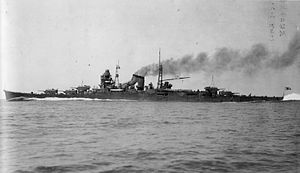 "Suzuya" on sea trials on August 18, 1937 | |
| Service | |
 Japan Japan | |
| Class and type of vessel | Mogami heavy cruiser |
| Organization | Imperial Navy of Japan |
| Manufacturer | Arsenal of the fleet, Yokosuka |
| Construction started | December 11, 1933 |
| Launched | November 20, 1934 |
| Commissioned | October 31, 1937 |
| Withdrawn from the fleet | December 20, 1944 |
| Status | Sunk by American carrier-based aircraft on October 25, 1944 |
| Main characteristics | |
| Displacement | Design: 9500 dl. tons (standard) Initially: 12,450 t (normal) By 1939: 12,000 tons (standard), 13,844 tons (normal) 14 795 tons (full) [1] |
| Length | 200.6 m (largest); 198.06 m (waterline, after modernization) |
| Width | 18.14 m (initially at the waterline); 19.20 m (after modernization) |
| Draft | 5.96 m (before modernization) 6.06 m (with normal displacement after modernization) |
| Reservation | Armor belt - 140-25 mm; deck - 35-60 mm; towers - 25 mm; cutting - 100-50 mm |
| Engines | 4 ТЗА "Kampon", 8 Kampon Ro Go Boilers |
| Power | 152 000 liters with. (111.8 MW ) |
| Mover | 4 propellers |
| Speed | 35.5 knots (tested) |
| Sailing range | 8000 nautical miles at 14 knots (design) " 7000-7500 nautical miles at 14 knots (after modernization) |
| Crew | 930 people (according to the project); 896 (58 officers and 838 sailors) in 1940 |
| Armament (1937) | |
| Artillery | 5 × 3 - 155 mm / 60 type 3 |
| Flak | 4 × 2 127 mm / 40 type 89 , 2 × 2 13.2-mm machine gun type 93 ; |
| Mine torpedo armament | 12 (4 × 3) - 610 mm TA type 90 model 1 (18 torpedoes type 90); |
| Aviation group | 2 catapults type No. 2 model 3, up to 3 seaplanes |
| Armament (1940) | |
| Artillery | 5 × 2 - 203 mm / 50 type 3 No. 2 |
| Flak | 4 × 2 127 mm / 40 type 89 , 4 × 2 - 25 mm / 60 type 96 (50 by 1944), 2 × 2 13.2 mm machine gun type 93 |
| Mine torpedo armament | 12 (4 × 3) - 610 mm TA type 90 model 1 (24 torpedoes type 93 ) |
| Aviation group | 2 catapults type Kure No. 2 model 5, up to 3 seaplanes |
Ordered among four cruisers of this type under the First Fleet Replenishment Program of 1931. Its construction in 1933-1937 was carried out by the Navy Arsenal in Yokosuka. The cruiser’s initial commissioning in January 1936 was delayed by more than a year and a half by carrying out work to improve the strength of the hull and stability.
After an approximately one-year service period, the Suzuya reappeared at the shipyard for the planned replacement of gun turrets, which lasted from January to September 1939. In 1940-1941, the cruiser, along with the ships of the same type, actively participated in exercises, as well as operations to capture French Indochina .
As part of the 7th cruiser division, Suzuya took an active part in the fighting at the Pacific Theater of World War II , including the capture of Malaya, the Netherlands East Indies, a campaign in the Indian Ocean , battles at the Midway Atoll , off the Santa Cruz Islands and in the Philippine Sea . From the spring of 1943 to the summer of 1944, the cruiser successively passed three military modifications . During the battle in Leyte Gulf on the morning of October 25, 1944, the Suzuya island was damaged by two close explosions of bombs from American carrier-based aircraft and sank by noon due to subsequent explosions and fires on board. .
Construction
In August 1933, under the First Fleet Replenishment Program, an order was issued for the construction of the third “8500-ton” cruiser worth 24,833,950 yen [2] . On August 11, 1933, the future ship was given the name "Suzuya" - in honor of the river in Karafuto Prefecture (now Susuya in the Sakhalin Region of Russia). Earlier, the name was the former Russian cruiser Novik , who served in the Japanese fleet in 1908-1913 [3] . "Suzuya" was laid on the slipway No. 2 of the Navy Arsenal in Yokosuka on December 11, 1933 and launched on November 20, 1934 [4] .
In 1933, it was decided that the second pair of Mogami-class cruisers would receive only eight steam boilers instead of ten, and the single-barrel 127 mm units provided for in the project would be replaced by twin ones. At the final part of the construction on the slipway, the ship in the summer and autumn of 1934 passed the so-called “First stage of work to increase efficiency”, caused by the incident with the destroyer Tomodzuru in March of that year. In the course of these works, equipment for receiving / discharging ballast water into the double bottom was installed on the cruiser, the distance between the decks was reduced compared to the design one, and they also facilitated superstructures in comparison with the initial project [5] .
On November 10, 1935, the Suzuya was at 96.6% readiness (it lacked only fire control systems, 127-mm installations and 25-mm anti-aircraft guns) went on sea trials. On the measured mile at Tateyama, the cruiser reached a speed of 36.50 knots with a displacement of 13,000 tons. The launch of the cruiser was planned for January 1936, but on November 20 he was put into dry dock No. 4 of the Yokosuka Navy Arsenal to inspect the corps as part of the investigation of the Fourth Fleet incident . Then, “Suzuya” was transferred to the Koumi pool, where it was disarmed and began to be prepared for reconstruction. In June 1936, the cruiser was again brought into dock No. 4, and on it began the implementation of the second stage of work to increase efficiency, which lasted until October 1937. During it, type-D steel sheets joined by electric welding were replaced with riveted ones (over the course of 80% of the length of the hull (their thickness was doubled in a number of sections)), and at the extremities with welded mild steel, the first tier of the superstructure (with an anti-aircraft deck) was shortened so that barbets of gun turrets No. 3 and 4 did not pass through it; bullets of increased width were installed to compensate for the increased displacement. Also, in parallel with these works, the missing feed 127-mm installations and 25-mm anti-aircraft guns were installed, the height of the main mast was reduced, and the rail system was redesigned to accommodate seaplanes. In repeated sea trials on August 18, 1937, the Tateyama Suzuya developed 35.50 knots with a displacement of 13,636 tons and a machine capacity of 160,020 liters. with. October 31, the cruiser was handed over to the fleet simultaneously with the fourth cruiser - "Kumano" [6] .
Service History
Pre-War Service
After being transferred to the fleet on October 31, 1937, Suzuya was assigned to the Navy Kure and received the callsign JJOA. He was in the reserve of the 1st category until December 1, until he was enrolled in the 7th division (three marks on pipes) along with Kumano (flagship, one mark) and Mikuma (two marks). From April 9 to April 14, 1938, three cruisers of the 7th Division made a campaign from Sasebo to Takao . In August, ships participated in exercises in the Bungo and Ise Straits. From October 17 to 23, they made a trip from Sasebo to Mako and then returned back [7] .
On December 15, 1938, Suzuya was withdrawn to the 3rd category reserve in connection with the planned start of the next modernization. It became known as the Third stage of work to increase efficiency and was aimed primarily at replacing the main caliber - the 155-mm three-gun installations were dismantled and 203.2-mm two-gun installations were installed on their barbets (the so-called “Mogami models”) . At the same time, the Kure type 2 model 3 arsenal catapults were replaced with heavier type 2 model 5 type catapults, type 90 combined-cycle torpedoes with oxygen type 93 (with an increase in ammunition load of up to 24 pieces), and a type 92 torpedo fire control device was installed on the foc- masts [8] . The Suzui was modernized by the Navy Arsenal in Yokosuka, work was carried out from January 31 to September 30, 1939 [9] .
November 15, 1939 "Suzuya" returned to the 7th division, becoming its flagship (the second ship - "Kumano"). On March 27, 1940, both cruisers sailed from Sasebo to the coast of southern China, returning to base on April 2. On May 1, the Mogami and Mikuma returned to the 7th Division, and from that moment on it included all four representatives of the Mogami type. At the end of 1940, stamps on pipes were removed. Since January 7, 1941, the 7th division received an internal division into two divisions (the first - "Kumano" and "Suzuya", the second - "Mikuma" and "Mogami"), the flagship was "Kumano" [7] .
In connection with the exacerbation of the Franco-Thai conflict, the 7th Division left Kure on January 23, 1941 and arrived in Samakh on Hainan Island on January 29. On January 31, a truce was signed on board the cruiser Natori, mediated by Japanese diplomats. On February 6, the 7th division went to sea, visited 10th Bangkok and 13th Saigon . On February 18, she went to Samakh, stood at Mako on 20-21, Okinawa on 23-26, Takao on March 3-7, Saeki Bay on 11-28, and arrived in Kure on March 29. From April 11 to 17, the “Suzuya” (together with the “Mikuma”) underwent docking there, during which a demagnetizing winding was also installed [7] .
On April 25, the cruiser, along with the Kumano, left Kure; On April 26, they arrived in Ovase Bay, where on April 28, Mikuma joined them. On May 17, the ships crossed to Ise Bay, where they merged with the Mogs, and on the 22nd returned. On June 3-4, Suzuya, Kumano, and Mogami left Ovase Bay and headed for Beppu, where they stood from June 6 to 10, spent on June 12-19 in Sukumo Bay and teamed up with Mikuma on the 23rd Ariake. On June 27–30, the 7th division transferred to Yokosuka, and from there on July 8–12 - to Kure [10] .
July 16, the cruiser left Kure to participate in the capture of French Indochina . On July 22, they arrived in Samakh and on July 25-30 escorted from there transports with troops to Saigon. On August 7-19, the 7th division stood in Sukumo Bay and returned to Kure on the 20th. From August 31 to September 7, the Suzuya (along with Kumano) underwent another docking there. On September 16, the 7th division went on a training trip, visiting Muradzumi (September 16 - October 14), Saeki Bays (October 15-19), Beppu (October 20-23 and November 10-11), Sukumo (October 23 - November 1 ), Ariake (November 2-9) and on November 13 arrived at the anchorage at the island of Hasira. On November 16, the cruisers entered Kure to receive fuel and ammunition. On November 20–26, the “Suzuya” together with the “Mogs”, “Mikuma” and “Chokai” made the transition from Kure to Samakh, and three days later, “Kumano” joined them [11] .
World War II
On December 4, 1941, the 7th division left Samakh port to cover the 1st Malay convoy and the landing areas in Kota Baru, Singor and Patani. On the night of December 9, she, along with the 3rd squadron of destroyers, was ready for a night battle with the British “Z” compound (previously discovered by the I-65 submarine), but could not find it and in the morning joined with the main forces (battleships “ Congo ”and“ Haruna ”, heavy cruisers“ Atago ”and“ Takao ”). The next day, this task lost its relevance, as British ships were sunk by aircraft of the carrier group of the Japanese Imperial Fleet at Kuantan. During the pursuit of the “Z” compound late in the evening of December 9, one seaplane of the cruiser “Suzuya” was damaged during landing [12] [13] .
On December 11, Suzuya and Kumano (1st Division of the 7th Division) arrived in Kamran. On the 13th they again went to sea and on December 16 supported the landing at Miri in northern Kalimantan, returning to the base on December 27. January 5-10, 1942 both cruisers covered the convoys to Kamrani [12] [13] .
On January 16, 1942, the 7th division, together with the cruisers "Youkai", "Sendai" and "Jura", went to sea to intercept British ships, but on January 18 this order was canceled, and the next day the division returned. On January 23, she again left Kamran, Suzuya, Kumano, and the 19th destroyer (Ayanami and Ison), while covering the landing on the Anambas Islands. On January 26, they met with the cruiser Yura and, after covering the landing at Endau, returned to Kamran on the 30th. After a short stop, all four cruisers of the 7th Division and the “Youkai” went to sea on February 10 and on the 13th provided cover for Operation “L” (capture of Palembang and Bank Island). On February 16, the 7th division was transferred to the Main Forces with the aim of capturing western Java, and the next day arrived on the Anambas Islands to receive fuel and supplies [12] [13] .
On February 24, all 4 cruisers went to sea, while the Suzuya and Kumano went to cover the landing at Indramaju east of Batavia . On March 1, the ships of the 7th division merged, on the 4th they left the Java area and the next day arrived in Singapore . From March 9 to 12, 4 cruisers and the Chokai covered the landing areas in Sabang and Iri in northern Sumatra, and on the 15th returned to the port for refueling and replenishment. Since March 20, they took part in the capture of the Andaman Islands and, after completing the task, they anchored in the Burmese port of Mergui on the 26th. On April 1, as part of Operation C, all five cruisers set sail, heading for the formation of Vice Admiral Ozawa in the Bay of Bengal . At 8:30 p.m. on April 5, Ozawa ships split into three independent groups, of which Suzuya, Kumano, and the destroyer Shirakumo entered the north. Between 09:52 and 11:50 the next day they sank five ships of the countries of the anti-Hitler coalition - the British Silkworth, Autolikus, Malda, Shinkuan and American Exmoor. "Suzuya" at the same time spent 190 203 mm and 64 127 mm shells. On April 11, the 7th division entered Singapore, the 13th in Kamran and the 22nd arrived in Kure, where the cruisers embarked on a scheduled repair in the Arsenal of the fleet. From April 27 to May 4, “Suzuya” and “Kumano” were docked there [14] [13] .
On May 22, 1942, the 7th division (Rear Admiral Kurita’s flag on the “Kumano”), under cover of the 8th destroyer division ( Asashio and Arashio) left Hashirajima and arrived on May 26 in Guam. May 28, she went to sea to participate in the MI operation, initially covering the connection of rear-admiral Fujita's hydroavianos ("Chitose" and "Kamikawa-maru"). On May 30, the 7th division and the 8th division met with Rear Admiral Tanaka’s transport group (12 transports with 5,000 soldiers on board) and the Akebono-maru and Nitiey-maru tankers, accompanying them from now on. In the afternoon of June 4, Kurita received Nagumo’s order to shell Midway, which was supposed to do what the First Mobile Connection in the Japanese aircraft carrier’s battle to defeat was to destroy American aircraft and coastal fortifications on the atoll, which could prevent the landing. Since another 410 nautical miles had to be reached to the destination, it was necessary to overcome them at a maximum speed of 35 knots. The destroyers Asashio and Arashio could not support her in the stormy sea and gradually began to lag behind [13] [15] .
Since it became clear by night that the cruisers would not be able to reach Midway without being hit by American aircraft, at 00:20 on June 5, Yamamoto canceled Nagumo's order of shelling. However, his message by mistake was initially sent not by the 7th, but by the 8th Division (Tone and Tikuma). It reached Kurita more than two hours later, at 02:30, when there was less than 50 nautical miles to Midway, and only from that moment did the 7th division head north-west, heading for a meeting with the main forces [16] . At the same time, at 02:15, Japanese ships were seen as a US submarine “Tambor” (commander - 3rd-rank captain John Murphy) marching aboard, as four large unidentified targets, but soon the submarine lost contact with them in the dark. At 02:38, contact was resumed, and almost immediately the boat itself was spotted from the flagship Kumano. Due to the threat of a torpedo attack, four cruisers of the 7th Division received orders to complete the “all of a sudden” turn by 45 °, but due to errors in its transmission and darkness, they only performed it correctly on the first Kumano and the fourth Mogami. The “Suzuya” and “Mikuma”, who were going second and third, began to make a 90 ° turn “all of a sudden”. The Suzuya marched dangerously close behind the Kumano stern, and the Mikuma rammed the Mogami by the end of the fifth minute. “Kumano” and “Suzuya” after that continued to go west at full speed and on June 13 arrived at Truk [13] [17] .
On June 17, the Suzuya, together with the Kumano and destroyers Arare and Kasumi, left Truk and arrived in Kure on the 23rd. On July 14, during the reorganization of the IFI, the 7th division was transferred from the Second Fleet (cruiser) to the Third (aircraft carrier). From July 17 to July 23, both cruisers moved from Hashirajima to Singapore. July 28, they again went to sea, heading to the port of Mergui in Burma as part of Operation "B". At around 6:00, the Suzuya and Kumano four destroyers, who were escorting four destroyers, were attacked by the Dutch submarine O-23, which fired 4 torpedoes at them. They all passed by, the subsequent six-hour pursuit of the submarine ended in failure. In Mergui, the union arrived on July 30 [18] [13] .
On August 7, as part of Operation Ka, the Suzuya and Kumano left Mergui and headed east. Refueling in Balikpapan on August 14-16, they joined the aircraft carrier of Admiral Nagumo on the 22nd north of Guadalcanal and participated in the battle near the eastern Solomon Islands . After the battle, the 7th division patrolled the area of the northern part of the Solomon Islands and on September 5 arrived at Truk. On September 9, she again went to sea as part of an aircraft carrier formation in the same area. On September 14, Japanese ships were attacked by 10 B-17 bombers, and on the 23rd returned to base [19] [13] .
On October 11, the Suzuya and Kumano went to sea as part of the Third Fleet to support the next offensive on Guadalcanal, scheduled for the 24th. On October 17-18, the ships refueled at sea, and on the 19th, in connection with sending Kumano to the escort of the 1st division of aircraft carriers, the Suzuya was left alone for a while in the 7th division, and Rear Admiral Nisimura transferred to it your flag. He took part in the battle of the Santa Cruz Islands on October 26 and the subsequent unsuccessful attempt to impose a night battle on the Americans. He returned to the base on October 30. On November 3, the Suzuya left the Truk together with the May cruiser and on the 5th arrived on the island of Shortland . On November 13, both ships, along with the cruisers "Chokai" and "Kinugasa" sailed to Guadalcanal to cover the convoy with reinforcements and shelling the Henderson Field airfield. On the night of November 14, "Suzuya" fired at him 504 incendiary and armor-piercing shells of 203 mm caliber . The American submarine “Flying Fish” fired 6 torpedoes on the cruiser, but they all passed by, on the afternoon of November 14th it successfully survived all US air raids (while the “Kinugasa” was sunk, and the “Youkai” and “Maya” were damaged ) and returned to Shortland the next day. On November 17-18, the Suzuya moved to Kavieng , where it stood in readiness for two weeks. On December 2, he returned to Shortland and on December 5, after a two-day stay, he arrived in Rabaul , where he met with Kumano. On December 5-6, both cruisers moved to Kavieng, where Rear Admiral Nishimura moved the flag to Kumano. Оба корабля почти месяц стояли там в готовности в связи с эвакуацией Гуадалканала, за это время совершив только один поход с войсками на борту к Лоренгау 12—13 декабря [20] [13] .
4 января 1943 года «Судзуя» покинул Кавиенг, 6—7 января дозаправился топливом на Труке и 12-го прибыл в Курэ, где встал на ремонт. Он прошёл там докование в период с 14 по 25 января. 5 февраля крейсер вышел в море и 10-го прибыл на Трук, 13 февраля к нему присоединился «Кумано». Полтора месяца оба корабли простояли там, занимаясь боевой подготовкой и находясь в готовности выйти на перехват очередного американского рейда. 24—29 марта «Судзуя» и «Кумано» перешли из Трука в Курэ и стали там на ремонт, включавший и первую военную модернизацию. В ходе неё снимались 13,2-мм пулемёты, количество 25-мм автоматов доводилось до 4 строенных и 4 спаренных (всего 20 стволов), устанавливалась РЛС обнаружения воздушных целей № 21 на вершине фок-мачты, на передней части компасного мостика разместили командный пост ПВО, все иллюминаторы на нижней палубе и многие на средней были заварены, растяжки антенн на крышах башен № 3 и 4 сняли. Докование «Судзуя» в Арсенале флота прошёл с 27 апреля по 2 мая [21] [13] .
20 мая «Судзуя», «Кумано» и «Могами» покинули Токуяму и направились в Токийский залив , куда прибыли на следующий день. Там в течение 9 дней они занимались боевой подготовкой перед планируемым походом к Алеутским островам, однако тот затем был отменён. С 30 мая по 1 июня крейсер вместе с «Кумано» перешёл в Хасирадзиму («Могами» задержался на один день из-за повреждений при столкновении с танкером). Оба крейсера 11 июня вышли из Курэ и 13-го прибыли в Йокосуку, где взяли на борт личный состав 5-го подразделения ПВО ЯИА. С 16 по 21 июня вместе с линкорами «Конго», «Харуна», авианосцами «Рюхо», «Унъё» и «Тюё» и 7 эсминцами они перешли на Трук. Затем «Судзуя» и «Кумано» в сопровождении эсминца «Ниидзуки» 23—25 июня совершили переход до Рабаула, где высадили солдат, после чего к 27 июня вернулись обратно. 9—11 июля оба крейсера снова перешли в Рабаул и 18 июля вместе с «Тёкаем», «Сэндаем» и 4 эсминцами направились в залив Велья для прикрытия высадки там подкреплений. В ночь на 20 июля в результате налёта «Эвенджеров» КМП «Кумано» был повреждён. 21 июля корабли вернулись в Рабаул, и «Судзуя» простоял там до начала октября. 22 июля контр-адмирал Нисимура перенёс на него свой флаг с «Кумано», так как последний уходил на ремонт в Японию [22] [13] .
8—10 октября «Судзуя» перешёл из Рабаула на Трук. 17 октября в составе авианосного соединения адмирала Кога он выходил к атоллу Эниветок в направлении ожидавшегося по данным радиоперехвата американского рейда. Соединение прибыло к атоллу 20 октября, но никого не обнаружило и 26 октября вернулось на базу. 3 ноября «Судзуя», «Тикума» и «Могами» вышли в море для удара по месту высадки американских сил в заливе Императрицы Августы на Бугенвиле . Утром 5 ноября крейсера прибыли в Рабаул и вскоре после этого попали под удар американской авиации . «Судзуя» в ходе налёта не пострадал, но на следующий день был отправлен сопровождать повреждённый «Могами» обратно на Трук, достигнув его 8 ноября. 24 ноября из-за начала высадки американцев на атоллах Тарава и Макин «Судзуя» и «Кумано» снова вышли в море. 26—27 ноября «Судзуя» провёл на стоянке в Рои, 28—29 ноября вместе с прибывшим «Кумано» находился у атолла Эниветок, с 30 ноября по 3 декабря оба крейсера пробыли у Рои и 5 декабря вернулись на Трук. 8 декабря контр-адмирал Нисимура перенёс свой флаг с «Судзуи» на «Кумано». 26 декабря оба крейсера направились в поход с грузом на борту в Кавиенг, но были обнаружены американской авиацией и 28-го вернулись обратно. 29 декабря оба корабля вместе с эсминцем «Митисио» снова вышли в Кавиенг, вернувшись обратно 1 января 1944 года [23] [13] .
1 февраля 1944 года 7-я дивизия («Судзуя», «Кумано», «Тонэ», «Тикума») оставила Трук и 4 февраля прибыла на острова Палау . Простояв там в готовности 12 дней, она с 16 по 21 февраля перешла на якорную стоянку у острова Линга для проведения боевой подготовки. Последнюю неделю марта и первую неделю апреля «Судзуя» и «Кумано» провели на судоремонтном заводе № 101 в Сингапуре, где прошли Вторую военную модернизацию. В ходе неё на крейсер были установлены дополнительно 8 одиночных 25-мм автоматов, в результате чего общее число стволов возросло до 28. 11—14 мая крейсера 7-й дивизии и «Могами» перешли из Линги в Тави-Тави, где провели почти месяц (с перерывом на поход к острову Таракан для дозаправки 15—17 мая). С началом операции «А-Го» 13 июня они вышли в море в составе Мобильного флота вице-адмирала Одзава и 19—20 июня участвовали в сражении в Филиппинском море , не получив в ходе него никаких повреждений. 22 июня корабли зашли на Окинаву и 25-го прибыли в Курэ. По прибытии «Судзуя» прошёл в Арсенале флота Третью военную модернизацию, завершившуюся 8 июля. В ходе неё были добавлены ещё 4 строенных и 10 одиночных 25-мм автоматов (общее число стволов — 50), установлены РЛС обнаружения надводных целей № 22 на фок-мачте и РЛС обнаружения воздушных целей № 13 на грот-мачте, два комплекта инфракрасных приборов наблюдения и связи тип 2 на мостике, жилые помещения максимально очищены от огнеопасных предметов, дополнительно улучшена водонепроницаемость переборок ниже ватерлинии [24] [13] .
8 июля 7-я дивизия вместе с 1-й дивизией линкоров, 4-й дивизией крейсеров и 2-й эскадрой эсминцев покинула Курэ, имея на борту войска и грузы. 10 июля она зашла на Окинаву, а 16-го прибыла в Сингапур — конечную цель похода. 17 июля корабли перешли на базу в Линге, где провели порядка трёх месяцев. В ходе стоянки РЛС № 22 4-й модификации «Судзуи» была модернизирована с установкой супергетеродинного приёмника , позволяла после этого управлять артиллерийским огнём [25] [13] .
5 октября «Судзуя» принял запас продовольствия с транспорта «Китаками-мару». С 18 по 20 октября 7-я дивизия крейсеров вместе с 3-й дивизией линкоров и 10-й эскадрой эсминцев перешли из Линги в Бруней [25] [13] .
Сражение в заливе Лейте
22 октября 1944 года 7-я дивизия в составе Первого набегового соединения адмирала Куриты покинула Бруней для выполнения операции «Сё-Го» . После боя в море Сибуян 24 октября ночью того же дня она прошла проливом Сан-Бернандино, выходя к конечной цели пути в заливе Лейте [13] .
Утром 25 октября у острова Самар в ходе боя с оперативным отрядом 77.4.3 американской оперативной группы 77.4 контр-адмирала Спрэгью «Судзуя» шёл вторым в колонне крейсеров 7-й дивизии. В 7:10 с дальности в 10 км он открыл огонь по американскому эсминцу «Джонсон», произведя по нему пять залпов главным калибром и накрыв цель двумя из них. Сразу после этого его в первый раз атаковали примерно 20 американских самолётов [26] . В 7:27 в результате попадания торпеды с «Джонсона» флагманский «Кумано» лишился носовой оконечности. «Судзуя» начал маневрировать вокруг него, однако в 7:35 подвергся новому налёту примерно 10 самолётов. В результате близкого разрыва бомбы по левому борту был повреждён левый внешний винт, после его отключения максимальная скорость упала до 20 узлов [прим. 2] . Затем «Судзуя» взял курс на повреждённый «Кумано», чтобы снять с него адмирала Сираиси со штабом, выйдя таким образом из боя с кораблями оперативного отряда 77.4.3 и более в него уже не возвращаясь [27] . В 10:50 крейсер был атакован в третий раз 30 самолётами, и в результате близкого разрыва по правому борту от попадания осколка сдетонировала торпеда в торпедном аппарате № 1, а затем и три других, заряженных в него. В результате их взрыва были сразу же разрушены обе кормовые 127-мм установки, выведены из строя машинные отделения правого борта и котельное отделение № 7. Крейсер потерял ход, а в его центральной части начался сильный пожар. В 11:05 для оказания помощи к «Судзуе» подошёл эсминец «Окинами», а в 11:30 крейсер «Тонэ» снял адмирала Сираиси. Несмотря на борьбу с пожаром, ближе к полудню начал рваться боекомплект передних 127-мм установок и торпедных аппаратов левого борта, после чего весь корабль был охвачен пламенем. В 11:50 капитан 1-го ранга Тэраока приказал команде покинуть борт. В 13:15 «Судзуя» опрокинулся на правый борт и в 13:22 затонул в точке с координатами Командир Тэраока и ещё 401 член экипажа крейсера на борту «Окинами» прибыли в Корон 27 октября [28] [13] . Согласно отчёту о боевых действиях крейсера «Судзуя» за 18-25 октября 1944 года, из числа его команды погибло 90 (1 офицер и 89 матросов), пропало без вести 564 (34 офицера и 530 матросов) и было ранено 69 (1 офицеров и 68 матросов) человек [прим. 3] [29] . Несколько членов экипажа также были позже подобраны американцами [прим. 4] [25] .
21 ноября 1944 года 7-я дивизия была расформирована, и «Судзуя» был формально передан в состав Объединённого флота. Из списков он был исключён 20 декабря того же года [30] .
Commanders
- 20.11.1934 — 1.12.1936 капитан 1 ранга (тайса) Цунэмицу Ёсида ( яп. 吉田庸光 );
- 1.12.1936 — 1.12.1937 капитан 1 ранга (тайса) Сёдзиро Мидзусаки ( яп. 水崎正次郎 );
- 1.12.1937 — 15.11.1938 капитан 1 ранга (тайса) Яитиро Сибата ( яп. 柴田弥一郎 ) [13] ;
- 15.11.1938 — 15.11.1939 капитан 1 ранга (тайса) Кюдзи Кубо ( яп. 久保九次 ) [13] ;
- 15.11.1939 — 15.10.1940 капитан 1 ранга (тайса) Гихати Такаянаги ( яп. 高柳儀八 ) [13] ;
- 15.10.1940 — 24.11.1942 капитан 1 ранга (тайса) Масатоми Кимура ( яп. 木村昌福 ) [13] ;
- 24.11.1942 — 7.9.1943 капитан 1 ранга (тайса) Такэдзи Оно ( яп. 大野竹二 ) [13] ;
- 7.9.1943 — 1.9.1944 капитан 1 ранга (тайса) Юдзи Такахаси ( яп. 高橋雄次 ) [13] ;
- 1.9.1944 — 25.10.1944 капитан 1 ранга (тайса) Масао Тэраока ( яп. 寺岡正雄 ) [13] .
Notes
- Comments
- ↑ Официально классифицировался как крейсер 2-го класса (нито дзюнъёкан), после замены артиллерии как крейсер 1-го класса (итто дзюнъёкан), которым в принятой тогда международной терминологии соответствовали термины «лёгкий» и «тяжёлый крейсер».
- ↑ Доподлинно неизвестно, « Эвенджеры » каких именно эскадрилий атаковали «Судзую». Повреждение крейсера около 7:35 связывают с заявками старших лейтенантов Джерри Джейкоби и Харви Лайвли из состава 68-й смешанной эскадрильи (VC-68) с эскортного авианосца «Фэншоу Бей». См. William T. Y'Blood, The Little Giants: US Escort Carriers Against Japan. — Naval Institute press, 1987, p. 169.
- ↑ В книгах Лакруа и Уэллса и Лундгрена фигурирует цифра в 620 спасённых, а также информация о том, что командир Тэраока погиб вместе с кораблём. Однако это противоречит документу, на который стоит ссылка, и по всей видимости, является застарелой ошибкой.
- ↑ В описывающем Лейте томе History of United States Naval Operations in World War II Морисона упоминается, что корабли тактической группы 34.5 контр-адмирала Бэджера в ночь с 25-го на 26-е октября 1944 года подобрали 6 членов экипажа «Судзуи». Но неизвестно, были ли эти все спасённые, раз в книге Лакруа и Уэллса много позже было написано обтекаемо про нескольких выживших.
- Сноски
- ↑ Lacroix, Wells, 1997 , p. 821.
- ↑ Lacroix, Wells, 1997 , p. 436.
- ↑ Lacroix, Wells, 1997 , p. 437.
- ↑ Lacroix, Wells, 1997 , p. 438, 820.
- ↑ Lacroix, Wells, 1997 , p. 438—439.
- ↑ Lacroix, Wells, 1997 , p. 440—442, 481.
- ↑ 1 2 3 Lacroix, Wells, 1997 , p. 483.
- ↑ Lacroix, Wells, 1997 , p. 443.
- ↑ Lacroix, Wells, 1997 , p. 818.
- ↑ Lacroix, Wells, 1997 , p. 483-484.
- ↑ Lacroix, Wells, 1997 , p. 484-485.
- ↑ 1 2 3 Lacroix, Wells, 1997 , p. 485.
- ↑ 1 2 3 4 5 6 7 8 9 10 11 12 13 14 15 16 17 18 19 20 21 22 23 24 Hackett, Kingsepp .
- ↑ Lacroix, Wells, 1997 , p. 486-487.
- ↑ Parshall, Tully, 2005 , p. 342.
- ↑ Parshall, Tully, 2005 , p. 344-345.
- ↑ Parshall, Tully, 2005 , p. 345-346.
- ↑ Lacroix, Wells, 1997 , p. 488.
- ↑ Lacroix, Wells, 1997 , p. 488-489.
- ↑ Lacroix, Wells, 1997 , p. 490-491.
- ↑ Lacroix, Wells, 1997 , p. 489-490.
- ↑ Lacroix, Wells, 1997 , p. 493.
- ↑ Lacroix, Wells, 1997 , p. 493-495.
- ↑ Lacroix, Wells, 1997 , p. 495-496.
- ↑ 1 2 3 Lacroix, Wells, 1997 , p. 497.
- ↑ Lundgren, 2014 , p. 58.
- ↑ Lundgren, 2014 , p. 78.
- ↑ Lundgren, 2014 , p. 218.
- ↑ “Report on the combat operations of the warship“ Suzuya ”for 18-25.10.44” from 1.11.44, (JACAR document with code C08030568900).
- ↑ Lacroix, Wells, 1997 , p. 498.
Literature
- in English
- Eric Lacroix, Linton Wells II. Japanese cruisers of the Pacific war. - Annapolis, MD: Naval Institute Press, 1997 .-- 882 p. - ISBN 1-86176-058-2 .
- Jonathan B. Parshall, Anthony P. Tully. Shattered Sword: The Untold Story of the Battle of Midway. - Dulles, Virginia: Potomac Books, 2005 .-- ISBN 1-57488-923-0 .
- Robert Lundgren. The World Wonder'd: What Really Happened Off Samar. - Ann Arbor, Michigan: Nimble Books, 2014 .-- 288 p. - ISBN 978-1608880461 .
- Bob Hackett, Sander Kingsepp. CombinedFleet.com IJN Suzuya: Tabular Record of Movement . JUNYOKAN! . Combinedfleet.com (1997-2016).