V.I. Lenin died at the age of 53 on January 21, 1924 at 18 hours 50 minutes in the estate of Gorki, Podolsky district, Moscow province (now the Leninsky district of the Moscow region ). The funeral took place on January 27, 1924 in Moscow on Red Square .
Content
- 1 Disease and causes of death
- 2 reaction to death
- 2.1 Political reports of the OGPU on the reaction of the population to the death of V. I. Lenin
- 3 Conclusion on the cause of death
- 4 The funeral of V.I. Lenin
- 4.1 The idea of preserving the body of Lenin
- 4.2 Laboratory for the preservation of the body of Lenin
- 5 Creation of the Mausoleum
- 6 Question of the burial of the body of Lenin
- 7 notes
- 8 Literature
- 9 References
Disease and causes of death
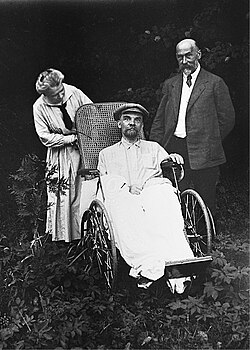
In May 1922, V.I. Lenin became seriously ill. Leading German experts in nervous diseases were called in to treat the head of the Soviet government, and the neurologist Otfried Förster was the chief attending physician of Lenin from December 1922 until his death in 1924 . On October 2, Lenin returned to work. His last public speech took place on November 20, 1922 at the plenum of the Moscow Soviet . December 12, 1922, he last worked in the Kremlin . On December 16, 1922, the state of health of the Soviet leader deteriorated again, and on May 15, 1923, due to his illness, he moved to the Gorki estate near Moscow. From March 12, 1923, daily bulletins on the health of Lenin were published. On October 18-19, 1923, he last visited Moscow.
In January 1924, Lenin's state of health suddenly experienced a sharp deterioration; January 21, 1924 he died.
Presumably, the illness of V.I. Lenin was caused by severe congestion and the consequences of the assassination attempt on August 30, 1918 . At least, the authoritative researcher of this issue, surgeon Yu. M. Lopukhin, refers to these reasons [1] . There have also been allegations of the neurovascular form of syphilis as a cause of cerebral hemorrhage: Lenin was treated with arsenic-containing drugs for the meningovascular form of syphilis. However, in the conclusion of pathologists, syphilis was not confirmed. The attending physician of the Ulyanov family, F. A. Getye , agreed with the cause of death (the cause of death was brain hemorrhage due to the use of arsenic-containing drugs against the background of atherosclerosis [2] ), while the formulation of the causes of the disease caused him objections.
Death Response
Of the Bolshevik leaders, Bukharin was a direct witness to death.
The first news of Lenin's death came at a meeting of the XI Congress of Soviets on January 21, 1924. The news was reported to the delegates by the chairman of the All-Russian Central Executive Committee, M. I. Kalinin . Frightened exclamations were heard in the hall, several people cried. The members of the Presidium, in particular, Zinoviev and Kamenev, “having dropped their heads on the table, cried like children.” On the same day, mourning was declared in the country, a Central Committee commission was organized to organize the funeral, Bolshevik leaders urgently arrived in Gorki. On January 22, Dzerzhinsky wrote an order from the OGPU “not to succumb to panic” and maintain “special vigilance”.
On January 21, a pilgrimage of peasants who came to bow to Lenin began in Gorki. Arriving at the Paveletsky train station, the funeral train was greeted by a huge crowd. According to Nina Tumarkin, up to half a million people visited the tomb of Lenin on January 23-26.
The sorrow aroused by the death of Lenin was probably partly due to other circumstances. Farewell to the deceased in Moscow and mourning ceremonies in other cities, of course, were a kind of catharsis for people who survived the tragic decade - war, revolution, civil unrest, famine and epidemics. The death of Lenin became the occasion for the first national ritual of mourning after all the ordeals of the past years. Society was swept by a wave of hysterical sorrow, fueled by open access to the body of the late leader and mourning ceremonies that were held throughout the country. The cult of Lenin, which spread throughout the cities and regions of Russia in 1924, was intended to perpetuate the people's grief over the loss that befell the country; this largely explained the success achieved by the authorities, since the evoked feelings corresponded to the actual state of mind of Soviet citizens who suffered long and painful sufferings. [3]
The Bolshevik leaders personally attended the funeral ceremony, reading a passage dedicated to the deceased. The most striking of them were the performance of Zinoviev and the famous “oath” of Stalin.
Trotsky did not appear at the funeral of Lenin, since, according to him, Stalin misled him by telling him the false date of the funeral. Richard Pipes and Ian Thatcher find Trotsky's explanations “unsatisfactory” [4] . Nina Tumarkin believes that Trotsky did not really come because he was “depressed” in connection with the death of Lenin.
Adolf Ioffe, a close associate of Trotsky, turned to Zinoviev with a proposal to replace the post of chairman of the Council of People's Commissars with a "presidium" of Kamenev, Zinoviev and Trotsky, or to appoint Trotsky as the "first candidate" [5] .
Political reports of the OGPU on the reaction of the population to the death of V.I. Lenin
Researcher Nikolai Zenkevich in his work “Leaders and Companions” quotes the OGPU archival special political report summarizing the country's reaction to the death of Lenin and the rumors that arose for the country's leadership. A common place for them was false reports of arrests by some party leaders of others. Rumors were aggravated by the fact that at the time of Lenin's death, Trotsky was sick and was being treated in Sukhumi [6] .
These rumors alleged, in particular, that Trotsky allegedly demanded that Dzerzhinsky cancel the decree on the expulsion of stock traders from Moscow, or that Trotsky was not really sick, but “wounded in the stomach” by Kalinin (another option was wounded by Zinoviev). Rumors appeared in the city of Dimitrov that the Congress of Soviets allegedly dismissed Trotsky as a Jew, in Orekhovo-Zuevsky district, rumors announced that Trotsky allegedly owned several factories.
In the Moscow province there were rumors that Lenin allegedly died six months ago, and all this time was stored frozen.
In the Nizhny Novgorod province, the mood of the workers in connection with the death of Lenin was described as depressed, the employees as indifferent. Most factories decided to deduct half-day earnings for mourning wreaths.
Among the workers of the Ivanovo-Voznesensk province, the mood is "extremely depressed."
In the Irkutsk province, rumors have been recorded that Lenin allegedly was alive and went abroad with Trotsky, and that a demonstration of the unemployed was allegedly shot in Moscow and that a Jewish pogrom had taken place . In the Tomsk province - that Trotsky and Preobrazhensky were allegedly brought to a local prison.
There were rumors in Belarus that supposedly Preobrazhensky, Sapronov and Trotsky had already been arrested, and Trotsky had a lot of values when he was arrested. The mood of the population in Belarus is described as depressed, the population expects a split at the top and a new intervention of the Poles.
In the Smolensk province, rumors reported that “Trotsky sent killers to take the place of Lenin,” he himself was arrested and fled. In this regard, merchants began to fear that “Trotsky will destroy the NEP”; in some churches, even prayers were served for "commemoration of the newly-departed servant of God Vladimir." There were rumors among the peasants that “Trotsky will be the chairman of the Council of People's Commissars instead of Lenin”, some peasants, bridging buildings with portraits of Lenin, were baptized and wished him the kingdom of heaven. On January 27, 1924, 30 thousand people gathered for a mourning demonstration in Smolensk, "there were crying people."
In February 1924, the OGPU recorded rumors in Vladivostok that a coup had supposedly taken place in Moscow, after which Trotsky fled to Turkey. In Harbin, mass production of portraits of Grand Duke Nikolai Nikolayevich, which allegedly forms an army of 250 thousand people in Serbia, began. against the Bolsheviks. In the Nizhny Novgorod province, workers massively filed applications for joining the party. Memorial services for Lenin were served in the Tver province with a large gathering of believers. In Bashkiria, the mood is heavy, the collapse of the party and a new war are expected.
On February 4, new rumors appeared in Belarus that Lenin had supposedly died three months ago, and instead a wax figure was exhibited in the Hall of Columns (option: Lenin fled to Crimea or abroad). The Polish population "greeted the death of Lenin."
The "anti-Soviet elements" sent to the city of Nikolaevsk sent Kalinin a message of condolences.
In Pskov, families of the Red Army "served a prayer service for the repose of Ilyich in churches."
In the Simbirsk province, the death of Lenin caused “deep regret” among the workers, and “regret” among the peasants.
Rumors appeared in the Tver province that Trotsky allegedly poisoned Lenin because Lenin was going to abolish taxes from peasants and merchants.
Conclusion on the cause of death
The official report on the cause of death in the autopsy report on January 22, 1924 read:
The basis of the disease of the deceased is widespread atherosclerosis of blood vessels due to premature wear (Abnutzungssclerose). Due to the narrowing of the lumen of the arteries of the brain and a violation of its nutrition from insufficient blood flow, focal softening of the brain tissue occurred, explaining all the previous symptoms of the disease (paralysis, speech disorders). The immediate cause of death was:
- increased circulatory disorders in the brain;
- soft hemorrhage in the area of the quadruple [7] .
In June 2004, an article was published in the European Journal of Neurology , the authors of which suggest that Lenin died of neurosyphilis . [8] Lenin himself did not exclude the possibility of syphilis and therefore took salvarsan , and in 1923 he still tried to be treated with drugs based on mercury and bismuth; a specialist in this field Max Nonne was invited to him. However, the guess was refuted by him. “ Absolutely nothing testified about syphilis, ” Nonne subsequently wrote [9] . As Director of the Institute of Physicochemical Medicine, Academician of the Russian Academy of Sciences Yuri Lopukhin , author of the book “Disease, Death and Embalming of V. I. Lenin” notes: “He died of atherosclerosis of the cerebral vessels,” there can be no other opinions ” [10] .
The funeral of V.I. Lenin
On January 23, in a baggage car No. 1691, the coffin with the body of Vladimir Ilyich Lenin was delivered to Moscow. All the way from the Gerasimovskaya platform (now Leninskaya ) to the Paveletsky station, this mourning train was driven by the official Lenin steam engine - U127 (Lenin was appointed as his senior engineer 8 months before his death), which was run by a locomotive crew from the Moscow depot. The brigade included: the driver Luchin, assistant driver Gavryushin and the stoker Podvoisky.
Further, the coffin was installed in the Hall of Columns, where an official farewell took place for five days and nights. On January 27, the coffin with the embalmed body of Lenin was placed in a mausoleum specially built on Red Square (architect A.V. Schusev ).
The idea of preserving the body of Lenin
The Soviet leadership was preoccupied with the fate of Lenin’s body in the event of his death while the leader was still alive: in the fall of 1923, a meeting of the Politburo (consisting of Stalin , Trotsky , Bukharin , Kalinin , Kamenev and Rykov ) was held, at which Stalin said that Lenin’s health had deteriorated, lethal was possible Exodus. In this regard, Stalin announced that there was a proposal "of some comrades from the provinces" in the event of Lenin's death to subject his body to embalming [3] . Trotsky recalled this meeting of the Politburo [11] :
When Comrade Stalin had finished his speech to the end, then it only became clear to me where these initially obscure reasonings and indications were pointing that Lenin was a Russian man and that he should be buried in Russian. In Russian, according to the canons of the Russian Orthodox Church, saints became relics. Apparently, we, the parties of revolutionary Marxism, are advised to go in the same direction - to preserve the body of Lenin. Before there were relics of Sergius of Radonezh and Seraphim of Sarov , now they want to replace them with relics of Vladimir Ilyich. I would very much like to know who these comrades are in the provinces, who, according to Stalin, suggest using modern science to embalm the remains of Lenin and create relics from them. I would tell them that they have nothing to do with the science of Marxism.
Trotsky (who, according to some sources, called this idea “madness” [12] ), Kamenev (who condemned it as “priesthood”) and Bukharin (who opposed attempts to “exalt the dust”) [3] opposed this idea. However, after the death of Lenin, none of them openly spoke out against embalming [3] .
According to Soviet historiography, the idea of not burying Lenin’s body, but preserving it and placing it in a sarcophagus arose among workers and ordinary members of the Bolshevik party, who sent numerous telegrams and letters about this to the leadership of Soviet Russia . Officially, this proposal was voiced by M. I. Kalinin .
Most post-Soviet historians believed that this idea was actually inspired by I.V. Stalin , and the roots of this idea were seen in the desire of some Bolsheviks (see God-building ) to create a new religion for the victorious proletariat. According to some historians, Stalin at that time intended to restore the historical paradigm , giving the people of the king in the person of himself and God in the person of Lenin. N. I. Bukharin wrote in a private letter: “We ... instead of icons hung the leaders, and we will try for Pakhom and the lower classes to open the relics of Ilyich under communist sauce” [12] .
There is also a point of view that the ideologist of the posthumous preservation of Lenin’s body was Leonid Krasin (he oversaw the embalming of Lenin’s body), who shared the ideas of Alexander Bogdanov about physical immortality and Nikolai Fedorov about the possibility of physical resurrection of the dead in the future [3] .
There is also a point of view that one of the reasons that prompted the country's leadership to preserve the body of Lenin was the desire to prevent the appearance of impostors impersonating Ilyich, as rumors began to spread that Lenin was trying to escape from the Kremlin and repent to the people, but was stopped guarded by the Iversky Gate and isolated in Gorki [13] .
Lenin's Body Conservation Laboratory
On February 26, 1924, a medical commission was created "to monitor the state of embalming the body of Vladimir Ilyich Lenin and to take the necessary measures in a timely manner." The issue of body conservation was discussed at meetings thirteen times [14] . The first embalming could not long preserve the body of Lenin; spring warming also prevented this. In early March, Academician Alexei Abrikosov announced the appearance of pigmentation on Lenin's body and a change in skin color - irreversible processes began. A new, thorough embalming was required. The Executive Committee, chaired by Vyacheslav Mikhailovich Molotov, decided to use low temperatures to preserve the body [15] [16] . Professor of anatomy Vladimir Vorobyov spoke out against freezing: he believed that this would only worsen the condition of the body [17] .
On March 5 and 12, 1924, two meetings were held with scientists, they were tasked with preserving the body of Lenin for as long as possible in an accessible form for viewing, in which Lenin was in the first days after his death [18] [19] .
Boris Zbarsky and Vladimir Vorobyov proposed a method of long-term embalming: Vladimir Vorobyov was engaged in the mummification of animals and birds, the mummies were kept at the department under ordinary conditions and for 15 years were preserved in excellent condition. Scientists were offered embalming [20] . To carry out the plan, the Mausoleum was again closed, and on March 26, 1924, a laboratory was built in it [21] .
Задача требовала постоянного наблюдения и круглосуточной работы. По приказу Дзержинского к Мавзолею проложили трамвайные рельсы и электрические провода, был установлен специально оборудованный вагон, чтобы учёные могли отдыхать от работы в нормальных условиях [22] .
Воробьёв использовал смесь из формалина, ацетата калия и глицерина. Процесс проходил следующим образом: на несколько дней тело Ленина обложили ватой, смоченной в формалине, после чего поместили в ванну с 3%-м раствором формальдегида. Для глубокой пропитки мышц формалином и бальзамирующим раствором на теле сделали разрезы [20] .
В апреле Воробьёв с помощью пергидроля отбеливал потемневшие участки кожи. Когда тело Ленина переложили в ванну, в неё поочерёдно добавили спирт, глицерин , а в июне добавили ацетат калия . В конце июня жидкость в ванной состояла из следующих компонентов: 240 литров глицерина, 150 литров воды и 110 килограммов ацетата калия [20] .
26 мая в 16 часов Мавзолей посетили делегаты XIII съезда партии [23] . Успехи учёных произвели на делегатов впечатление. В июне 1924 года началась работа по устройству саркофага, а Мавзолей открыли на один день для участников пятого конгресса Коминтерна . 26 июля комиссия ЦИК СССР по увековечиванию памяти Ленина признала новое бальзамирование удавшимся. Оно давало право рассчитывать на сохранение тела Ленина в течение десятилетий [24] .
Мозг Ленина в Институте Бехтерева разделили примерно на 30 000 срезов и поместили каждый между двумя стеклянными пластинами: в 1920-х годах считалось, что гениальность человека можно определить по структурным элементам мозга, для чего мозг разрезали на тончайшие срезы [25] .
Создание Мавзолея
Как хорошо, что мы решили хоронить Ильича в склепе! Как хорошо, что мы вовремя догадались это сделать! Зарыть в землю тело Ленина — это было слишком уж непереносимо
Замысел создания Мавзолея нёс в себе элементы не только христианской , но и более древней традиции — обычай бальзамирования правителей существовал в Древнем Египте , а само сооружение напоминало вавилонский зиккурат [12] .
Первый деревянный Мавзолей (проект А. В. Щусева ) был возведён ко дню похорон Владимира Ильича Ульянова (Ленина) ( 27 января 1924 ), имел форму куба , увенчанного трёхступенчатой пирамидой. Он простоял лишь до весны 1924 года.
Во втором временном деревянном Мавзолее, установленном весной 1924 года (проект А. В. Щусева), к ступенчатому объёму были пристроены с двух сторон трибуны. [27] Первоначальный проект саркофага был признан технически трудным и архитектор К. С. Мельников в течение месяца разработал и представил восемь новых вариантов. Один из них был утверждён, а затем и реализован в кратчайшие сроки под наблюдением самого автора. Этот саркофаг стоял в мавзолее вплоть до окончания Великой Отечественной войны.
Лаконичные формы второго Мавзолея были использованы при проектировании третьего , ныне существующего варианта из железобетона , с кирпичными стенами и облицовкой гранитом , с отделкой мрамором , лабрадором и малиновым кварцитом (порфиром) ( 1929 — 1930 , по проекту А. В. Щусева с коллективом авторов). Внутри здания находятся вестибюль и траурный зал, оформленный И. И. Нивинским , площадью 100 м². В 1930 году по сторонам Мавзолея были возведены новые гостевые трибуны (архитектор И. А. Француз ), оформлены могилы у Кремлёвской стены .
В период Великой Отечественной войны тело Ленина было эвакуировано из московского Мавзолея в Тюмень , где содержалось в здании нынешней Тюменской государственной сельскохозяйственной академии . Сам Мавзолей был замаскирован под особняк.
Вопрос о захоронении тела Ленина
С началом « перестройки » появились первые дискуссии о дальнейшей судьбе тела Ленина. Так, уже в мае 1989 г. режиссёр Марк Захаров , выступая в популярной тогда телепрограмме «Взгляд» , призвал перезахоронить Ленина на Волковском кладбище Ленинграда, рядом с матерью [28] .
После распада Советского Союза в 1991 году некоторыми политическими партиями и деятелями высказывалось мнение о необходимости выноса из Мавзолея и захоронении тела и мозга Ленина (мозг хранится отдельно, в Институте мозга [29] , в том числе в виде десятков тысяч гистологических препаратов ) [30] . В частности, такие идеи высказывали Анатолий Собчак и Юрий Лужков , занимавшие посты мэров Санкт-Петербурга и Москвы соответственно [28] .
Весной 1997 года президент России Борис Ельцин высказался о необходимости перезахоронения тела Ленина [31] , что вызвало неоднозначную реакцию в обществе [32] . В апреле 1997 года Государственная Дума (большинство которой составляли тогда коммунисты) приняла специальное заявление по поводу этой президентской инициативы, в котором, в частности, говорилось:
| Это заявление несостоятельно, ибо при всех конституционных полномочиях Президента Российской Федерации он не вправе это делать. Во-первых, решение о сооружении на Красной площади Мавзолея для саркофага с телом В. И. Ленина было принято высшим органом народной власти — II Всесоюзным съездом Советов 26 января 1924 года в связи с просьбой миллионов граждан — представителей рабочих, крестьян, интеллигенции России, Украины, Белоруссии, народов Закавказья и Средней Азии. Строительство усыпальницы было выражением воли народов СССР, и никто не вправе пренебречь ею. Во-вторых, Мавзолей В. И. Ленина является неотъемлемой частью уникального ансамбля Красной площади, которая решением XIV сессии Комитета всемирного наследия ЮНЕСКО, состоявшейся в Канаде в 1990 году, включена в список всемирного культурного и природного наследия и находится под охраной ЮНЕСКО. Беречь памятники истории и культуры, заботиться о сохранении исторического наследия требует от нас и статья 44 Конституции Российской Федерации [33] . |
Позже (летом 1997 г.) пресс-секретарь Ельцина Сергей Ястржембский сообщил, что на проработке в Администрации Президента находится вопрос о проведении всенародного опроса о перезахоронении тела Ленина [34] , однако такой опрос проведён впоследствии не был.
В 1999 году Ельцин вновь вернулся к идее перезахоронения Ленина, сказав в интервью газете «Известия», что по данному вопросу должна быть создана «специальная общественно-государственная комиссия» [35] .
Владимир Путин в самом начале своего первого президентского срока (в 2001 году) заявил, что считает обсуждение вопроса о перезахоронении Ленина преждевременным: «Когда я увижу, что подавляющее большинство населения хочет этого, тогда это может быть предметом дискуссии. Пока я этого не вижу — это не обсуждается», и с тех пор его позиция существенных изменений не претерпела [36] .
В конце 2012 года на встрече со своими доверенными лицами Путин, впрочем, высказался по данному вопросу более определённо и сказал, что не согласен с мнением о несоответствии Мавзолея Ленина христианской традиции: «Чего не соответствует? Поезжайте в Киево-Печерскую лавру, на Афон — там мощи можно увидеть… Коммунисты даже в этой части традиции перехватили, сделали это грамотно» [37] .
Дмитрий Медведев , будучи президентом России, не делал каких-либо публичных заявлений относительно судьбы захоронения Ленина [38] .
Высказывания о выносе тела Ленина из Мавзолея, а также о ликвидации мемориальных захоронений возле кремлёвской стены, периодически слышны и по сей день со стороны различных российских государственных деятелей, политических партий и сил, представителей религиозных организаций. Как сообщил [ when? ] пресс-секретарь Управления делами президента Российской Федерации Виктор Хреков , «этого вопроса и не было, и нет; эта тема даже не рассматривается; это вопрос не сегодняшнего поколения» [39] .
Однако в апреле 2017 года ряд депутатов от фракций ЛДПР и « Единая Россия » внесли в Госдуму проект закона о перезахоронении тела Ленина. Проект предусматривает поправки в закон «О погребении и похоронном деле» и вводит понятие «перезахоронение», которому «подлежат останки Владимира Ильича Ульянова (Ленина)». Согласно законопроекту, порядок, сроки и место перезахоронения указанных останков определяет Правительство Российской Федерации. Законопроект устанавливает необходимость погребения, не устанавливая каких-либо конкретных сроков [40] .
В пояснительной записке подчеркивается, что «само по себе тело Ленина не является ни символом эпохи, ни символом объединения нации», и приводятся данные опроса ВЦИОМ , согласно которым 60 % населения согласны с необходимостью предать земле тело Ленина — либо прямо сейчас (36 %), либо когда уйдет из жизни «поколение, для которого он дорог» (таковых 24 %) [40] .
Notes
- ↑ Лопухин Ю. М. Болезнь, смерть и бальзамирование В. И. Ленина: Правда и мифы. — М. : Республика, 1997. — С. 58—60. — ISBN 5-250-02615-X .
- ↑ Елена Кокурина. Ильич — тоже скрепа? (рус.) // Новая газета . — 2018. — № 35 . — С. 18—19 .
- ↑ 1 2 3 4 5 Нина Тумаркин. Ленин жив! Культ Ленина в Советской России / Перевод с англ. С. П. Сухарева. - SPb. : Гуманитарное агентство "Академический проект", 1997. — 285 с. — (Современная западная русистика). — ISBN 5-7331-0058-3 .
- ↑ Thatcher ID Trotskii and Lenin's Funeral, 27 January 1924: A Brief Note // History. — 2009. — С. 194—202 .
- ↑ Письмо А. А. Иоффе Г. Е. Зиновьеву 23 января 1924 г. .
- ↑ Николай Зенькович Вожди и сподвижники. Слежка. Оговоры. Травля. Приложение № 1: ИЗ ЗАКРЫТЫХ ИСТОЧНИКОВ Из специальных политсводок ОГПУ в Кремль о реагировании населения на смерть В. И. Ленина Москва, Олма-пресс, 171стр. 1998 ISBN 5-87322-705-5
- ↑ Cit. по: Лопухин Ю. М. http://leninism.su/books/132-lopukhin.html?showall=&start=2 Аутопсия. Временное бальзамирование // Болезнь, смерть и бальзамирование В. И. Ленина: Правда и мифы. — Чем же болел Ленин? (Глава II)
- ↑ Lerner V., Finkelstein Y., Witztum E. The enigma of Lenin's (1870-1924) malady (англ.) // Eur. J. Neurol. : journal. — 2004. — June ( vol. 11 , no. 6 ). — P. 371—376 . — DOI : 10.1111/j.1468-1331.2004.00839.x . — PMID 15171732 .
- ↑ Александр Грудинкин . В поисках тайны Ленина (недоступная ссылка) . Журнал « Знание — сила », 2004, № 1. Дата обращения 24 апреля 2013. Архивировано 30 апреля 2013 года.
- ↑ Российский ученый опроверг версию смерти Ленина от яда — Александр Сотов — Российская газета
- ↑ Валерий Каджая Тело и дело Архивная копия от 12 декабря 2013 на Wayback Machine Огонёк № 4 21—27 января 2008 года
- ↑ 1 2 3 Артём Кречетников. В России снова обсуждают захоронение Ленина . Русская служба Би-би-си (19 апреля 2012). Дата обращения 19 апреля 2012. Архивировано 1 июня 2012 года.
- ↑ Олег Шишикн . Красный Франкенштейн. Секретные эксперименты Кремля . — М. : Ультра.Культура , 2003. — 320 с. — ISBN 5-98042-017-7 . Архивная копия от 26 августа 2014 на Wayback Machine
- ↑ Мавзолей Ленина, 1946 , с. 27.
- ↑ Правда и вымыслы о кремлёвском некрополе и Мавзолее, 2005 , с. 62.
- ↑ Мавзолей Ленина, 1946 , с. 26.
- ↑ Объект №1, 2000 , с. 52.
- ↑ Михаил Карпов. И тело его живёт. Какие тайны скрывает мавзолей Ленина . Лента (30 ноября 2016). Дата обращения 21 марта 2018.
- ↑ Мавзолей Ленина, 1946 , с. 28.
- ↑ 1 2 3 Петр Образцов. Главное тело России . Известия (25 января 2011). Дата обращения 25 марта 2018.
- ↑ Мавзолей Ленина, 1946 , с. 34.
- ↑ Мавзолей Ленина, 1946 , с. 35.
- ↑ Мавзолей Ленина, 1946 , с. 36.
- ↑ Мавзолей Ленина, 1946 , с. 37.
- ↑ Елена Костылева. Ленин мёртв . Colta (1 июня 2015). Дата обращения 20 марта 2018.
- ↑ На средства, потраченные за семьдесят лет советской власти на увековечивание памяти вождя мирового... - Газета «ФАКТЫ и комментарии»
- ↑ М.: Архитектура-С, 2006. — C. 168.
- ↑ 1 2 Евгений Козичев. Как предлагали предать тело Ленина земле: История вопроса . « Коммерсантъ » (21 января 2011). Дата обращения 8 декабря 2013.
- ↑ В 1928 году в Москве на базе лаборатории по изучению мозга Ленина был создан Институт мозга // Календарик
- ↑ Профессор Алексей Кононский: «Мозг у Ленина стандартный по весу, но извилин в нём значительно больше, чем у обычного человека», газета «Факты и комментарии», 22 апреля 2006 г.
- ↑ Дмитрий Пинскер. Борис Ельцин намерен "освободить Красную площадь от кладбища" до 2000 года . «ИТОГИ». №32(65) (19 августа 1997). Дата обращения 8 декабря 2013.
- ↑ Сергей Баймухаметов. СТРАСТИ ПО МАВЗОЛЕЮ . Русский базар , № 24 (634). Дата обращения 8 декабря 2013.
- ↑ Постановление ГД ФС РФ от 02.04.1997 г. № 1281-II ГД «О Заявлении Государственной Думы Федерального Собрания Российской Федерации "По поводу высказываний Президента Российской Федерации Б. Н. Ельцина о перезахоронении В. И. Ленина"» . bestpravo.com. Дата обращения 8 декабря 2013.
- ↑ Матвей Полежаев. Что делать с Ильичом? . « Коммерсантъ » (19 июня 1997). Дата обращения 8 декабря 2013.
- ↑ Ельцин собирается закончить свою политическую карьеру в будущем году, хвалит Степашина и считает нужным похоронить Ленина — интервью президента "Известиям" . Полит.ру (5 июля 1999). Дата обращения 8 декабря 2013.
- ↑ Аарон Зюс. Тело Ленина — это вам не культура. Так считает министр Авдеев. . Аргументы и факты (7 мая 2009). Дата обращения 8 декабря 2013.
- ↑ Снова доверился. Владимир Путин собрал проверенную команду (рус.) // Аргументы и факты : газета. — 2012. — № 50 за 12 декабря . — С. 5 .
- ↑ Большинство россиян выступают за перезахоронение Ленина (недоступная ссылка) . Телерадиокомпания «Мир» . Дата обращения 8 декабря 2013. Архивировано 13 декабря 2013 года.
- ↑ Захоронение тела Ленина — это вопрос не сегодняшнего поколения
- ↑ 1 2 Депутаты ЛДПР и «Единой России» внесли законопроект о перезахоронении Ленина // ТАСС , 20 апреля 2017 г.
Literature
- Збарский Б. И. Мавзолей Ленина. — М: ОГИЗ Государственное издательство политической литературы, 1946. — 48 с. — 250 000 экз.
- Абрамов А. Правда и вымыслы о кремлёвском некрополе и Мавзолее. — М. : Эксмо, Алгоритм, 2005. — 320 с. - 4000 copies. — ISBN 5-699-10822-Х.
- Збарский И. Объект №1. — М. : Вагриус, 2000. — 320 с.
Links
- Александр Колесниченко, Александр Мельников Тайны последних дней. Как и от чего умер Владимир Ленин // Аргументы и факты , № 4 22 января 2014 г.
- Полная кинохроника похорон В. И. Ленина
- Каджая В. Тело и дело Огонёк № 4 21—27 января 2008 года
- День смерти Ленина.
- Смерть Ленина. Воспоминания. Публикация подготовлена научным сотрудником ЦХДМО И. Н. Ковалевой.
- Фельштинский Ю. Г. Смерть и похороны Ленина // Портреты революционеров. 1991 ISBN 5-239-01313-6
- Владимир Ленин. Кремлёвские похороны. серия −3. фильм НТВ .
- Kremlin: a history of disease. Lenin: leader and patient (1996) film 24DOK Director N. Pokrovka-Yasny 1996