Pentemyli is a beach on the northern coast of Cyprus where Turkish troops landed on July 20, 1974 and the Turkish invasion began. It is located 5 miles (8 km) west of Kyrenia [1] . For 3 days (July 20–22, 1974 ) , heavy battles were fought between Turkish and Cypriot forces behind the bridgehead on the Pentemily beach.
| Battle on Pentemili Beach | |||
|---|---|---|---|
| Main conflict: Turkish invasion of Cyprus | |||
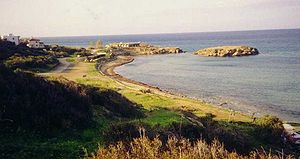 Pentemili Beach | |||
| date | July 20 - 22, 1974 | ||
| A place | Cyprus , Mediterranean | ||
| Cause | Cyprus conflict | ||
| Total | Turkey's victory, the consolidation of Turkish troops on the island | ||
| Opponents | |||
| |||
| Commanders | |||
| |||
| Forces of the parties | |||
| |||


The landing of Turkish troops on Pentemili became the starting point of Operation Attila - the invasion of Turkish armed forces into northern Cyprus in the last days of the junta of the “black colonels” in Greece . In July 1974 , with the support of the Greek junta, the President of Cyprus, Archbishop Makarios, was overthrown but survived, control of the island passed to the group of radicals headed by Nikos Sampson , a representative of the Greek underground organization EOKA-B , which declared its goal of joining Cyprus to Greece ( Enosis ) . Despite assurances of the new leadership in loyalty to the Turkish population of the island, under the pretext of restoring constitutional order, on July 20, 1974, Turkey sent its army to the island.
July 20, 1974
Landing
The Turkish military group left the port of Mersin at 11:30 on July 19 [1] . At about 05:00 on July 20, the fleet reached the northern coast of Cyprus . The Turks missed the landing point on Pentemili and found themselves on an unsuitable for landing a rocky beach at Glykiotissy, 3 km west of Kyrenia [1] . Because of this, the scheduled start of the landing began to move from 05:30 to 07:15 [1] . By 13:00, the Turkish troops were landed.
The Turkish assault force consisted of one Cakmak infantry brigade (consisting of the 50th infantry regiment (3 battalions) and a marine regiment) of 3,500 men, 12 guns, 15 M47 tanks and 20 M113 armored personnel carriers . Tanks M47 failed to land on the beach, because the narrow coastal strip did not allow transport to approach the beach. One company was also landed from helicopters on the hills south of the beach. In total, about 3,000 soldiers landed on the Pentemily bridgehead that day.
The landing took place without resistance, since there were no units of the Cyprus National Guard in this area. The target of the Turkish troops was the port city of Kyrenia , about 8 km east of Pentemili. The Turks, having carried out the landing, immediately began to expand the bridgehead.
Greek opposition to the Turkish assault force
The possibility of landing Turkish troops on Pentemili was provided for in the plan of the Cypriot National Guard "Aphroditi 1973". The implementation of this plan by order of the High Command of the National Guard began at 07:00. Closer to other units, the 251st infantry battalion of Lieutenant Colonel Pavlos Kurupis was stationed to the beach. The 1st company of this battalion took up positions opposite the Turkish positions around 09:30 [2] , while the 2nd and 3rd company were located in the Templos village of Turks . The 251st battalion supported a tank platoon of 5 T-34-85 tanks of the 23rd tank battalion based in Nicosia . The 1st Company took up positions east of the Turkish bridgehead, and a tank platoon to the south-west of the bridgehead, in the Pikro Nero area [3] .
At 10:00 the battalion received an order to attack the bridgehead. The numerical superiority of the Turks did not allow to count on serious success, but the attack, obviously, came as a surprise to the Turkish command and led to some losses. However, the Turks were able to organize a return fire and stop the further advance of the Greek Cypriots. Thus, a bridgehead was retained 300 meters deep to the south of the coast and 1-1.5 km long to the east of the landing site. Since the beginning of the shootout, several National Guard artillery batteries fired sporadic and inaccurate fire. Since these artillery units had no command, some of them did not operate at all [1] .
At around 12:00, Turkish troops attempted to advance east with the support of the BTR . The attack was repelled, two armored personnel carriers destroyed by T-34-85 tanks, but the 251st Cypriot battalion was forced to retreat somewhat eastward. On the western side of the bridgehead, Turkish troops advanced about 1 km without encountering resistance, and stopped, as the main goal remained expanding the bridgehead in the east, with a view to moving toward Kyrenia .
Mobilization of the National Guard
Two reserve battalions of Greek Cypriots were formed in Kyrenia (326th) and in Agios Georgios (306th). The 326th battalion was never mobilized, since its uniforms were stored north of Karavas - on the other side of the Turkish bridgehead [3] . The High Command of the National Guard also sent two battalions from Nicosia as reinforcements. Since the road from Nicosia to Kyrenia was under the control of the Turkish Cypriots of the Gönöli enclave, these units had to take a longer route through Panagru, west of the bridgehead. These units were combined into the 281st battalion, which was tasked with passing through the village of Panagra and, together with the 286th motorized rifle battalion, reinforced by three T-34-85 tanks, occupied the village of Karavas to the west of the Turkish bridgehead.
Both units in the area of the village of Kontemenos were attacked by the Turkish Air Force and suffered heavy losses, including 6 armored personnel carriers . The commander of the 286th battalion was wounded and subsequently died from wounds. As a result, the morale of the soldiers was undermined, and both units received orders to gain a foothold in Panagre and regroup. Towards evening, one company of the 286th battalion, including 3 tanks and a platoon equipped with recoilless guns of a M40 caliber 106 mm, was ordered to continue the offensive. The remaining parts of the 286th battalion were ordered to prepare to participate in the planned night attack [3] .
The 316th reserve battalion from Morfu (west of the bridgehead) was ordered to send two companies to Kyrenia . The soldiers, who did not know the location of the Turkish troops, were about 13:00 ambushed and suffered losses. Realizing that the road to Kyrenia was blocked, the battalion took up defensive positions. At 16:30, units of the 286th battalion arrived and united with the 316th battalion. One T-34-85 was hit by Turkish artillery fire.
At about 20:00, an officer of the headquarters of the High Command of the National Guard, Lieutenant Colonel Konstantinos Bufas, arrived in the western sector to coordinate the actions of the Cypriots .
At around 21:00, the 281st battalion, stationed in Panagre, received an order to strengthen its positions on the western flank of the bridgehead. The battalion arrived at the position at about 23:00.
The remaining fighters of the 281st battalion, 2 companies of the 316th battalion, 1 company of the 286th battalion, as well as artillery and tanks, combined into the so-called “ Bufas battle group ” were planned to be engaged in a night attack.
Night Attack
The night attack was planned around 02:30, without artillery support. At 02:15, the commander of the 316th battalion was seriously wounded by Turkish mortar fire.
The attack of the Cypriots in the west of the beachhead began only with mortar support. It was carried out mainly by the forces of the 286th battalion, which attacked the wedge-shaped fortifications of the Turks “head on”, reinforced by machine-gun fire from the BTR [3] . After overcoming the advanced Turkish fortifications and advancing 500 meters into the depths, the Cypriot attack was stopped by heavy fire from the Turkish units, which had equipped their defensive positions during the day. The 316th battalion remained in reserve. In order to avoid losses from the actions of the Turkish Air Force, on the eve of dawn Cypriots were forced to retreat to their original positions.
To the east of the bridgehead, the 1st company of the 251st battalion was ordered to attack, but under heavy Turkish fire, it soon retreated to its original positions. The arrived 306th battalion later launched its own attack, which also failed.
In the south of the bridgehead, the reserve battalion, overloaded with reservists (the turnout of reservists in Nicosia was greater than expected) - the “Panthais Battalion” (on behalf of the commander) arrived without information about the positions of the enemy. At night, at some point, moving north, the soldiers of the battalion realized that they had crossed the Turkish positions. After a shootout without serious casualties, the battalion was able to leave the Turkish ambush and take up defensive positions. The battalion lost a total of 7–10 people killed and wounded, including its commander, who was wounded in the arm. By the end of the night, many of the reservists of the battalion deserted and returned to Nicosia . The battalion disintegrated [1] [3] .
Death of Colonel Karaoglanoglu
At about 03:00, Turkish Colonel Karaoglanoglu, commander of the 50th Infantry Regiment of the Turkish Army, was killed in a building 300 meters east of Pentemi Beach. The cause of his death was officially the mortar or artillery fire of the Cypriots. However, according to the memoirs of General Bedrettin Demirel , two shells that killed the colonel were fired from a 3.5-inch M20 grenade launcher. The holes that the shells made in the building were located in such a way that Demirel suspected a violation of "fire discipline" - a friendly fire. This position is also supported by the fact that the maximum firing range of the M20 is 300 m, and judging from the side from which the shells came, the shots were fired from inside the Turkish beachhead [1] .
July 21, 1974
July 21 at the bridgehead Pentemily significant hostilities were not conducted. Turkish troops occupied some territory in the east by noon. On the southern flank, where there were no Cypriot units, the Turks advanced 500 m to the foot of the Pentadaktylos mountains, but stopped due to a major fire caused by the bombings of the Turkish Air Force.
Far away from Pentemili, in the port of Mersin , a second wave of Turkish troops was preparing to ship. It consisted of a tank company (17 tanks) of the 39th divisional tank battalion and a motorized rifle company of the 49th regiment with several M113 armored personnel carriers. The group called the Bora Task Force left Mersin at 1:30 pm on July 21, 1974 and headed for Pentemili.
July 22, 1974
Arrival of the second wave of Turkish troops
The Bora Task Force arrived on Pentemili Beach at 09:00. Major General Bedrettin Demirel , the commander of the 39th Division, appointed Brigadier General Hakki Boratas as Commander of the Task Force, while he assumed command of all Turkish forces on the bridgehead.
Upon arrival, Demirel, who knew of the signing of the cease-fire agreement from 5:00 pm, decided to immediately launch an attack on Kyrenia . He noted that the Turkish troops on the front lines were in poor condition and had low morale, however, he insisted on an immediate offensive.
The attack of the Boron Task Force, supported by the 50th Regiment, began at 11:00.
Changes on the Greek side
On the Greek side, the High Command of the National Guard recognized the inability of the 3rd tactical group responsible for the Kyrenia sector to coordinate forces and dismantle the Turkish bridgehead and transfer command to all Greek forces west and east of the bridgehead to Colonel Kobokis , commander of the Cyprus Special Forces. Kobokis received the 33rd Special Forces battalion as reinforcements, as well as a company of the 346th infantry battalion with improvised armored personnel carriers (modified tracked artillery tractors ATS-712) and a platoon with 4 artillery pieces.
Between the night attack of July 20–21 and the morning of July 22, most of the soldiers of the 306th battalion retreated to Kyrenia . At 09:00 the 33rd special forces battalion (two companies, with a total number of less than 150 people) arrived in the village of Agios Georgios, where the 306th battalion was to consolidate.
Attack on Kyrenia
At 11:00, Turkish troops launched an offensive east, toward Kyrenia . The burden of the main blow of the Turks fell on the 33rd Special Forces Battalion. After a short battle in which two Turkish tanks M47 were destroyed, at about 11.30 the Greek defense was broken through. The 33rd Special Forces Battalion was ordered to disband and re-form in Kyrenia . Parts of the 251st and 306th battalions of the Cypriots, who were on the flanks of the Turkish breakthrough, could not influence the outcome of the battle and also retreated to Kyrenia . After Kobokis appealed to the commander of the 241st battalion stationed east of Kyrenia , his units left the city and tried to organize his defense. To the left of the 241st battalion, reservists of the 306th battalion took up positions, the rest of the soldiers settled on the local football field. Three more Turkish M47s were destroyed, but in the end the position of the 241st Cypriot battalion was captured, and the commander of the 306th battalion was captured [3] . Clearing the city of the remaining Greek troops took a long time, until the morning of July 23 [3] . During the storming of Kyrenia, the commander of the Bohr Task Force, Hakki Boratas, was seriously wounded in the leg.
The Turkish commander, Major-General Demirel , leaving half of the Turkish forces in Kyrenia to further cleanse the city of Greek forces, sent the rest south towards Bogaz in order to combine the bridgehead with the Gönöli enclave. At about 5.30pm Turkish tanks united with Turkish Cypriots and Turkish paratroopers in Bogaz.
Despite the entry into force of the ceasefire agreement, fighting continued in Kyrenia and in the Pentemily bridgehead area [1] .
See also
- Operation "Attila"
- Cyprus conflict
- Annan Plan
Notes
- ↑ 1 2 3 4 5 6 7 8 Savvas D. Vlassis, O Aporritos Attilas, Athens 2004 ISBN 960-630-211-3
- ↑ Kostas Hatziantoniou, Kypros 1954–1974, Athens 2007 ISBN 978-960-426-451-3
- ↑ 1 2 3 4 5 6 7 Georgios Sergis, The Second of Cyprus: July-August 1974, Second Edition (improved), Athens 1999, ISBN 960-302-049-4