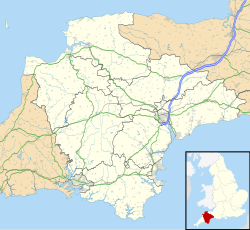
Erme ( Eng. Erme ) - a river in the south of the county of Devon , South West England . It originates in the moorlands of Dartmoor . It flows into Bigbury Bay, English Channel .
| Erm | |
|---|---|
| English Erme | |
 Erme River in Ivybridge Erme River in Ivybridge | |
| Watercourse | |
| Source | Source Erma |
| • Coordinates | |
| Mouth | English Channel |
| • Height | 0 m |
| • Coordinates | |
| Location | |
| A country |
|
| Region | England |
| Area | Devonian |



Dartmoor
Erm originates near the center of the southern ridge of Dartmoor, less than a mile south of the source of the Plym river , on the so-called The path of the Abbot [1] .
The first mile, approximately, the river flows in a southeast direction. Left tributaries: Volleyk, Dry Lake and Red Lake. Merge Erma with the Red Lake River and Erma spring are 2 of the 33 places that mark the ancient borders of the Dartmoor Forest . To the right, a short stream flows into the river, flowing along the Hortonsford-Bottom lowland from Lancom Hill.
Between the Stingers Hill and the abandoned Redlake clay masonry, the river turns south into a place called Meadow, where it crosses the longest (3320 m) menhir avenue in Dartmoor. Further, for over a mile, the banks of the river are dotted with archaeological remains.
Approaching the borders of the upland swamp, the river flows through a small canyon cut by it between Stolldown-Barrow Hill on the right bank and Piles Hill on the left. Here, on the left bank of the river, is Piles-Cops, one of the few remaining sections of the ancient forest of Dartmoor, which, moreover, is of special scientific interest .
Despite the fact that the marshy valley, from the source to Piles Cops, seems virgin today, the bottom of its channel is completely man-made and is the result of tin mining (washing of tin ore) during the IV-XIV centuries. This is evidenced by floodplain sediments dating back to the 4th-7th centuries. and XIII century. [2]
After exiting open swamps, the river flows through fenced land. In the village of Harfordreck , the first road bridge crosses. A section from Harford to the border of the national park Dartmoor, which runs along the railway between Plymouth and Exeter , is covered in forests and is popular with kayakers and kayakers.
From Ivybridge to Holbton
After exiting the national park, the river continues to flow southward, passing through the city center of Iyvibridge . Erm, whose energy the locals used to operate the milling, paper and felting mill, became here the key to prosperity. [3] In 1813, the only bridge over the river in this village (which Ivibridge was at that time) inspired William Turner to paint The Ivy Bridge .
Immediately after Ivibridge, the Devon highway crosses the river - High-speed, of primary importance class A highway, the main road between Exeter and Plymouth. Further, the river continues south through the countryside. On the west bank of the river is the village of Eirmington , famous for its church with a crooked spire [3] and an architectural monument of the 1st category Fleet House . And about a mile to the east lies the small town of Modbury . Between Modbury and Yalmpton the Crossroad Bridge with the A379 road running across it is thrown across the river , after which the river overflows overflow dam and becomes prone to tides.
In the area of this section of the river there are several apple orchards, the remains of a previously developed economy [3] .
Notes
- ↑ Legendary Dartmoor - Dartmoor's Abbot's Way
- ↑ Thorndycroft, Varyl R .; Pirrie, Duncan and Brown, Antony G. Alluvial records of medieval and prehistoric tin mining on Dartmoor, southwest England (Eng.) // Geoarchaeology. - 2004. - T. 19 , No. 3 . - S. 219-236 . - DOI : 10.1002 / gea.10114 .
- ↑ 1 2 3 South Devon AONB. Heritage, Landscape & Wildlife: The River Erme - Ivybridge to Ermington Neopr (Link not available) . Date of treatment December 18, 2013. Archived February 15, 2012.