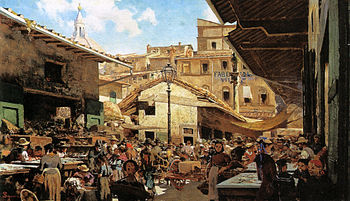
Mercato Vecchio ( Italian. Mercato Vecchio - Old Market, Bazaar) - a former square in Florence , Italy , which was demolished simultaneously with the old Jewish ghetto between 1885 and 1895 to create a new Republic Square during the redevelopment of the city in the 19th century .
Content
History
Initially, this site was the Roman Forum . Being the center of the then city, in which Roman paths “corda” and “decumanos” intersected, it was symbolically designated by a column, later replaced by the column of Affluence, which still exists today.
In the medieval era, this place, still a meeting place, acquired a commercial purpose: the city’s main bazaar was located there. Then there were two early Christian churches: Santa Maria in Campidoglio and Sant Adria. The status of the institutional market received only after 1000 .
As in other Italian cities, Mercato Vecchio, as a trading place, supplemented the Cathedral Square dedicated to religious purposes and the Political Square of Signoria .
The second market that had become necessary developed at the gates of St. Mary, where in the XIII century the Loggia del Mercato Nuovo (new market) was built. The third trading pole was erected nearby - the loggia del Grano.
The market square existed under Cosimo I Medici when he instructed Giorgio Vasari to carry out the Pesche loggia . Gradually, its space was filled with small public buildings, shops and residential buildings, which radically changed the appearance of the area, which was littered with wells , stoves , oratorios , towers , loggias , wooden dwellings. Multiple toponyms contain information about the specialization of economic activities in Mercato Vecchio: “Piazza dell'Olio” (oil), “Via dei Pellichchai” (later “Via Pellichcheria”) (fur), “Piazza del Cipolla” (onion) (today " Piazza Strozzi "), "Via delle Cheste" (baskets), "Piazza del Vino", "Piazza del Ricotta" ... In the Taverni loggia, meat was sold, while the was named so because of the nearby pipe workshop.
Reorganization
By the 1880s , journalist Giulio Piccini, published under the pseudonym of Jarro, denounced in his series of articles, then compiled in the book Underground Florence (1881), the living conditions of the poor inhabitants of this quarter - the historic center of the city. In his works there are exaggerations about the depressive state of the quarter, from which it is necessary to create in his place the “real district”. Poggi’s plan, which excluded part of the fortification wall around the city to create circular boulevards, meeting the new demands of the bourgeoisie, the police and pedestrians, also affected the territory of Mercato Vecchio.
Not to mention the speculative side of the operation (the so-called "Center Deal"), which led to the eviction of the poor classes from the historic center of the city [1] to create new residential and commercial premises, which were more important for the rich segments of the population of Florence. Many historians point out that economic reasons have become the real engine of Sventramento (demolition of buildings), which ideologically justified the requirements of public safety.
In 1881, the commune established a special fee to assess the state of the buildings and living conditions of the Mercato Vecchio district, which revealed a threatening decline of the state of the land in the area and proved the need for its reorganization. The final draft was approved on April 2, 1885 : in June, the entire population of the area was evacuated and all property was expropriated .
The works began in 1888 : then the entire northern part of the square between the Plenty column and the side of the modern cafe Gilly was demolished. However, soon the work was forced to be suspended due to the problem of preserving the loggia of the Pazhe Vasari work. However, the stunning Florentine bourgeoisie needed new beautiful buildings, and soon the demolition area was expanded and reached Strozzi Square, via de Vécchiatti, via de Pecori, via de Calzaiouoli, Signoria Square and the Porta Ross gate.
Many old architectural reminders of the past [2] were erased from the city without much hesitation: old churches, tower houses, workshops' activities [3] . The Jewish ghetto with its two synagogues [4] was also compared with the land.
Mercato Vecchio Traces
The Column of Abundance, after it had been freed from the residential buildings that had furnished it, was dismantled and rearranged. Only in 1956, the City Decoration Committee, with the support of the tourist bureau, returned the column to its original centuries-old place (or rather its copy, made by Mario Moschi, while the original Fogini was placed in the Palace of the Savings Fund of Florence).
The Loggia Pesche was also dismantled, and its remarkable architectural elements were transferred to the lapidary museum of the monastery of San Marco . In 1956, it was very qualitatively restored on Piazza Kompy near the church of Santa Croce . The chapel of Santa Maria della Tromba was reconstructed in 1905 and is now located on the corner of the Palazzo della'Arte della Lana after a lawless restoration.
In place of the medieval city quarter there is a railway track of several ruts with a total width of 12 meters, next to which large palaces, cafes, entrances to hotels with porticoes, a triumphal arch and a large square of Victor Emmanuel II (now Republic Square ) are built.
Many architectural elements can be found in the antiques market, such as those that are among the exhibits of the Bardini Museum donated to the Florentine commune by great antiquarian Stefano Bardini, who carefully collected these historical jewels. Some of the remnants of the Mercato Vecchio can be seen in the public museums of the city, in the San Marco Lapidar Museum and in the Florence Museum as it was before the closure of the last in 2010 .
In art and popular culture
- Mercato Vecchio is depicted in the paintings of the Italian artist from the group Macchiaoli Telemaco Signorini , who loved the picturesque views of this part of the city before its demolition.
- The poet Antonio Pucci immortalized Mercato Vecchio in his verse “Le proprietà di Mercato Vecchio”, where he vividly described the incomparable street life of the crowded Florentine market.
- In the Mercato Vecchio market, one of the missions of the Assassin's Creed II game takes place, whose actions develop in Italy at the end of the 15th century [5] .
See also
- Republic Square (Florence)
Notes
- ↑ During the demolition, 26 ancient roads were lost, 20 between the squares and Piazzetta, 18 narrow streets; 341 residential buildings and 451 shops were demolished; 1778 families, totaling about 5,822 people, were evicted.
- ↑ The Kaponsaki tower, the Amieri tower, the old Pilly pawnshop, the houses of the old families of the city: Medici first, Strozzi, Sassetti, Della Luna, Lamberti, Toncingi, Anselmi, Vecchietti, Tornavquinchi and others.
- ↑ Many of the headquarters of the workshops of the congregation are lost: dei Medici e Spetsiali, degli Albergatori, dei Rigattiere, degli Oljandoli e Pizcicanyoli e dei Linaioli e Starti, in which there was a chapel with a magnificent painting of Fra Angelico, which is kept today in the national museum of the monastery’s museum. -Marco.
- ↑ One Italian and one Spanish or Levantine
- ↑ Mercato Vecchio at assassinscreed.wikia.com (Eng.)
Literature
- Bargellini Piero Com'era Firenze 100 anni fa. - Florence: Bonechi editore, 1998.
- Cesati Francesco La grande guida delle strade di Firenze. - Rome: Newton Compton Editori, 2003.
- Guida d'Italia, Firenze e provincia (Guida Rossa). - Milan: dizioni Touring Club Italiano, 2007.
- Cesati Franco Le chiese di Firenze. - Rome: Newton Compton Editori, 2002.
Links
- Mercato Vecchio : Wikimedia Commons Media