The striated collar shark [1] ( lat. Parascyllium collare ) is a species of the collar shark genus of the same family of the Wobbegong -like order . It lives in the southwestern part of the Pacific Ocean at a depth of up to 160 m. The maximum recorded size is 87 cm. Propagated by egg production . It is not an object of commercial fishing [2] .
| Striped collar shark |
| Scientific classification |
|---|
| No rank : | Bilateral symmetrical |
| View: | Striped collar shark |
|
| International scientific name |
|---|
Parascyllium collare EP Ramsay & JD Ogilby , 1888 |
| Area |
|---|
|
| Security status |
|---|
Least ConcernedIUCN 3.1 Least Concern : 41841 |
|
Content
The species was first scientifically described in 1888 [3] . The holotype is an adult male, caught in 1888 off the coast of New South Wales (33 ° 51 'S 151 ° 17' E) at a depth of 128 m [4] . Species epithet comes from the word lat. collare - “necklace” [5] .
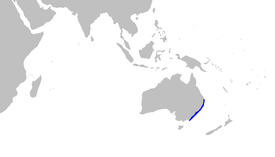
Striated collar sharks in the southwestern Pacific Ocean. They are endemic to the temperate and subtropical waters of the eastern coast of Australia ( New South Wales , Queensland and Victoria ) and are found at the bottom along the continental shelf at a depth of 20 to 160 [6] , usually between 55 and 128 m [2] .
The striated collar sharks have a thin elongated body and a short snout. The base of the first dorsal fin is located behind the free tip of the ventral fins. The mouth is located before the eyes, there are narrow nasal grooves, the nostrils are surrounded by folds. Slit-like eyes are elongated horizontally. Behind the eyes are tiny splatter . Dorsal fins of the same size, spines at their base absent. The pectoral fins are small and rounded. The anal fin is smaller than the second dorsal fin. Its base is located in front of the base of the second dorsal fin. The caudal fin is asymmetric, with an ventral notch at the edge of the upper lobe. The lower lobe is absent. Around the gill zone there is a characteristic dark “necklace”. The body, tail, and caudal fin cover 6–8 chaotic saddle marks. Large dark spots are scattered throughout the body and fins, with the exception of the pectorals. The main color is from light yellow to reddish-brown in color [2] .
Striated collar sharks breed by egg-production. Males and females reach puberty with a length of 80–85 cm and 85–87 cm [2] .
These sharks are not subject to commercial fishing. By- catch may be caught in fishing nets. Caught sharks are most likely thrown overboard. The survival rate is apparently high. There is insufficient data to evaluate the conservation status of the species by the International Union for Conservation of Nature [6] .
- ↑ Reshetnikov Yu.S. , Kotlyar A.N. , Russ T.S. , Shatunovsky M.I. The Bilingual Dictionary of Animal Names. Fish. Latin, Russian, English, German, French. / edited by Acad. V. E. Sokolova . - M .: Rus. Yaz., 1989 .-- S. 19 .-- 12,500 copies. - ISBN 5-200-00237-0 .
- ↑ 1 2 3 4 5 Compagno, Leonard JV 1. Hexanchiformes to Lamniformes // FAO species catalog. - Rome: Food and Agricultural Organization of the United Nations, 1984. - Vol. 4. Sharks of the World: An Annotated and Illustrated Catalog of Shark Species Known to Date. - P. 170–171. - ISBN 92-5-101384-5 .
- ↑ Ramsay, EP & Ogilby, JD (1888) Description of two new Australian fishes. Proceedings of the Linnean Society of New South Wales, ser. 2, 3: 1310-1312
- ↑ Parascyllium collare (neopr.) . Shark references. Date of treatment November 26, 2013.
- ↑ On-line ethymology dictionary (neopr.) . Date of treatment November 26, 2013.
- ↑ 1 2 Heupel, MR (SSG Australia & Oceania Regional Workshop, March 2003) 2003. Parascyllium collare. In: IUCN 2013. IUCN Red List of Threatened Species. Version 2013.2. <www.iucnredlist.org>. Downloaded on 26 November 2013.