Clever Geek Handbook
📜 ⬆️ ⬇️

Feather of Lessing

Lössing's feather grass [2] , feather grass [3] ( Latin Stipa lessingiana ) - a perennial herb with a dense turf ; a species of the genus Kovyl ( Stipa ) of the family Cereals ( Poaceae ).

Feather of Lessing
Stipa lessingiana habitus.jpg
General view of the plant
Scientific classification
Domain:Eukaryotes
Kingdom:Plants
Kingdom :Green plants
Department:Flowering
Grade:Monocotyledonous [1]
Order :Lilianae
Order:Melliferous
Family:Cereals
Subfamily :Bluegrass
Tribe :Feather grass
Gender:Feather grass
View:Feather of Lessing
International scientific name

Stipa lessingiana Trin. & Rupr.

Synonyms
See text
Security status
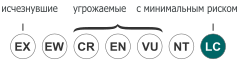
Status iucn3.1 LC ru.svg Виды под наименьшей угрозой
Least Concerned
IUCN 3.1 Least Concern : 44392778

Botanical Description

A dense perennial plant, the stems are numerous, bare, green with a grayish tint 30-70 cm tall. The inflorescence is low-spike, rare, narrow-celled. Leaf blades 0.3-0.6 mm in diameter, externally shabby, densely covered with short hairs on the inside, sheaths of the stem leaves bare. Tongues of leaves up to 0.3 mm long. The pedicel is about 2 mm long, the bracts are 8–9 mm long, of which the outer one is completely circumferential and is almost covered with hairs, and at the very top there is a corolla made of hairs. The tail is twice cranked, 12-25 cm long, the lower bare and twisted knee 3-5 cm long, the upper one is cirrus, with hairs about 3 mm long [4] . Obligatory Calcephilus. It blooms in June-July [5] .

Distribution and habitat

European-West Asian view of the steppe zone. In the Russian Federation it grows in the regions of the Central Black Earth Region, the Middle and Lower Volga Region, in the Ciscaucasia, Dagestan, in the Southern Urals, in the south of Western Siberia and Altai.

It is found outside Russia in Central and Eastern Europe, on the Balkan Peninsula, in the Crimea, in the Caucasus and Transcaucasia, in Northern Iran, Siberia, and Central Asia [6] .

Limiting factors are cattle grazing, road laying, plowing of virgin steppes, spring fall [4] .

Economic characteristics

In terms of feed , the Lessing feather grass is the best of feather grass. It is considered mainly a pasture plant, but is also used for haying. Eat well in the early spring. At this time, it contains a significant amount of protein and a small amount of fiber . It is rich in nutrients and its aftermath . At the beginning of heading, the plant's nutritional value drops, and livestock begins to eat it much worse. Horses eat better than other animals; feathers are somewhat worse than sheep; camels are good and satisfactory. Hay harvested before flowering is eaten by all types of cattle, especially horses. Hay harvested during flowering is eaten only satisfactorily and is considered average and even below average quality [3] .

Synonymy

According to The Plant List for 2010, the synonymy of the species includes [7] :

  • Stipa brauneri ( Pacz. ) Klokov
  • Stipa cyllenaea strid
  • Stipa lessingiana subsp. brauneri Pacz.
  • Stipa lessingiana var. brauneri (Pacz.) Roshev.
  • Stipa lessingiana subsp. cyllenaea (Strid) Strid
  • Stipa lessingiana var. zeberbaueri hack .
  • Stipa pennata var. lessingiana (Trin. & Rupr.) Richt.

Guard Status

In Russia

In Russia, the species is included in many Red Books of the constituent entities of the Russian Federation : Belgorod, Voronezh, Nizhny Novgorod, Omsk, Penza, Tyumen and Ulyanovsk regions, as well as the republics of Bashkortostan, Mordovia and Tatarstan, and the Altai Territory. It grows on the territory of several specially protected natural territories of Russia [8] .

In Ukraine

Included in the Red Book of Ukraine [9] .

Notes

  1. ↑ For the conventionality of indicating the class of monocotyledons as a superior taxon for the plant group described in this article, see the APG Systems section of the Monocotyledonous article .
  2. ↑ Stipa lessingiana : information on a taxon in the Plantarium project (a identifier of plants and an illustrated atlas of species). (Retrieved November 26, 2013)
  3. ↑ 1 2 Larin, Larin, 1950 , p. 259.
  4. ↑ 1 2 The Red Book view of Stipa lessingiana in the Red Book of Altai Territory (Russian) . Protected areas of Russia. Date of treatment November 25, 2013.
  5. ↑ The Red Book view of Stipa lessingiana in the Red Book of the Ulyanovsk Region (Russian) . Protected areas of Russia. Date of treatment November 25, 2013.
  6. ↑ The Red Book view of Stipa lessingiana in the Red Book of the Nizhny Novgorod Region (Russian) . Protected areas of Russia. Date of treatment November 25, 2013.
  7. ↑ Stipa lessingiana Trin. & Rupr. is an accepted name . Royal Botanic Gardens, Kew and Missouri Botanical Garden. Date of treatment November 26, 2013.
  8. ↑ Stipa lessingiana Trin. & Rupr. (Russian) . Protected areas of Russia. Date of treatment November 26, 2013.
  9. ↑ Kovil Lessing Stipa lessingiana Trin. et Rupr. (Ukrainian) . Chervona book of Ukraine. Date of treatment November 25, 2013.

Literature

  • Flora of the USSR, 1940
  • Flora of the European part of the USSR, 1974
  • Green Book of the Ukrainian SSR, 1987
  • Rare and endangered plants and animals of Ukraine, 1988.
  • Larin I.V., Larin V.K. Stipa I. - Feather grass // Forage plants for hayfields and pastures of the USSR. - 1950. - T. 1. - S. 259—262.

Links

  • Lessing's feather grass, feather grass (Russian) (inaccessible link) . Virtual herbarium of the Rostov region. Date of treatment November 26, 2013. Archived on May 17, 2011.
Source - https://ru.wikipedia.org/w/index.php?title=Lessing_Covel &oldid = 95421185


More articles:

  • Gilkoja
  • Kalm (river)
  • Yakunin, Anna Alexandrovna
  • Akimovo (Karelia)
  • Prime Number
  • Guo Ara
  • Arkoyla
  • Ignoil
  • Authentic frets
  • Hamilton, Bethany

All articles

Clever Geek | 2019