The American dwarf shrew ( Latin Sorex hoyi ) is a species from the genus of the shrew of the family Shrew , the smallest mammal in North America. A specific Latin name is given in honor of the American physician and naturalist Philip Hoy (Philip Romayne Hoy, 1816-1892) [1] .
| American dwarf shrew |
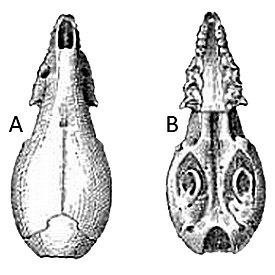
Skull of a shrew-crumb: A - top view, B - bottom view |
| Scientific classification |
|---|
| No rank : | Bilateral symmetrical |
| View: | American dwarf shrew |
|
| International scientific name |
|---|
Sorex hoyi ( Baird , 1857) |
| Area |
|---|

|
| Security status |
|---|
Least ConcernedIUCN 3.1 Least Concern : 41400 |
|
The species is common in Canada and the USA . The little shrew lives in northern coniferous and deciduous forests and open habitats.
Body length about 5 cm, including a tail 2 cm long, weight from 2 to 2.5 g. Coloring of fur is gray-brown or red-brown in color with a lighter bottom. In winter, the fur turns gray.
Active day and night throughout the year. It feeds on insects, worms and other small invertebrates. Natural enemies: hawks, owls, snakes and domestic cats.
Propagated in early summer. Pregnancy lasts 18 days. The female gives birth once a year from 3 to 8 cubs in a hole under a log or stump.