Clever Geek Handbook
📜 ⬆️ ⬇️

Common-mode and quadrature components of the signal

An example of how a phase-modulated signal ( green line ) decomposes into two components: in-phaseI(t) {\ displaystyle I (t)} I (t) and quadratureQ(t) {\ displaystyle Q (t)} Q (t) .

Common-mode and quadrature components - the result of the analog signalS(t) {\ displaystyle S (t)} S (t) in the form of a combination of real and imaginary parts [1] :

S(t)=Aone(t)cos⁡(ωt)+A2(t)sin⁡(ωt){\ displaystyle S (t) = A_ {1} (t) \ cos (\ omega t) + A_ {2} (t) \ sin (\ omega t)} {\ displaystyle S (t) = A_ {1} (t) \ cos (\ omega t) + A_ {2} (t) \ sin (\ omega t)} ,

where the first term is called the in-phase component (or I-component , from the English in-phase ) of the signalS(t) {\ displaystyle S (t)} S (t) , the second is called the quadrature component (or Q-component , from the English quadrature ) of the signalS(t) {\ displaystyle S (t)} S (t) :

I(t)=Aone(t)cos⁡(ωt){\ displaystyle I (t) = A_ {1} (t) \ cos (\ omega t)} {\ displaystyle I (t) = A_ {1} (t) \ cos (\ omega t)}
Q(t)=A2(t)sin⁡(ωt){\ displaystyle Q (t) = A_ {2} (t) \ sin (\ omega t)} {\ displaystyle Q (t) = A_ {2} (t) \ sin (\ omega t)}

Although this decomposition can be obtained for any signal, it is of most interest for narrow-band signals, that is, for signals with a small spectrum width. For such signals,Aone(t) {\ displaystyle A_ {1} (t)} {\ displaystyle A_ {1} (t)} andA2(t) {\ displaystyle A_ {2} (t)} {\ displaystyle A_ {2} (t)} change slowly compared to the signal itself [2] .

This decomposition underlies the quadrature amplitude modulation (QAM). Based on KAM, such modulations as BPSK and QPSK are created and widely used.

Harmonic

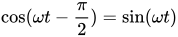
It is known that a linear combination of harmonic oscillations with the same frequency is a harmonic oscillation with the same frequency. The converse is also true: any harmonic signalS(t)=Asin⁡(ωt+φ) {\ displaystyle S (t) = A \ sin (\ omega t + \ varphi)} {\displaystyle S(t)=A\sin(\omega t+\varphi )} can be decomposed into the sum of two signals of the same frequency, but shifted in phase. It’s most convenient to take a phase shift byπ/2 {\ displaystyle \ pi / 2} \pi/2 . This means that any harmonic oscillation can be represented as the sum of two functionscos⁡(ωt) {\ displaystyle \ cos (\ omega t)} {\displaystyle \cos(\omega t)} andcos⁡(ωt-π2)=sin⁡(ωt) {\ displaystyle \ cos (\ omega t - {\ frac {\ pi} {2}}) = \ sin (\ omega t)} {\displaystyle \cos(\omega t-{\frac {\pi }{2}})=\sin(\omega t)} :

S(t)=Asin⁡(ωt+φ)=Aonesin⁡(ωt)+A2cos⁡(ωt){\ displaystyle S (t) = A \ sin (\ omega t + \ varphi) = A_ {1} \ sin (\ omega t) + A_ {2} \ cos (\ omega t)} {\displaystyle S(t)=A\sin(\omega t+\varphi )=A_{1}\sin(\omega t)+A_{2}\cos(\omega t)}

HereAone=Acos⁡(φ),A2=Asin⁡(φ) {\ displaystyle A_ {1} = A \ cos (\ varphi), A_ {2} = A \ sin (\ varphi)} {\displaystyle A_{1}=A\cos(\varphi ),A_{2}=A\sin(\varphi )} . This is similar to how a vector in a plane with polar coordinates(A,φ) {\ displaystyle (A, \ varphi)} {\displaystyle (A,\varphi )} decomposes into the sum of two vectorsAonex→+A2y→ {\ displaystyle A_ {1} {\ vec {x}} + A_ {2} {\ vec {y}}} {\displaystyle A_{1}{\vec {x}}+A_{2}{\vec {y}}} whereAone=Acos⁡(φ),A2=Asin⁡(φ) {\ displaystyle A_ {1} = A \ cos (\ varphi), A_ {2} = A \ sin (\ varphi)} {\displaystyle A_{1}=A\cos(\varphi ),A_{2}=A\sin(\varphi )} Are the Cartesian coordinates of the original vector.

Quasi-Harmonic Signal

If the signal is not a pure harmonic signal, but is quasi-harmonic , that is, a signal of the formS(t)=A(t)sin(ωt+φ(t)) {\ displaystyle S (t) = A (t) sin (\ omega t + \ varphi (t))}   where is the amplitudeA(t) {\ displaystyle A (t)}   and phaseφ(t) {\ displaystyle \ varphi (t)}   change over time, but not very fast compared to frequencyω {\ displaystyle \ omega}   then we can still decomposeS(t) {\ displaystyle S (t)}   in the same way:

S(t)=Aone(t)cos⁡(ωt)+A2(t)sin⁡(ωt){\ displaystyle S (t) = A_ {1} (t) \ cos (\ omega t) + A_ {2} (t) \ sin (\ omega t)}  

But nowAone,A2 {\ displaystyle A_ {1}, A_ {2}}   will also depend on time. This is the decomposition into in-phase and quadrature components.

Integrated Envelope

For the concept of the meaning of I / Q decomposition, it is useful to have an idea of ​​the complex envelope . Using Euler's formula , the complex signalZ(t)=A(t)cos(ωt+φ(t))+jA(t)sin(ωt+φ(t)) {\ displaystyle Z (t) = A (t) cos (\ omega t + \ varphi (t)) + jA (t) sin (\ omega t + \ varphi (t))}   wherej {\ displaystyle j}   - imaginary unit , can be represented asZ(t)=A(t)ej(ωt+φ(t)) {\ displaystyle Z (t) = A (t) e ^ {j (\ omega t + \ varphi (t))}}   , and in the case of unequal amplitudes of the sinusoidal and cosine components, we obtainZ(t)=Aone(t)cos(ωt+φ(t))+jA2(t)sin(ωt+φ(t)) {\ displaystyle Z (t) = A_ {1} (t) cos (\ omega t + \ varphi (t)) + jA_ {2} (t) sin (\ omega t + \ varphi (t))}   and thenZ(t)=Aone(t)2+A2(t)2ej(ωt+φ(t)) {\ displaystyle Z (t) = {\ sqrt {A_ {1} (t) ^ {2} + A_ {2} (t) ^ {2}}} e ^ {j (\ omega t + \ varphi (t) )}}  

Quadrature Modulation

The main application of I / Q decomposition is quadrature modulation . Radio signalS(t) {\ displaystyle S (t)}   described by such basic parameters as: amplitudeA(t) {\ displaystyle A (t)}   , the carrier frequency ω and the initial phase φ.

S(t)=A(t)sin(ωt+φ){\ displaystyle S (t) = A (t) sin (\ omega t + \ varphi)}  

Each of these parameters over time can vary within certain limits. The nature of a change in a parameter may contain information transmitted using a signal. Changing a signal parameter is called modulation . A carrier signal is also distinguished from a modulating signal (one that “overlaps” the carrier). Cosine argument is called full phaseΦ(t)=ωt+φ {\ displaystyle \ Phi (t) = \ omega t + \ varphi}   . Thus, we can say that either the amplitude can be modulatedA(t) {\ displaystyle A (t)}   ( amplitude modulation ) or full phaseΦ(t) {\ displaystyle \ Phi (t)}   ( frequency and phase modulation). The carrier frequency of the signal is constant, so when modulating, you can control only two parameters - the amplitude and phase. Based on the foregoing, the signal can be represented as

S(t)=A(t)cos(ωt+φ(t)){\ displaystyle S (t) = A (t) cos (\ omega t + \ varphi (t))}  

The basic idea of ​​quadrature modulation is that the signalS(t) {\ displaystyle S (t)}   is represented as the sum of two sinusoidal components whose phase difference is 90 ° (π / 2). The first component:I=I(t)cos(ωt) {\ displaystyle I = I (t) cos (\ omega t)}   . The second component:Q=Q(t)cos(ωt+π/2)=Q(t)sin(ωt) {\ displaystyle Q = Q (t) cos (\ omega t + \ pi / 2) = Q (t) sin (\ omega t)}   . By changing the amplitude of the I / Q components and their further summing, you can get a signal of any kind of modulation.

See also

  • Signal constellation
  • Complex amplitude
  • Quadrature modulation
  • Single band modulation

Notes

  1. ↑ Quadrature signal . / Technical Dictionary // Big Technical Encyclopedia
  2. ↑ Zyuko A.G., Klovsky D.D., Nazarov M.V., Fink L.M. Theory of signal transmission. - M .: Communication, 1980. - S. 51. - 288 p.

Literature

  • Gast, Matthew. 802.11 Wireless Networks: The Definitive Guide. - 2. - Sebastopol, CA: O'Reilly Media, 2005-05-02. - Vol. 1. - P. 284. - ISBN 0596100523 .
  • Franks, LE Signal Theory. - Englewood Cliffs, NJ: Prentice Hall, September 1969. - P. 82. - ISBN 0138100772 .
  • Steinmetz, Charles Proteus. Lectures on Electrical Engineering. - 1. - Mineola, NY: Dover Publications, 2003-02-20. - Vol. 3.- ISBN 0486495388 .
  • Steinmetz, Charles Proteus (1917). Theory and Calculations of Electrical Apparatus 6 (1 ed.). New York: McGraw-Hill Book Company. B004G3ZGTM .
  • Wade, Graham. Signal Coding and Processing. - 2. - Cambridge University Press, 1994-09-30. - Vol. 1. - P. 10. - ISBN 0521412307 .
  • Naidu, Prabhakar S. Modern Digital Signal Processing: An Introduction. - Pangbourne RG8 8UT, UK: Alpha Science Intl Ltd, November 2003. - P. 29–31. - ISBN 1842651331 .

Links

  • I / Q Data for Dummies
  • What is I / Q Data? (eng.)
Source - https://ru.wikipedia.org/w/index.php?title=Synphase_and_square_components of a signal&oldid = 100288782


More articles:

  • Zheran
  • Murray Feg
  • Universal Theater (Lodz)
  • Barsina, Yolanda
  • Russian Snowboard Championship 2013
  • Esquiva d'Ibelin (1253-1312)
  • DandyDiana
  • South Asian Games 2004
  • Sadykov, Turgunbai Sadykovich
  • Ryujoji (genus)

All articles

Clever Geek | 2019