Carnival in French Guiana ( French: Carnaval de Guyane ) is a costume festival held annually in the communes of Cayenne , Kourou and Saint Laurent du Maroni , in French Guiana , the overseas department of France . The feast lasts from the Epiphany in early January to the week of Ash Wednesday in late February - early March. On the last day of the carnival - Fat Sunday, followed by a forty-day post before Easter , the main celebrations are held. Carnival is a tourist attraction of French Guiana.
| Carnival in French Guiana Carnaval de guyane | |
|---|---|
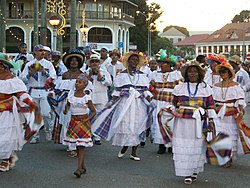 Cayenne Carnival in 2007 | |
| Type of | ethnic, historical |
| Installed | in 1848 after the abolition of slavery |
| Since | beginning of January |
| By | early March |
| Celebration | family parade |
| Traditions | cooking biscuit cake |
Content
The origin of the holiday
Carnival in French Guiana was born among local creoles and maroons. Already the first colonists laid down the local tradition of holding a carnival before the beginning of Lent, as was customary in Europe. Only free residents of the colony could participate in it. Contrary to the ban, the slaves at the same time secretly staged their carnivals, which absorbed elements of the African cult of fertility. During these meetings, they ridiculed their masters. [one]
The festival gained its true scope only after the abolition of slavery in 1848. Nowadays, not only creoles and maroons participate in the carnival, but also local Brazilians and Chinese.
Festive events are held between the Epiphany festival in early January and Ash Wednesday, in February or early March. The end of the holiday lasts from Friday evening to Monday morning. The main carnival procession takes place on Fat Sunday, when the communities compete among themselves in whose procession was more solemn and brighter.
Masquerade
At the carnival in French Guiana, the participation of traditional characters, combining the features of Christian and African cultures, is mandatory. The main character of the carnival is King Waval, who is born at the beginning of the festival and dies at the end of the carnival to be reborn next year. Burning his stuffed animals is the culmination of the whole holiday.
Other popular carnival masks are: Tululu (Tololo) - an elegantly dressed lady whose entire body is hidden under a cloth (skirt, balaclava, mask and long gloves) - the prototype of a noble lady of the XVIII century; Negmarons - groups of people covered in soot and oil - prototype runaway slaves; Same Faren - a man dressed in all white (trousers, a shirt, a pointed hat and a mask), children laugh at him, for which he sprinkles them with flour - a prototype baker; Bobi - a character in a suit of ragged potato bags - a prototype of a bear; Carolen - a lady in gold clothes and jewelry with her husband, who wears on his back - a prototype of a jealous wife; Lamno - a character in a suit of white fabric, covering the wearer from head to toe - the prototype is death; Susuri - a character in a suit of black fabric, harboring a character from head to toe - a prototype of evil; Dyab Rouge - red devil.
Each stage of the carnival has its own colors (from red to black and white) and is associated with a historical or religious event in the history of French Guiana. Every Sunday, parades take place along the streets of Cayenne, Courou and Saint Laurent du Maroni. These are preparatory processions during which groups demonstrate their capabilities before a large parade. The most famous groups are: Cassialata, Kemit, Calagiru, Piraeus, Renault Ban, Shire Ban, Os Ban, Le Bel de La Madeleine, Juneo City, Walled, Mayuri Tho Nyeg, Patava Folia. Communities of local Brazilians and Chinese are represented by traditional costumes characteristic of their national carnivals. During the carnival, “dance universities of Tululu” operate, open in the evenings from Thursday to Saturday. [2]
Orchestras also demonstrate their skills in parades. At the same time, some performers become popularly known, for example, as Victor Klet, nicknamed Keket, the soloist of the blues stars orchestra ( French Les Blues Stars ), whose photograph fell on a bottle of Saint-Maurice rum during the carnival in 2006. [3] At the end of the carnival, the two most popular orchestras hold a musical duel in the Grand Blanc hall.
Traditions
During the carnival, families get together to eat cake-biscuits. This cake is traditionally prepared in Europe during the Epiphany. In French Guiana, it is cooked throughout the carnival and seasoned with almond , guava or coconut cream.
Gallery
Notes
- ↑ Carnaval de Guyane. Le carnaval le plus long du monde (French) . Imagesplus.fr.
- ↑ Qu'en pensez vous? Les bals de tololos. (Fr.) . Portal of the city of Saint Laurent du Maroni.
- ↑ Victor "Quéquette" Clet (Fr.) . Africultures.com.
Links
- Le Carnaval de Cayenne . Ville-cayenne.fr. - Carnival in Cayenne. (fr.)
- Comité du Tourisme de la Guyane - France . Tourisme-guyane.com. - Committee on Tourism in French Guiana. (fr.)