The Battle of Tierzen is the battle of the Livonian War , held on January 17, 1559 . The advanced regiment of the Russian army, led by commander Vasily Serebryanny-Obolensky, defeated a large detachment of the Livonian Order , headed by knight Friedrich von Voelkerszam . The winter campaign of the Russian army was called up by the perfidious (in violation of the truce) Livonian siege of the Ringen fortress in September-October 1558 , as a result of which the Russian garrison capitulated was captured and exterminated in violation of the honest words of the Livonians. In the battle of Tirzene (now the village of Tirza in northeastern Latvia ), 400 knights fell, including the Volkers. Much of the Livonian army captured. After this victory, the Russian army raided the lands of the Livonian Order all the way to Riga , where the Livonian fleet was able to burn. In February, the army returned to the Russian state with a huge booty and a large number of prisoners.
| Battle of Thirzen |
|---|
| Main conflict: Livonian war |
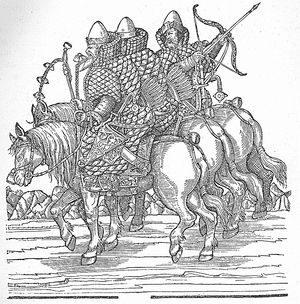
Russian horsemen. German engraving from 1557 |
| date | January 17, 1559 |
|---|
| A place | Tirzen, now Tirza |
|---|
| Total | The decisive victory of the Russian troops |
|---|
|
 Livonian Confederation Livonian Confederation
|  Russian kingdom Russian kingdom
|
|
|
Friedrich von Völkersz † | Vasily Silver-Obolensky |
|
|
4.5 thousand [1] | 2.5 thousand [1] |
|
|
400 killed knights
500 prisoners [1] | unknown |
|
|
The devastation of Livonia after the battle of Tirzene demonstrated the inability of the Livonian Order to resist the Russian state. As a result, Master Gothard Kettler signed the Vilna Treaty with the Polish-Lithuanian monarch Sigismund II , by which he recognized the protectorate of the latter. The treaty served as the basis for the entry of the Grand Duchy of Lithuania into the war.

