The capture of Cayenne was a battle during the Napoleonic wars , which took place on January 7-14, 1809 between the Portuguese-British and French armies, the result of which was the occupation of French Guiana by the Portuguese until November 8, 1817. [one]
| Taking cayenne | |||
|---|---|---|---|
| Main conflict: Napoleonic Wars | |||
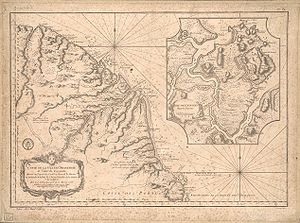 Coastline of French Guiana in 1763 | |||
| date | January 7 - 14, 1809 | ||
| A place | Cayenne , French Guiana | ||
| Total | victory of Portugal and the UK | ||
| Changes | occupation of French Guiana by the Portuguese Empire | ||
| Opponents | |||
| |||
| Commanders | |||
| |||
| Forces of the parties | |||
| |||
| Losses | |||
| |||


Background
During the Napoleonic wars, the colonial possessions of the French Empire in the Caribbean region were attacked by the naval forces of Great Britain . At the same time, the naval forces of the French Empire attacked the ships of the British merchant fleet, thus trying to divert the enemy’s navy to their guard. The British naval forces blocked the fleet of the French empire in its own harbors and interrupted trade relations between the metropolis and the colonies, which caused a shortage of recent food. In the summer of 1808, the governors of the local colonies of the French Empire requested urgent assistance from the metropolis.
Some of these messages were intercepted by UK patrols. Upon learning of the catastrophic situation in the French colonies, the British decided to conduct a series of amphibious operations to capture them, in order to eliminate the presence of France in the Caribbean region. The command of the campaign was entrusted to Rear Admiral Alexander Cochrane , who concentrated all his efforts on the seizure of the island of Martinique . To this end, he prepared the army and navy in Barbados . The main forces of the British focused on the occupation of the French colonies among the Leeward Islands. The remaining forces were thrown by them to invade other enemy colonies in the region.
The frigate " Confident " ( born Confiance ) under the command of Captain James Lucas Yeh was sent to the northern coast of South America. [2] Realizing that a single ship was not enough to invade French Guiana, the British tried to conclude an agreement with the Portuguese about joint actions against the French. Negotiations led Rear Admiral Sydney Smith . The Portuguese empire wanted to redefine the border between Brazil and French Guiana, and agreed to cooperate with Great Britain, providing for its part a squadron consisting of the battleship Infant Don Pedro , the brigade " Swift ", the schooner "General Magellan" and the cutters " Revenge And the lion . 700 soldiers of the Brazilian colonial army were under the command of Lieutenant General Manuel Marquez ; Marines commanded by Luis Moreira da Cunha . The command of the entire operation was assigned to Captain James Lucas Ye, who arrived in Belen in early December 1808.
Battle Course
The first battle took place on December 15, 1808 on the banks of the Apruage River, which resulted in the arrest of two French ships. On January 6, 1809, the Portuguese-British forces launched an operation to capture Cayenne. Already on January 7, at three o'clock in the morning on five canoes, despite the heavy rain that lasted throughout the operation, the Portuguese-British landing force landed on the banks of the Mayuri River on the Ile de Cayenne. Marines attacked Fort Degra de Cannes . Having captured him, they moved to Fort Dyaman , which was soon also captured. During this battle, 7 people were injured by the Portuguese and British, 6 people were killed and 4 injured by the French, 90 people surrendered. The Portuguese and the British captured four guns. A garrison was stationed in the captured forts and landed from the squadron ships.
Fearing the blockade of Kayena, Victor South, the governor of French Guiana, attacked enemy positions with 600 soldiers. James Lucas Ye took down Fort Dyaman and concentrated the main forces in Fort Degra de Cannes. He sent down the river scouts who discovered two more forts - the Trio and the Canal de Torcy. The last fort defended the approaches to the residence of the governor, located on the channel. James Lucas Ye, using the “Revenge” and “Lion” cutters, decided to immediately attack these forts. He himself led the attack and captured the Trio fort. Both forts were captured, and their garrisons retreated.
In the meantime, the three-hour attack by the French on Fort Degra de Cannes failed. The governor strengthened his residence with the help of 100 soldiers and 2 artillery guns. He refused to conclude a truce. Repulsing the attacks of the Portuguese and the British, Victor South managed to ambush them in a grove near his residence. At a signal from one of the artillery guns, the French opened fire from ambush at the advancing enemy. James Lucas Ye led an ambush attack and captured the residence of the governor in hand-to-hand combat. Gathering his strength, he moved to Cayenne, preparing for a decisive battle on the plain of Beauregard, where Victor Yug established fortifications with the 400 soldiers and policemen who remained with him.
Arriving at the position of January 10, 1809, James Lucas Ye sent two junior officers to Cayenne, again offering a truce, which this time was accepted by the French. The capitulation lasted for the next four days. The Portuguese and British forces entered Cayenne on January 14, 1809. [3]
Summary
The losses of the French were very tangible. 16 people were killed, 20 injured. 400 regular army soldiers, 600 European policemen and 200 black militias surrendered. They were all allowed to return to their homes. The French lost 200 cannons, all military and state arsenals, settlements and trading posts in French Guiana, whose territory stretched from the border with Brazil to the river Maroni .
The losses of the British and the Portuguese were light: the British lost one lieutenant killed, 23 people were injured; the Portuguese lost 1 person killed, 8 were injured.
French Guiana was occupied by the Portuguese Empire. The command of James Lucas Ye was highly praised, but in December of that year for health reasons he was demobilized in Rio de Janeiro. Upon returning to active service, James Lucas Ye was awarded the diamond ring by the Prince Regent of Brazil and knighted by the Portuguese and British crowns. Subsequently, he was appointed commander of the frigate " Southampton ". In 1849, a medal was instituted in Great Britain in memory of the capture of Cayenne in 1809, which was awarded to all participants of the operation who lived at that time. [four]
Notes
- Royal Royal Navy and Royal Marines from 1512 to 1891 (English) . The Royal Naval Exhibition 1891 Official Catalog and Guide . Minotaur.org.
- ↑ Royal Garrison Church. - Captain Sir JL Yeo. (English) (inaccessible link) . Memorials and monuments in Portsmouth. Archived November 11, 2013.
- ↑ On January 13, 1809, that is, one day before the final surrender of the French, the frigate Topaz , sent from France with provisions and weapons, arrived in the port of Cayenne. James Lucas Yeh, realizing that in the event of a battle, the advantage would be on the side of the enemy, he managed with cunning to make the French believe in the opposite. The frigate "Topaz" retreated without giving a fight.
- ↑ The London Gazette (English) . London-gazette.co.uk.
Sources
Literature
- William James, Frederick Chamier. Accession of George IV . - London: R. Bentley, 1837.
- England's historical diary and imperial class book, by a student of Christ's hospital . - London: Cowie, 1827.
Links
- Medal commemorating the capture of the Cayenne, 1809 . collections.rmg.co.uk. - Medal for taking Cayenne in 1809. (eng.)