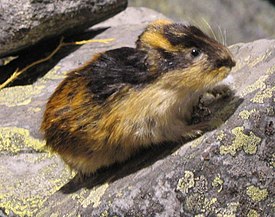
Norwegian lemmings [1] ( lat. Lemmus lemmus ) is a species of the genus of real lemmings of the vole subfamily.
| Norwegian Lemming |
 |
| Scientific classification |
|---|
| No rank : | Bilateral symmetrical |
| Squadron : | Euarchontoglires |
|
| International scientific name |
|---|
Lemmus lemmus ( Linnaeus , 1758 ) |
| Synonyms |
|---|
- Cuniculus iterator gistel, 1850
- Lemmus borealis Nilsson, 1820
- Lemmus norvegicus Desmarest, 1822
|
| Area |
|---|

|
| Security status |
|---|
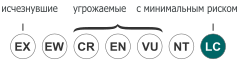
Least ConcernedIUCN 3.1 Least Concern : 11481 |
|
Content
Endemic to Norway, western and northern Sweden, northern Finland and the Kola Peninsula (Russia). Found on some islands. The southern border of the range is not stable due to large migrations occurring from time to time. It lives in various alpine and subarctic places of residence, including peat bogs, wastelands of dwarf shrubs, as well as slopes and ridges with rare vegetation. During mass breeding, it can be found in forests, agricultural land, as well as in frozen lakes.
Body length up to 15.5 cm, tail 1.0–1.9 cm long, weight up to 130 g. The fur is dyed on top of a gray-brown color, a black line passes from the head to the middle of the back. The throat and chest are black-brown, the bottom is yellowish-gray.
Adults feed mainly on sedge, herbs, and moss. Active both day and night, alternating rest time with periods of activity. It has a three to four year cycle of population change, in which the population periodically rises to an unacceptable level, which leads to high mortality among animals, and then to a sharp and large reduction in the population. Spends the winter in nests under the snow.
They reach puberty in less than a month after birth and multiply year round, if conditions are favorable, each offspring contains from six to eight cubs, pregnancy lasts about twenty days. Young lemmings scatter in different directions in search of free territory.
- ↑ Sokolov V.E. The pagan dictionary of animal names. Mammals Latin, Russian, English, German, French. / edited by Acad. V. E. Sokolova. - M .: Rus. lang., 1984. - S. 160. - 10,000 copies.
- Ronald M. Nowak: Walker's Mammals of the World. Johns Hopkins University Press, 1999
- Wilson DE & Reeder DM (eds). Mammal Species of the World . - 3rd ed. - , 2005. - Vol. 1. - P. 743. - ISBN 0-8018-8221-4 . OCLC 62265494 .