Tubifera ( lat. Tubifera , = Tubulifera ) is a genus of living organisms from the class of myxomycetes (plasmodial mucus) . Species of the genus are distributed mainly in forest ecosystems; observed on dead wood and leaf litter. They live in the temperate, tropical and equatorial zones, found on all continents except Antarctica. Sporings of the Tubifer genus differ in rather large sizes (0.5-5 cm), and are clearly visible to the naked eye, especially in the young state, when they have a bright pink, flesh or cream color [1] [2] . In the English language, the popular name “mullbery slime mold” is known - “raspberry slime” [3] .
| Tubifer |
|---|
|
|
|
|
Tubifera JFGmel. |
|
- Tubifera applanata
- Tubifera casparyii
- Tubifera corymbosa
- Tubifera dictyoderma
- Tubifera dimorphotheca
- Tubifera dudkae
- Tubifera ferruginosa
- Tubifera magna
- Tubifera microsperma
- Tubifera montana
- Tubifera papillata
- Tubifera pseudomicrosperma
|
|
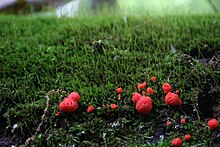
The immature sporulation of Tubifera ferruginosa
Like other myxomycetes, tubifers have a complex life cycle. Spores germinate with the release of amoeboid cells , which develop with the formation of multinucleated plasmodium . Upon reaching a critical mass, plasmodium is transformed into a fruiting body - a sporophore [2] .
Sporophores are pseudoethelia formed primarily by cylindrical spotlights ; cushion-shaped, hemispherical, open. Hypothallus is spongy, white, yellowish or brown, may form a cylindrical pedicle. Individual sporothecs are cylindrical, less often spherical or labyrinth-shaped, arranged in the form of one or several layers, in the section round or polygonal from mutual compression; the tops of the sporoticles are rounded, club-shaped, conical or flat. The peridium is membranous, elastic, shiny or matte, sometimes slightly iridiating; irregular opening, mainly in the upper part. The pseudo - columella is absent or present, conical or cylindrical, sometimes fused with the apex of the sporeca; may form lateral branches. Pseudocapillitis is absent, less often it has the appearance of filmy strands between the perforated sections of the peridium. The spores in the mass are rusty-brown, less often ocher-brown, copper-brown; ornamented with a mesh, occasionally with warts or crests, often with a pale area. Plasmodium and young sporocarps - various shades of pink, when ripe - chestnut-brown or black [1] [2] .
Species of the genus Tubifer are widespread in forest ecosystems around the globe. They are common in coniferous and deciduous forests of the temperate zone of the Northern Hemisphere (USA, Canada, Russia), are noted in Western Europe, India, China, Central and South America, Australia [1] (inaccessible link) .
The most famous polymorphic species is T. ferruginosa , which is ubiquitous in the forests of the Northern Hemisphere. T. applanata is described from temperate latitudes of Eurasia. The species T. dimorphotheca and T. bombarda are found in the equatorial zone and the Southern Hemisphere [1] .
Currently, the genus includes 12 species, including: [1]
- Tubifera applanata [4]
- (Tubifera bombarda ) - the modern name of Alwisia bombarda [5]
- Tubifera casparyii
- Tubifera corymbosa [6]
- Tubifera dictyoderma
- Tubifera dimorphotheca
- Tubifera dudkae [6]
- Tubifera ferruginosa
- Tubifera magna [6]
- Tubifera microsperma
- Tubifera montana [6]
- Tubifera papillata
- Tubifera pseudomicrosperma [6]
- ↑ 1 2 3 Nannenga-Bremekamp NE A Guide to Temperate Myxomycota. - Bristol: Biopress Ltd, 1991 .-- 410 p.
- ↑ 1 2 3 Glushchenko V.I., Leontiev D.V., Akulov A.Yu. Slugs. - Kharkov: KhNU, 2001 .-- 135 p.
- ↑ Stempen H., Stephenson LS Myxomycetes. A Handbook of Slime Molds. - Portland: Timber Press Ltd, 1994 .-- 183 p.
- ↑ DV Leontyev, KA Fefelov. Nomenclatural status and morphological notes on Tubifera applanata sp. nov. (Myxomycetes) // Mycotaxon. - 2012-09-28. - T. 120 , no. 1 . - S. 247-251 . - DOI : 10.5248 / 120.247 .
- ↑ Dmitry V. Leontyev, Martin Schnittler, Gabriel Moreno, Steven L. Stephenson, David W. Mitchell. The genus Alwisia (Myxomycetes) revalidated, with two species new to science (English) // Mycologia. - 2014-09-01. - Vol. 106 , iss. 5 . - P. 936-948 . - ISSN 0027-5514 . - DOI : 10.3852 / 13-314 .
- ↑ 1 2 3 4 5 Dmitry V. Leontyev, Martin Schnittler, Steven L. Stephenson. A critical revision of the Tubifera ferruginosa complex (English) // Mycologia. - 2015-09-01. - Vol. 107 , iss. 5 . - P. 959-985 . - ISSN 0027-5514 . - DOI : 10.3852 / 14-271 .
- Neubert H., Nowotny W., Baumann K., Marx H. Die Myxomyceten Deutschlands und des angrenzenden Alpenraumes unter besonderer Berücksichtigung Österreichs. Bd. 1-3, Karlheinz Baumann Verlag, Gomaringen, 1993-2000.
- George W. Martin, Constantine John Alexopoulos, Marie Leonore Farr: The genera of Myxomycetes, Iowa City, 1983, ISBN 0-87745-124-9
- Henry Stempen, Steven L. Stevenson. Myxomycetes. A Handbook of Slime Molds. Timber Press, 1994, ISBN 0-88192-439-3 .
