The Canary of Ajud ( Cancioneiro da Ajuda ) is the oldest of the three main surviving medieval collections of secular cantiges in the Galician-Portuguese language of the late 13th century [1] . The name of the songbook comes from its place of storage - the library of the palace of Ajuda ( Palácio Nacional da Ajuda ) in Lisbon .
| Ajud's Songbook | |
|---|---|
| Cancioneiro da ajuda | |
| “Song of Ajud”, “Ajudian canconeiro” | |
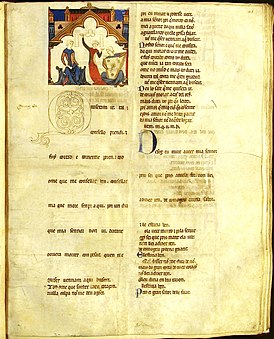 Folio 16. Cantiga A 64 - Quisera-m'ir - tal conselho prendi, .. | |
| Authors | anonymous |
| Date of writing | end of the 13th century |
| Original language | Galician-Portuguese |
| A country | |
| Describes | XII — XIII century |
| Genre | cantig compilation |
| Content | love songs of Galician-Portuguese troubadours and jugglers |
| Closely related | Cancioneiro da Vaticana , Cancioneiro da Biblioteca Nacional |
| Original |  Ajud Palace - manuscript storage place |
This collection, along with the “ Songbook of the National Library ” ( Cancioneiro da Biblioteca Nacional or “Kolochchi-Brankuti”) and “The Songbook of the Vatican” ( Cancioneiro da Vaticana ) is one of the main sources of secular cantigas of the troubadours of the Iberian Peninsula . On the one hand, the collection is of value as a manuscript of the 13th century, on the other hand, as a literary monument of the first and common literary movement for the Iberian kingdoms in the new Romance language , which became the lyrics in the Galician-Portuguese language. At the same time, poetry in the Provencal language dominated in the eastern part of the peninsula.
Content
- 1 Description
- 2 Authors
- 3 Editions
- 4 See also
- 5 notes
- 6 Literature
- 7 References
Description
The manuscript of the collection was found at the beginning of the 19th century in Lisbon. The songbook was first published partially in 1823 in Paris by British diplomat Charles Stewart with a circulation of 25 copies. The second edition was published in 1849 . Until now, the fundamental critical edition in 2 volumes of Carolina by Michaelis de Vascocelos ( Carolina Michaëlis de Vasconcelos , 1851-1925), published in 1904, is considered classical.
The manuscript resembles the collection of paralurgic Cantigas of St. Mary ( Cantigas de Santa Maria ), compiled at the court of the Castilian king Alfonso X. However, unlike the Alfonsin codes, the “Song of Ajud” does not contain a notation . Songs recorded on parchment in Gothic type [2] . Work on the manuscript has not been completed, since it contains blank sheets and unfilled spaces for notation. Thus, all the songs in the collection are presented without notation . The illumination and ornamentation of the manuscript is not completely completed.
For the abbreviated designation of the cantiga of the collection, the letter “A” (from Ajuda ) with its serial number, or “CA”, is used. For example: Cantiga da Ribeiriña ( No mundo nom me sei parelha - Cancioneiro da Ajuda, A 38).
All the cantiges of the collection are examples of courtesan poetry , were written under the influence of the work of the Provencal troubadours and were created before the reign of King Dinish I. The collection contains mainly songs about love ( cantigas de amor ). Of the total of 310 cantigas, the manuscript contains 295 songs about love, 4 songs of mockery and slander [3] and 11 cantiges of an indefinite genre [4] [5] . The manuscript does not contain sections of other main genres of Galician-Portuguese troubadour lyrics: cantig about a friend ( cantigas de amigo ) and cantig of ridicule and slander ( cantigas de escárnio e maldizer ). This fact served as the basis for the hypothesis of Carolina Michaelis de Vashkoselush that the “Song of Ajud” was part of a more complete unexploited general collection of cantigons ( Cancioneiro Geral galaico-português ). The Italian medievalist Giuseppe Tavani ( Giuseppe Tavani ) conducted a comparative analysis of the three main songbooks (CA, CB, CV) [6] and suggested that the surviving “Song of Ajud” was part of a copy of an earlier collection containing songs of all three main genres of secular cantig. In any case, the hypothesis that CA served as the original for CB and CV collections cannot be taken into account if only because in the last two there are no 64 cantigs from “Ajud's Songbook”.
Authors
All 38 songwriter authors in the manuscript were presented anonymously. Their names were restored from similar works preserved in the “Songbook of the National Library of Portugal” and the “Vatican Songbook”. The names of 5 authors cannot be precisely determined. In addition, the authorship of 7 cantigs is controversial [7] . From 38 authors of “Ajud's Songbook”:
- Galician - 13 (of which the nationality of 2 authors is not exactly clarified)
- Italians - 1
- Castilians - 3
- Portuguese - 16 (of which the nationality of 2 authors is not exactly clarified)
- Unknown nationality of 2 authors
- Anonymous - 3.
- Italians - 1
- Galician - 13 (of which the nationality of 2 authors is not exactly clarified)
The author’s only name was recorded by the auditor and addressed to the corrector when compiling the anthology . This barely distinguishable litter was made next to the initial of the first cantiga stanza about love Meus ollos gran cuita damor (A 39). In 2004, the Portuguese paleographer Suzana Tavares Pedro ( Pedro, Susana Tavares ) first drew the attention of researchers to this record, deciphering it as the name of the Galician troubadour or segrelo Pero da Ponte : p̊ dapõnt - Pero da Ponte [8] . Currently, the correctness of this reading is shared by other specialists [9] [10] . Perhaps the auditor drew the attention of the corrector to the fact that the first cantigue stanza was written under the heading of the Galician troubadour Pai Soares de Taveiros , although its author was most likely Pero da Ponte. For this reason, the recording of the full text of the song was interrupted, and the question of its authorship is still open. In the “Songbook of the National Library” and in the “Songbook of the Vatican” this cantiga is absent, only a fragment of it is preserved in the “Songbook of Ajud”.
Describing the work of researchers, Vashconselush noted that in 1858, Brazilian researcher Francisco Adolfo de Varnhagen compared the text of the manuscript with a copy of the Vatican Songbook and determined that the authorship of 8 cantiges of love from the Song of Ajud (228, 229 , 230, 231, 232, 233, 234, 240) belongs to the Portuguese troubadour Juan García de Guillade [11] . But so far it has become clear that the cantiga A 240 is not written by Guillade.
Of the authors of the songbook, Italian troubadour Bonifaci Calvo ( Bonifaci Calvo ), referred to in the collections of Bonifacius from Genoa ( Bonifaz de Génova ), cannot but attract attention. In the Songwriter of Ajud, his 2 love songs are recorded in the Galician-Portuguese language. His 19 songs in Provencal have been preserved. In one song ( Un nou sirventes ses tardar / voill al rei de Castela far ), the troubadour appears as a polyglot: the text is written in Provencal, Galician-Portuguese and French [12] . This essay by Boniface Kalvo is not included in the “Song of Ajud”.
Editions
- Fragmentos de hum Cancioneiro inedito, que se acha na livraria do Real Collegio dos Nobres de Lisboa / Charles Stuart de Rothesay . - Paris: Paço de Sua Magestade Britanica, 1823. Impresso à custa de Carlos Stuart [Lord Stuart de Rothesay].
- Cancioneiro da Ajuda. Edição crítica e comentada (port) / Carolina Michaëlis de Vasconcelos . - Halle : Max Niemeyer, 1904. - Vol. one.
- Cancioneiro da Ajuda. A Diplomatic Edition: [ port ] / Henry H. Carter. - New York-London: Modern Language Association of America-Oxford University Press, 1941. - Vol. 1. Reprint, New York, Kraus Reprint Co., 1975. Lisboa. Imprensa Nacional - Casa da Moeda. 2007.
- Fragmento do Nobiliário do Conde Dom Pedro. Cancioneiro da Ajuda. Edição fac-similada do códice existente na Biblioteca da Ajuda, apresentação de MC de Matos, NS Pinheiro e FG Cunha Leão; estudos de JV de Pina Martins, MA Ramos e FG Cunha Leão. Lisboa. Edições Távola Redonda, Instituto Português do Património Arquitectónico e Arqueológico, Biblioteca da Ajuda. 1994.
See also
- National Library Songbook
- Vatican Songbook
Notes
- ↑ Cancioneiro da Ajuda. In Infopédia. Porto: Porto Editora, 2003—2013
- ↑ Cancioneiro da Ajuda Manuscript of the Songwriter of Ajuda
- ↑ A 62, A 146, A 281, A 282
- ↑ A 37, A 38, A 104, A 105, A 106, A 136, A 142, A 143, A 241, A 256, A 305
- ↑ Lopes, Graça Videira; Ferreira, Manuel Pedro et al. (2011-), Cantigas Medievais Galego-Portuguesas (base de dados online). Lisboa: Instituto de Estudos Medievais, FCSH / NOVA. The list of cantigues “Song of Ajud”
- ↑ Cancioneiro da Ajuda - CA, Cancioneiro da Biblioteca Nacional - CB, Cancioneiro da Vaticana - CV
- ↑ A 39, A 69, A 213, A 226, A 227, A 241, A 291
- ↑ Pedro, 2016 , 2.2.2. Nota do fl. 9V, p. 37.
- ↑ Arbor Aldea, Mariña. Escribir nas marxes, completar o texto: as notas ós versos do Cancioneiro da Ajuda : [ galis. ] // Pola melhor dona de quantas fez nostro senhor: homenaxe á profesora Giulia Lanciani / Coordinadora Mercedes Brea. - Santiago de Compostela: Centro Ramón Piñeiro, 2009 .-- P. 52-53. - ISBN 978-84-453-4784-3 .
- ↑ Paio Soares de Taveirós ou Pero da Ponte . Meus olhos, gram coita d'amor (port) . Cantigas Medievais Galego-Portuguesas . Instituto de Estudos Medievais, FCSH / NOVA. Date of treatment February 22, 2018.
- ↑ Vasconcelos, 1904 , Capítulo I. § 38, p. 27.
- ↑ Lopes, Graça Videira; Ferreira, Manuel Pedro et al. Bonifaci Calvo (port.) . Cantigas Medievais Galego-Portuguesas . Instituto de Estudos Medievais, FCSH / NOVA. Date of treatment February 22, 2018.
Literature
- Drobinsky A.I. Kansoneiro // Brief Literary Encyclopedia / Ch. ed. A.A. Surkov . - M .: Soviet Encyclopedia , 1962-1978.
- Ferreira, MP "O rasto da música no Cancioneiro da Ajuda", O Cancioneiro da Ajuda, cen anos despois. Actas do Congreso realizado pola Dirección Xeral de Promoción Cultural en Santiago de Compostela e na Illa de San Simón os días 25-28 de maio de 2004, Santiago de Compostela, Xunta de Galicia. 2004. pp. 185-210.
- Lanciani, Giulia. Tavani, Giuseppe. Dicionário da Literatura Medieval Galega e Portuguesa. Lisboa. Caminho. 1993.
- Oliveira, A. Resende de. Depoisdo espectáculo trovadoresco. A estrutura doscancioneiros peninsulares e as recolhas dos séculos XIII e XIV, Lisboa, Colibri. 1994.
- Pedro, Susana Tavares. Análise paleográfica das anotações marginais e finais no Cancioneiro da Ajuda : [ port ] // À Volta do Cancioneiro da Ajuda - Actas do Colóquio “Cancioneiro da Ajuda (1904-2004)” / Coordenação de Maria Ana Ramos e Teresa Amado. - Lisboa: Imprensa Nacional - Casa de Moeda, 2016 .-- P. 23-59. - 320 p. - ISBN 9789722724470 .
- Ramos, MA Oliveira, A. Resende de. "Cancioneiro da Ajuda." Dicionário da Literatura Medieval Galega e Portuguesa. Lisboa. Caminho. 1993.
- Ron Fernández, Xavier. Carolina Michaëlis e os trobadores representados no Cancioneiro da Ajuda: [ galis. ] // Carolina Michaëlis eo Cancioneiro da Ajuda, hoxe / Coordinadora Mercedes Brea. - Santiago de Compostela: Centro Ramón Piñeiro, 2005 .-- P. 121-188. - 374 p.
- Vasconcelos, Carolina Michaëlis de. Cancioneiro da Ajuda. Edição crítica e comentada : [ port ] : in 2 vol. . - Halle : Max Niemeyer, 1904. - Vol. 2. - 1001 p.
- Vasconcelos, Carolina Michaëlis de. Cancioneiro da Ajuda. Edição crítica e comentada: [ port ] : in 2 vol. . - Reimpressão da edição de Halle, 1904. - Lisboa: Imprensa nacional - Casa da Moeda, 1990. - Vol. 2.