Leptodirus hochenwartii (lat.) Is a species of cave beetles of the genus Leptodirus from the family Leiodidae . Endemic of Europe . The first troglobiont species of insects discovered, which gave rise to the development of biospelology [2] .
| Leptodirus hochenwartii |
|---|
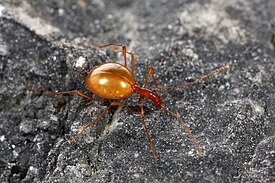
Beetle Leptodirus hochenwartii |
|
| No rank : | Bilateral symmetrical |
| Subtype : | Tracheo-breathing |
| Infraclass : | Winged insects |
| Treasure : | Fully Transformed Insects |
| Infrastructure : | Staffiliform |
| Superfamily : | Staphylinoid |
| View: | Leptodirus hochenwartii |
|
|
Leptodirus hochenwartii Schmidt , 1832 [1] |
|

L. hochenwartii on lithography of 1871

Portraits of Franz von Hohenwart and Ferdinand Jožef Schmidt from the archive of the National Museum of Slovenia in Ljubljana.
Length about 1 cm. Pronotum long and narrow. Eyes are reduced. The antennae and legs are very long, which allows them to move quickly. Elytra strongly convex, curved, hemispherical, almost completely cover the abdomen, giving it a physiogastric appearance. Troglobionts found in karst caves of Southeastern Europe ( Dinar Highlands : Slovenia and Croatia ) [2] . They live in large and cool caves, where the temperature does not exceed 12 ° C [3] .
The beetle Leptodirus hochenwartii was first discovered in 1831 by the assistant of the lantern Luka Čeč , who studied the cave system of Postojnska-Jama ( Slovenian. Postojnska jama ; Germ. Adelsberger Grotte ) in the south-west of Slovenia [3] [4] . He handed it over to Count Franz von Hohenwart, who, unable to determine the species of the find, asked him to do this by the Slovenian naturalist Ferdinand Joseph Schmidt Ferdinand Jožef Schmidt (1791-1878) from Ljubljana. Schmidt discovered in the obtained specimens a new species for science and described it in an article by Illyrisches Blatt (1832) [1] . The article presents the first formal description of cave animals in science. Subsequent research by Schmidt revealed other previously unknown cave dwellers, which aroused considerable interest among biologists. For this reason, the discovery of Leptodirus hochenwartii is regarded as the starting point of biospelology as a scientific discipline [1] [2] .
Leptodirus hochenwartii was named after the naturalist, entomologist and Count Franz von Hohenwart (1771-1844), founder of the National Museum of Slovenia in Ljubljana [1] [2] .
Six subspecies of L. hochenwartii are distinguished : [3]
- L. hochenwartii hochenwartii Schmidt , 1832
- L. hochenwartii reticulatus J. Müller , 1906
- L. hochenwartii schmidti ( Motschoulsky , 1856)
- L. hochenwartii croaticus Pretner , 1955
- L. hochenwartii velebiticus Pretner , 1970
- L. hochenwartii pretneri Müller , 1926
Due to its narrow range and low breeding rate, L. hochenwartii is considered a rare and endangered species, despite the high population density of this beetle in some caves. Therefore, L. hochenwartii is included in the Red Book of Slovenia as an endangered species (category R) [5] . An additional 15 protected areas (pSCI) of its distribution in Slovenia are included in Annex II of the European Union Directive EU Habitats Directive (92/43 / EEC); [6] [3] .


