The London and Northeast Railway ( London and North Eastern Railway , LNER ) is the second largest company of the Big Four railway companies, created by the union of all other companies in the United Kingdom under the 1921 . The company existed from January 1, 1923 until nationalization on January 1, 1948 , when it became part of British Railways .
| London and Northeast Railway | |
|---|---|
| London and North Eastern Railway | |
 Company `s logo | |
| Years of work | 1923 - 1948 |
| A country |  Great Britain Great Britain |
| City management | |
| condition | became part of British Rail |
| Length | 10 610 km |
| Site | |
Content
Creation
The main components of LNER companies are:
The total length of the tracks was 10 610 kilometers. Before the unification, the owned the longest tracks of 2828 km, and the only - only 171.4 km.
LNER owned:
- 7,700 locomotives , 20,000 passenger wagons , 29,700 freight wagons , 140 units of electric rolling stock, 6 electric locomotives and 10 motor wagons .
- 6 turbo-boats and 36 other steamboats and boats.
LNER, in partnership with London, Midland and Scottish Railway (LMS), was a co-owner of the Midland and Great Northern Joint Railway (M & GNJR), Britain's largest joint railway, most of which competed with its own LNER routes. In 1936, M & GNJR was fully connected to the railways of London and the Northeast. In 1933 , when the London Council of Passenger Transport (in charge of passenger transportation in London and the county) was created, LNER went to the that were not included in the council.
Route Geography
The London and North Eastern Railway covered territories north and east of London . The route network included the , one of the country's main lines from London to Edinburgh via York and Newcastle upon Tyne , as well as lines from Edinburgh to Aberdeen and Inverness . Most of Britain east of the Pennine Mountains was under the influence of the company, including East Anglia . The main workshops of the company were located in Doncaster , also located in Darlington , Inveruri and Stratford [1] [2] .
LNER received at its disposal 4 stations in London: former (formerly owned by ) [3] ; Kings Cross (formerly ); Liverpool Street (formerly ); and (formerly ) [4] .
Also, from London, the company made commuter services from the stations Broad Street ( London, Midland and Scottish Railway ) and Murgate ( ) [5] .
Additional activities
In the period before the advent of the Big Four, railways often owned not only directly railways, trains and workshops, but also participated in related businesses. Upon merger, LNER received:
- 8 water channels
- Docks and marinas in 20 locations, including Grimsby , Hartlepool , Kingston upon Hull , Middlesbrough , several ports in eastern Scotland , Harwich and London
- Other port assets (warehouses, moorings, piers)
- 2 electrified tram lines
- 23 hotels
- 49% share in the transportation company Mutter, Howey & Co. Ltd. [6]
- 22 ships of various tonnage
The companies also got stakes in various bus companies. In Halifax and Sheffield, the company participated in a joint omnibus committee [6] .
In 1935, the company took part in the creation of the ship company Associated Humber Lines Ltd. [6]
In 1938, LNER owned 800 Mechanical Horse tractors and was the largest owner of this type of equipment [7] .
Color Schemes
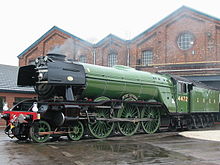
The most common colors were lined apple-green on passenger locomotives and one-color black on freight locomotives, with gold letters on both. Passenger cars were usually covered with varnished teak panels, the rare metal cars that were in the company were also painted in the color of wood.
Some special LNER Class A4 trains and locomotives were painted in other colors, including silver and blue.
Advertising
LNER routes covered a large part of the UK from London to northeast England and Scotland . The merger in 1923 meant that former competitors should now work together. The task of creating a recognizable brand was given to William Tisdale, the first head of advertising. Tizdale admired the London Underground advertising director of the time, who created extremely memorable posters. Tizdale did not set strict limits for his artists, but gave them a little freedom. William Barribal became the author of a series of posters in the Art Deco style in the 1920s - 1930s [8] . When Tizdale was promoted to deputy director, his successor Cecil Dandbridge continued this policy and held this post until nationalization. Largely thanks to Dundbridge, the font Gill Sans was accepted as corporate on British Railways .
LNER was a very industrial company, transporting a third of all coal in Britain and receiving two-thirds of the income from all freight traffic. But despite this, the main image was glamorous , with fast trains and sophisticated routes. Company advertising was usually more thoughtful and modern than its competitors. The best artists and designers were hired to encourage people to visit the resorts of the east coast in the summer.
After World War II
The company was nationalized in 1948 along with the rest of the country's railway companies. Legally, the company existed for another two years and formally closed on December 23, 1949 [9] .
During the privatization of British Rail in 1996, won the East Coast Main Line franchise, which named operator (GNER), a name and abbreviation similar to LNER.
Notes
- ↑ Hughes, 1987 , p. 146
- ↑ Awdry, 1990 , p. 144
- ↑ Whitehouse & Thomas, 1989 , pp. 57.59
- ↑ Hughes, 1987 , p. 50
- ↑ 1 2 3 Bonavia (1980)
- ↑ Whitaker (1938)
- ↑ Richard Durack, Beverley. Railway Posters 1923-1947. - London: Laurence King, 1992. - P. 128. - ISBN 1-85669-014-8 .
- ↑ The Railway Magazine (February 1950) “Main-Line Companies Dissolved”, p.73
Literature
- Awdry, Christopher. Encyclopaedia of British Railway Companies. - London: Guild Publishing, 1990 .-- ISBN CN 8983.
- Haws, Duncan. Merchant Fleets No. 25: Britain's Railway Steamers - Eastern and North Western Companies + Zeeland and Stena. - Hereford: TCL Publications, 1993. - ISBN 0-946378-22-3 .
- Hughes, Geoffrey. LNER. - London: Guild Publishing / Book Club Associates, 1987. - ISBN CN 1455.
- Whitaker. Whitaker's Almanack. - London: J. Whitaker & Sons, Ltd, 1938.
- Whitehouse, Patrick & Thomas, David St John (1989), LNER 150: The London and North Eastern Railway - A Century and a Half of Progress , Newton Abbot: David & Charles, 01LN01, ISBN 0-7153-9332-4