Moustached spiky shark [1] ( lat. Cirrhigaleus barbifer ) is a species of the genus of malleable spiky sharks of the family of Katran sharks of the cataract - like order . It lives in the southwestern part of the Pacific Ocean at a depth of 650 m [2] . The maximum registered size is 126 cm [3] . Propagated by egg production [4] . Not of interest for commercial fishing.
| Barbed whale shark | |||||||||||||||||||||||||||||||||||||||
|---|---|---|---|---|---|---|---|---|---|---|---|---|---|---|---|---|---|---|---|---|---|---|---|---|---|---|---|---|---|---|---|---|---|---|---|---|---|---|---|
 | |||||||||||||||||||||||||||||||||||||||
| Scientific classification | |||||||||||||||||||||||||||||||||||||||
| |||||||||||||||||||||||||||||||||||||||
| International scientific name | |||||||||||||||||||||||||||||||||||||||
Barbifer Cirrhigaleus S. Tanaka (I) , 1912 | |||||||||||||||||||||||||||||||||||||||
| Synonyms | |||||||||||||||||||||||||||||||||||||||
Phaenopogon barbulifer Herre, 1935 | |||||||||||||||||||||||||||||||||||||||
| Area | |||||||||||||||||||||||||||||||||||||||
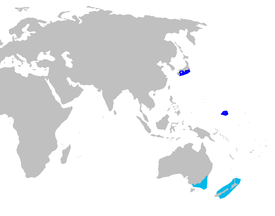 The range of Cirrhigaleus australis is marked in blue, and Cirrhigaleus barbifer in blue | |||||||||||||||||||||||||||||||||||||||
| Security status | |||||||||||||||||||||||||||||||||||||||

Content
- 1 Taxonomy
- 2 Area
- 3 Description
- 4 Biology
- 5 Human interaction
- 6 notes
- 7 References
Taxonomy
The scientific species was first described in 1912 [5] . Earlier Mandarin dogfish confused with Cirrhigaleus australis, whose habitat is located to the south. These species have morphological and genetic differences. Cirrhigaleus australis has relatively small eyes, shorter dorsal-caudal distances and less pectoral and dorsal fins, as well as spines at their base [6] . The holotype is a male 85 cm long, found on a market in Tokyo , now lost. The specific name comes from the word lat. barbus - “antennae” [7] .
Range
Barbed whorled sharks live in the southwestern Pacific Ocean off the coasts of Japan , Taiwan and Indonesia . These sharks are found at the bottom in the upper part of the continental and island slopes at a depth of 140 to 650 m.
Description
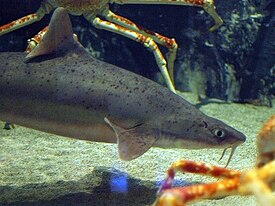
The maximum recorded size is 126 cm. The body is stocky. The nostrils are framed by a flap of skin, forming long antennae. The snout is short and rounded. The lips are thin. The upper teeth are slightly smaller than the lower. Both the upper and lower teeth are interlocked, forming a single cutting surface, similar to a blade. At the base of the dorsal fins there are long protruding spines. Anal fin missing. The upper and lower teeth are the same size. On the caudal stem there are lateral carinae. Ventral recess on top of the caudal fin blade offline. Coloring gray-brown, belly lighter. The caudal margins of the pectoral and ventral fins have a white border [8] .
Biology
These lesser known shark breed ovoviviparity . In the litter up to 10 newborns. Males and females reach puberty at a length of 86 and 92 cm, respectively [9] . Diet probably consists of bony fishes and invertebrates . The antennae can serve to detect prey at the bottom [8] .
Human Interaction
The view is not of interest to commercial fishing. Sometimes by- catch is caught in fishing gear. Due to the long dorsal spines, these sharks can become entangled in nets and trawls. Data for the assessment by the International Union for Conservation of Nature species conservation status is not enough [9] .
Notes
- ↑ Reshetnikov Yu.S. , Kotlyar A.N. , Russ T.S. , Shatunovsky M.I. The Bilingual Dictionary of Animal Names. Fish. Latin, Russian, English, German, French. / edited by Acad. V. E. Sokolova . - M .: Rus. lang, 1989. - pp. 35 - 12 500 copies. - ISBN 5-200-00237-0 .
- ↑ Cox, G. and M. Francis. Sharks and rays of New Zealand .. - Canterbury Univ. Press, Univ. of Canterbury, 1997.
- ↑ Last, PR and JD Stevens. Sharks and Rays of Australia. - 3rd. - the Harvard University then Press, 1994. - the ISBN 0674034112 .
- ↑ Breder, CM and DE Rosen. Modes of reproduction in fishes. - TFH Publications, Neptune City. - New Jersey, 1966.
- ↑ Tanaka, S. (1912) Figures and descriptions of the fishes of Japan, including the Riukiu Islands, Bonin Islands, Formosa, Kurile Islands, Korea, and southern Sakhalin. Figures and Descriptions of the Fishes of Japan , 9: 145-164
- ↑ the Mark McGrouther, Collection Manager, Ichthyology. Mandarin Shark, Cirrhigaleus australis White, Last & Stevens, 2007 - See more at: http://australianmuseum.net.au/Mandarin-Shark-Cirrhigaleus-australis-White-Last-Stevens-2007/#sthash.BYJUN4s9.dpuf . http: //australianmuseum.net.au+ (14 July 2012). Date of treatment October 30, 2013.
- ↑ My etymology. A universal etymology dictionary . Treatment Date March 21, 2013.
- ↑ 1 2 3 Compagno, Leonard JV 1. Hexanchiformes to Lamniformes // FAO species catalog. - Rome: Food and Agricultural Organization of the United Nations, 1984. - Vol. 4. Sharks of the World: An Annotated and Illustrated Catalog of Shark Species Known to Date. - P. 61-62. - ISBN 92-5-101384-5 .
- ↑ 1 2 White, WT 2009. Cirrhigaleus barbifer. In: IUCN 2013. IUCN Red List of Threatened Species. Version 2013.1. <www.iucnredlist.org>. Downloaded on 30 October 2013.
Links
- Speckled Barbed-headed Shark (English) in the World Register of Marine Species .