Marstalu street ( Latvian: Mārstaļu iela ) is a street in Old Riga .
| Marstalu street | |
|---|---|
| Latvian. Mārstaļu iela | |
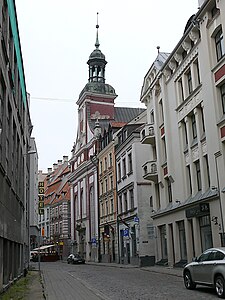 Marstalu street near the Reformed Church | |
| general information | |
| A country | |
| City | Riga |
| Area | central District |
| Historical district | Old Town (Old Town) |
| Length | |
Located between Grecinieku street and the promenade on November 11th . Crosses Kungu street . The length of the street is 279 meters [1] .
Content
History
It was formed in the XIII century. Originally called Rigemunde street ( lat. platea Rigemunde ). The origin of the name has two explanations: from the distorted name of one of the members of the Riga Magistrate or from the German name of the place where the Riga River flows into the Daugava , not far from which the street began. In the Middle Ages, the street passed near the Riga harbor (in modern Riga in its place is a small Albert Square , here previously was Lake of Riga ). Due to the convenience of transporting goods by water from the harbor to the center, large merchants' yards with storage barns were formed on the site of Marstalu Street from the 13th to the 15th centuries (some were also located on the Old Town Square, which starts from Alberta Square).
At the beginning of the 15th century, Marshalka Street was used in everyday life. Since 1415, the name Marstallstrasse (in German) has been fixed. In the Russian tradition - Konyushennaya (literal translation from German). On this street, travelers could rent or buy a horse. Also, for a long time there was a stable built in 1330 that belonged to the magistrate.
Attractions
- 2/4 - Reutern House - one of the most notable private residential buildings in Riga at the end of the 17th century, owned by the wealthy merchant Johann Reitern (built for him by the master builder from Strasbourg Rupert Bindenšu ) [2] . Currently, it houses a rock cafe.
- 8 - Residential building (16th century), now the Latvian Museum of Photography .
- d. 10 - Reformed Church , built on the orders of Peter the Great and Anikita Repnin in the 20s of the 18th century after numerous requests from the elder of the Riga Reformed community Anton Tering . It is distinguished by an unusual architectural characteristic; from the side of the side facade you can observe structural elements typical of barn construction (the ground floor and the attic of the church were leased by the reformers themselves for storage). The portal of sandstone with an allegorical image typical of Reformed emblem is of artistic value. In Soviet times - a recording studio “Melody” .
- The complex of residential buildings of the XVI — XVIII centuries (No. 19, 23, 26). The stucco facade of building No. 19 has artistic value, as well as the portals of buildings No. 6 and 26. In Soviet times, they were qualified as architectural monuments of republican significance.
- d.19 - Armisted Family House (Residential building of the XVIII century, rebuilt in the XIX century, renovated in 1998, architects Tatyana Vitola, Aldis Polis).
- 21 - Dannenstern House - a monument of Baroque architecture of the late XVII century, now in an abandoned condition. Belonged to the family of the head of Riga harbor, Dutchman, Johann Reitern’s son-in-law, Matteo Dannenstern . Author unknown.
- 28 - Art Nouveau style (architect P. Mandelstam , 1906)
A section of the fortress wall has been preserved on the street [3]
Street in the cinema
- A number of scenes of the television movie " Seventeen Moments of Spring " were shot on the street. At the New Gate, Stirlitz makes an appointment with Bormann and gets into a car parked there.
- In the movie "Two" on this street, at the gates of Dannerstern's house, the first meeting of the heroes of the film takes place.
Notes
- ↑ Rīgas ielu pamatlielumi (Latvian) (xls). Open data . Riga City Council (January 1, 2016). Date of treatment August 15, 2016.
- ↑ Riga surname Retern
- ↑ Fragments of city walls
Links
Literature
- Marstalu street // Riga: Encyclopedia = Enciklopēdija “Riga” / ch. ed. P.P. Eran. - Riga: Main Edition of Encyclopedias , 1989. - P. 446. - 880 p. - 60,000 copies. - ISBN 5-89960-002-0 .