The Carlo Bilotti Museum ( Italian: Museo Carlo Bilotti ) - a museum of modern art, which displays paintings and sculptures from the collection of the Italian-American collector Carlo Bilotti (1934-2006); located in Rome , in the park Villa Borghese .
| Carlo Bilotti Museum | |
|---|---|
| Museo carlo bilotti | |
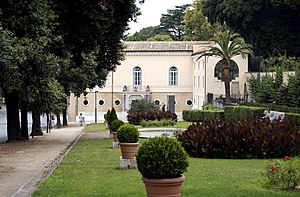 Museum building | |
| Established | 2006 |
| opening date | |
| Founder | Carlo Bilotti |
| Location | |
| Address | Italy , Rome , st. Fiorello La Guardia |
| Director | Ilma Rejo |
| Site | museum site |
Content
Building
This country house, owned by the noble Cheuli family, passed to the Borghese family at the beginning of the 17th century , when Cardinal Shipione bought up the lands surrounding his estate in order to set up a huge park, Villa Borghese. In the last quarter of the 18th century , by order of Prince Marcantonio Borghese (1730–1809), the “house by the curved wall” was rebuilt into the “house of water fun” and became the center of the “Garden by the Lake” broken around it with fountains , nymphaeum , gazebos , statues , pergolas from citrus [1] . The reconstruction took place in two stages. In 1775-1779, interiors were designed with the participation of a number of famous artists of their time. They painted the walls of the house and created paintings for them by T. Kunze, D. Kadez, K. Unterperger. Then, in 1790-1793, an orchestra room was added, decorated and painted with frescoes under the direction of K. Unterperger. Until the middle of the XIX century , numerous celebrations, balls and other social entertainments were held here. In 1849, with the suppression of the bourgeois-democratic revolution, the building was destroyed by the fire of French artillery, its interior decoration was completely lost. Subsequently, the house was restored in a more primitive form to serve as a greenhouse, that is, a winter storage for pots with citrus fruits. Only the nymphaeum with shells, the coat of arms of Borghese and a bowl for water in the form of a sarcophagus survived from its former splendor [2] . Since 1903 , after the transfer of Villa Borghese Park to the ownership of the city, the greenhouse housed residential premises and various offices; for some time the building was occupied by a religious institute, and since 1982 - offices of the city administration. When Carlo Bilotti, an entrepreneur engaged in the production of perfumes and cosmetics , a collector and philanthropist , donated his collection of contemporary art to the city of Rome, the building of the greenhouse was restored to a museum, which was opened in 2006 [1] .
Exposition
The museum features 22 works that make up the collection of Carlo Bilotti, 18 of which are works by Giorgio de Chirico . Several rooms are designed for temporary exhibitions of contemporary artists [3] .
Hall number 1 [4] :
- L. Rivers “Carlo Bilotti against the backdrop of the Dubuffet painting”, pictorial installation (1994);
- E. Warhol “Mother and Daughter: Tina and Lisa Bilotti”, canvas, acrylic paints , ink (1981).
Hall number 2 [5] :
- D. Severini “Summer”, oil on canvas (1951);
- D. de Chirico “Mysterious Archaeologists”, oil on canvas (1926);
- D. de Chirico “Archaeologists”, oil on canvas (circa 1927);
- D. de Chirico “Furniture in the room”, oil on canvas (1927);
- D. de Chirico “Horses on the Seashore”, oil on canvas (1927-1928);
- D. de Chirico “The Horseman with Two Antique Characters by the Sea”, oil on canvas (circa 1929);
- D. de Chirico “The blonde who turned her back”, oil on canvas (circa 1930);
- D. de Chirico “The Lonely Archaeologist”, oil on canvas (circa 1937);
- D. de Chirico “Self-portrait with the head of Minerva ”, oil on canvas (1950s);
- D. de Chirico “ The mystery and melancholy of the street, a girl with a hoop ”, oil on canvas (replica of the late 1960s paintings of 1914);
- D. de Chirico “Historical Regattas in Venice ”, oil on canvas (1950s);
- D. de Chirico “The Horseman Holding the Horse under the Bridle”, oil on canvas (circa 1953);
- D. de Chirico “Metaphysical interior with cookies”, oil on canvas (replica of the late 1960s paintings of 1918);
- D. de Chirico “The Lone Orpheus ”, oil on canvas (1973);
- D. de Chirico “The Horse”, watercolor, ink on paper (circa 1950);
- D. de Chirico “The Ancient Horseman”, watercolor , charcoal on paper (circa 1960);
- D. de Chirico “ Orestes and Pilad ”, bronze (casting of 1965 from the terracotta model of 1940);
- D. de Chirico "Archaeologist", bronze (cast of 1988 from the original 1972).
Yard [6] :
- D. Mantsu “The Great Cardinal”, bronze (casting 8 pieces in 2004 from the 1965 model);
- D. de Chirico " Hector and Andromache ", bronze (casting 2 copies in 2006 from the original 1966).
Link to works in the museum
Gallery of museum exhibits (neopr.) . Date of treatment October 21, 2013.
Notes
- ↑ 1 2 Museum site, the history of the greenhouse building. (unspecified) . Date of treatment October 27, 2013.
- ↑ Site of the Roman City Office for the Protection of Cultural Heritage, the history of the building of the greenhouse (Neopr.) . Date of treatment October 23, 2013.
- ↑ Museum website, current exhibitions (neopr.) . Date of treatment October 27, 2013.
- ↑ Museum website, Hall No. 1 (unopened) (unavailable link) . Date of treatment October 23, 2013. Archived October 29, 2013.
- ↑ Museum website, Hall No. 2 (unopened) (unavailable link) . Date of treatment October 23, 2013. Archived October 29, 2013.
- ↑ Museum site, courtyard (unopened) (unavailable link) . Date of treatment October 26, 2013. Archived October 29, 2013.