Gdańsk Polytechnic University ( Polish. Politechnika Gdańska ) is one of the leading technical universities in Poland, including the Pomeranian Voivodeship. State, autonomous university, one of the oldest universities in Europe. There are 9 faculties where more than 27 thousand students study in full-time and part-time studies. The number of employees exceeds 2,500, of which 1,200 are university professors and scientists. Most faculties have academic rights, their scientific councils have the right to assign the academic degrees of candidates, doctors of sciences and professors. GPU is one of the recognized international organizers of international conferences, symposia, and seminars.
| Gdansk Polytechnic University | |
|---|---|
| Politechnika gdańska | |
 | |
| International name | Gdańsk University of Technology |
| Motto | „Uniwersytet techniczny z wyobraźnią i przyszłości" ( Technical University with imagination and future ) |
| Year of foundation | October 6, 1904 |
| Type of | State |
| Rector | prof. Krzysztof Wilde |
| Students | |
| Location |  Poland : Gdansk Poland : Gdansk |
| Legal address | Gdansk , ul. Narutovich 11-12 80-233 Gdansk |
| Site | www.pg.edu.pl |
Traditionally, the university supports student and parliamentary life. In the 1960s, the first independent Student Parliament was created in the post-war period of all higher education in Poland. At the same time, the famous Bim-Bom theater began to operate, led by Zbigniew Tsibulsky and Bohumil Kobela. For many years, the Gdańsk Polytechnic University has supported the slogan “Technical University with the imagination and the future.”
Students from more than 30 countries of the world come to GPU. The largest groups of foreign students are from: Spain, China, Yemen, the Russian Federation, Ukraine and the Republic of Belarus, as well as India, Nepal, Iran and Vietnam. There are more than 420 agreements on the student exchange program Erasmus , Erasmus + i Erasmus Mundus, where students receive scholarships for study and practice in the framework of the student exchange program.
The Bureau for Serving Foreign Students and Guests (Polish Biuro Obsługi Studentów i Gości Zagranicznych ) is engaged in recruiting students for study, as well as in the care of incoming students from countries that are not EU countries
Content
University Location
The Gdańsk Polytechnic University is located in the center of Wrzeszcz itself - the district of Gdansk, which has an excellent transport interchange leading to every part of the Tricity.
Gdansk is a city with centuries of tradition. The city belongs to one of the largest, industrial, cultural, scientific and business centers of the country.
About 64 thousand people study at 21 Gdansk universities, of which half are students from the Gdansk Polytechnic University.
Gdansk is the capital of a large metropolitan area, with a population of more than 2.2 million people throughout the Pomeranian region, which at the same time represents one of the wealthiest cities in Poland. Most of the local production is shipbuilding and ship repair enterprises, as well as all types of water transport, carrying goods or passengers through waterways, both natural (oceans, seas, rivers, lakes), and artificial (canals, reservoirs). There are two ports in the city. One of them is the New Port - a real epicenter of the production of ships and ships, a set of metallurgical and chemical enterprises, as well as enterprises for the food processing industry. The second - the Northern Port, is the largest in Poland, a promising project in the field of marine industry. The port is engaged in coal export and oil import. In 1980, the Gdansk Shipyard was the birthplace and rebellion of Solidarity , which in 1989 led to the collapse of the power of the communist parties. Gdanchanin, Leader of Solidarity Lech Walesa (who received the Nobel Peace Prize in 1983) became president of Poland in 1990. Over the past 10 years, Gdansk has successfully implemented a strategy for gradual development, in which the knowledge-based economy plays a major role.
Campus
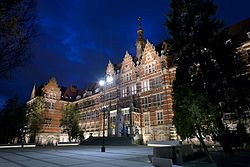
On the campus, both modern buildings and buildings that are historical landmarks are perfectly adjacent. The university’s symbol is the monumental Main Building, in the style of the Dutch Neo-Renaissance, built at the beginning of the 20th century by a famous architect, and later by the university professor Albert Karsten. During World War II, more than 60% of the surface and 70% of the roof of the entire building burned out. In this regard, only the metal structure remained from the clock tower. Despite the fact that soon all the damage was quickly repaired, the reconstruction of the tower was constantly postponed until later. After 67 years, namely May 13, 2012, the tower was completely restored and returned to its former place in the Main Building.
The campus of the Gdansk Polytechnic University is constantly in the process of development and additional restructuring. Some of the buildings that belong to architectural monuments are perfectly combined with modern buildings, the auditoriums and laboratories of which are equipped with the latest technologies. The result that can be observed today is a fresh interior design development by the new Laboratory of Innovative Electric Power Technologies and Integration of Renewable Energy Sources Energii, which will conduct research on the implementation and application of industrial patents in modern electric power industry.
It is planned that already in 2014, the complex will begin its work, which will consist of the Center for Nanotechnology (Building B), the Center for Mathematical Training and Distance Learning via the Internet, as well as underground parking for 50 cars.
The following modern centers are located on campus:
- The Nanotechnology Center , which houses 25 modern laboratories, is equipped with unique, modern equipment for atomic research.
- Center Interizon - Pomeranian ICT Cluster / cluster of information and communication technologies, which includes already 140 regional enterprises in the field of information technology. The cluster is considered the most dynamically developing and the best in all of Poland.
- The Center for Mathematical Training and Distance Learning via the Internet , which uses the latest information technologies for the development of concepts of mathematical modeling and analysis of visual data.
- The Center for Informatization of the Trujmey Academic Computer Network, which is also the Center for Powerful Servers. With the help of which access is made to all information resources, including computer digital systems, as well as to all departments of the university.
- The Center for Transfer of Science and Technology , which is engaged in supporting the innovative activity of the university.
- University Sports Center , which maintains top-level sports facilities, to which all students and university staff have access:
History
Main Events of the Gdansk Polytechnic University
- 1900 - the foundation stone of the university was laid
- 1904 - established Royal Higher Technical School (Königliche Technische Hochschule)
- 1921 - The Higher Technical School (Hochschule) was transferred to the authorities of the Free City of Gdansk. The name of the university was officially changed to the Technical Higher School of the Free City of Gdansk (Technische Hochschule der Freien Stadt Danzig)
- 1945 - May 24, the university is officially named as the Polish Gdansk Polytechnic University
- 2004 - 100th anniversary of the Gdansk Polytechnic University
- 2014 - Gdańsk Polytechnic University celebrates 110 years of the university
- 2020 - Smart University
Hevelius and Fahrenheit - Patrons of University Walls
Jan Hevelius (8.I.1611 Gdansk - 28.I.1687 Gdansk). The most famous astronomer after Nicholas Copernicus on Polish soil.
The developer of instruments for astronomical measurements, the inventor of suspended mechanical clocks, a periscope and a micrometer screw, the creator of the world's first large astronomical observatory, which was equipped with real telescopes.
Hevelius spent almost his entire life in Gdansk. On the roof of the houses in which he lived, he constantly built astronomical observatories, which for many years he equipped with devices of his own invention. The largest telescope was 39 meters long and was installed outside the city. In addition to Hevelius exploring stars, planets, comets, he also investigated the phenomenon of liberation of the lunar surface - the oscillatory motion of the moon when observed from the Earth.
He discovered 9 new constellations, was the first to discover 4 comets, with great success made measurements of the height of the lunar mountains, discovered centuries-old changes in magnetic declination. He was the author of many astronomical works.
He was also the first scientist on Polish soil to receive membership in the Royal Society of London for the Improvement of Natural Knowledge.
At one time, the study of the constellation of the southern hemisphere of the sky near the celestial equator, Louis XIV de Bourbon and Jan III Sobieski, provided him with financial support. Soon, namely in 1690, in the heavenly atlas “Uranography” Hevelius indicates the “Sobieski Shield” (Scutum Sobiescianum) in honor of the great Polish king and commander Jan Sobieski.
In 2006, a monument to Hevelius, authored by Jan Schipka (Polish Jan Szczypka), was erected on the square in the Old Town near the Town Hall.
In 2011, the Sejm of the Republic of Poland (Polish. Sejm Rzeczypospolitej Polskiej) decided to name the year in honor of Hevelius.
Daniel Gabriel Fahrenheit (24.V.1688 Gdansk - 16.IX.1736 The Hague). Well-known physicist and engineer, inventor of the mercury thermometer and Fahrenheit temperature scale. Born, lived and studied in Gdansk. After the death of his parents, he moved to Amsterdam, where he continued to study physics, conducted research with instruments measuring temperature and pressure, and at the same time taught chemistry.
In 1709 he returned to Gdansk and lived until 1712, during this period he was engaged in research on the development of instruments measuring temperature and pressure.
Fahrenheit was the first scientist in the world to use mercury in thermometers. He described the phenomenon of melting ice, proved that the boiling point of water depends on pressure, and also described the properties of platinum; doing optics, improved the Newton telescope.
The Royal Society of London for the Improvement of Natural Knowledge published the results of a study on the development of a thermometer, barometer, and instrument for measuring the density of liquids (hydrometer) in a scientific publication of the Royal Society of London for the Development of Natural Knowledge . The scale was named after the one who proposed it in 1725 (32 ° F = 0 ° C). For a long time, the Fahrenheit scale was the main one in English-speaking countries, but in the late 1960s and early 1970s it was almost replaced by the scale of the Swedish astronomer Celsius. Only in the USA, Australia and New Zealand the Fahrenheit scale is still widely used for domestic purposes.
In 2008, a meteorological column was installed in Gdansk. Fahrenheit. Glass tank with a thermometer 1.2 m high, next to both scales are Fahrenheit and Celsius.
On September 22, 2010, according to the decision of the Senate of the Gdańsk Polytechnic University, the Northern Well Palace was named in honor of Daniel Gabriel Fahrenheit, respectively, the South Palace and the Foucault Pendulum in honor of Jan Hevelius.
On October 2, 2011 and October 1, 2013 the walls of the university remained forever immortalized by portraits of the famous inhabitants of Gdansk.
Education
University's main goal
Providing high quality training for the needs of the dynamic development of the economy and society , which is based on science. Conducting research at the highest international level in the context of large-scale globalization of the world, as well as the implementation of innovative solutions for society, which primarily takes an active part in the changes of civilization, especially in the development of science and technology .
University Priorities - Smart University
S is a strategy.
Search for additional financing for the implementation of strategic tasks, according to the requirements of the EU, Poland and the entire Pomeranian region.
M - maximum innovation
The introduction of new mechanisms, cooperation with organizations to develop innovative solutions not only for the university, but also for the entire region as a whole.
A - open to all
Preparation and conduct of Long Life Learning training, the implementation of group projects, as well as e-learningu (online training) training programs, the modernization of scientific and didactic laboratories and the application of research in practice
R - personality development
All the necessary conditions for the comprehensive development of students, graduate students and employees have been created. The most active and diligent celebrate achievements in study and work.
T - creativity
Elimination of obstacles and administrative difficulties by proven effective methods, adherence to work culture and creative creation of a creative process of working with innovative technologies.
Education Proposal
Higher education I and II degree (bachelor and master), full-time and part-time education
33 directions, of which:
3 directions inter-faculty
2 inter-university - two unique programs: "mechanical-medical engineering" and "building chemistry"
postgraduate studies, full-time and part-time studies
56 postgraduate programs
3 areas of study MBA
more than 1,200 scientists
more than 27,000 students
9 faculties:
- Faculty of Architecture
- Faculty of Chemistry
- Faculty of Electronics, Telecommunications and Informatics
- Faculty of Electrical Engineering and Automation
- Faculty of Technical Physics and Applied Mathematics
- Faculty of Civil Engineering and Environmental Engineering
- Faculty of Mechanics
- Faculty of Ocean Engineering and Shipbuilding
- Faculty of Management and Economics
GPU Graduates
Between 1904 and 1939, about 11,080 people were trained at the Gdansk Polytechnic University. From 1945 to December 2012, the number of graduates reached 89,000. Thus, more than 100,000 people left the walls of the university with diplomas in their hands.
New Education Model - Engineer of the Future
Gdańsk Polytechnic University has won a competition under the European Foundation for the implementation of the project “engineer of the future”. The project includes a new model of education, focused on the implementation of projects in the group and the acquisition of skills such as effective cooperation, willingness to take risks and an analytical approach to solving problems. The funds received will be used to modernize the infrastructure and new laboratories. Thanks to the project, 921 places for practical training were created.
The university has an international certificate of educational quality ECTS i CDIO Label, as evidenced by the educational program in all areas. It is mainly focused on strengthening practical skills and the formation of initial professional knowledge among students.
Another valuable experience for the Gdańsk Polytechnic University is its participation in the international consortium CDIO, whose members use the formula “Conceive - Design - Implement - Operate” to train specialists.
International cooperation
International cooperation at the Gdansk Polytechnic University is gradually developing. Students and staff take part in numerous international educational programs and together with partner universities create an international network. Currently, the university implements 402 interagency agreements under the Erasmus program and 77 agreements on bilateral cooperation of a general nature.
Gdansk University of Technology coordinates and participates in projects like LLP Intensive Program, ERASMUS MUNDUS, Jean Monnet, CEEPUS, TEMPUS, Leonardo da Vinci. The University is one of the founding members of the Baltic Sea Region University Network (BSRUN) - a network of higher education institutions in Poland, Belarus, Estonia, Finland, Latvia, Lithuania and Russia.
Modern laboratories, a huge intellectual potential, a wide range of research groups and student organizations, are an ideal environment for the mutual exchange of experience, which is why the number of foreign students from around the world at the Gdansk Polytechnic University is growing every year.
Research
For several years, the number of projects implemented in collaboration with research funding institutions such as the National Research Center, the National Center for Research and Development, and the Polish Science Foundation has been increasing at the Gdańsk Polytechnic University. Among them are high-circulation projects under the Maestro program, the Applied Research Program, LIDER, INNOTECH and the new Graf-TECH program.
In addition, the university is implementing a project for outstanding students, the so-called “Diamond Grant”.
Gdańsk Polytechnic University can also boast of success in attracting funds from foreign institutions, for example - the school takes part in the implementation of a prestigious grant funded by the 7. EU Work Program in the framework of IDEAS - which can be compared to receiving a Nobel Prize.
The university also implements 26 projects in international research programs.
- 300 inventions are now ready for commissioning
- in the process of implementing 200 research and development projects from national and international sources of financing
- within 3 years the university has signed 700 agreements with enterprises
Economic Cooperation and Technology Transfer
Currently, the Gdansk Polytechnic University is carrying out numerous innovative studies on the development of projects that are aimed at introducing state-funded technologies. Many of these projects received funding from the Innovative Economy operational program.
The employees of the Gdańsk Polytechnic University are constantly attracted to cooperation by many famous companies, including: INTEL Technology Poland, Samsung Electronics Polska, IBM Polska, Young Digital Planet, Blue Services, TechnoService, Datera, Learnetics, IVO Software, FIDO Intelligence, GE Hitachi Nuclear Energy International , PGE Górnictwo i Energetyka Konwencjonalna, KGHM Polska Miedź, LOTOS Asfalt, PKN Orlen , Schlumberger LTD, Deep Ocean Technology, BioLab Innovative Research Technologies, BLIRT SA, Kruszwica.
Financing
The main source of income for the university is teaching (58%).
The university receives additional funding from the state budget, but paid educational services remain the main source of income. The main source of income for the university is teaching (58%). The university receives subsidies from the state budget, but the main source of income is paid educational services.
Research activities make up 30% of the total, and its main components are: grants to finance statutory activities, funds for projects funded by the National Center for Research and Development and the National Research Center, as well as financing of scientific and technical cooperation with other countries. The university also receives income from the sale of work and research services.