The 2nd Virginia Infantry Regiment ( eng. The 2nd Virginia Volunteer Infantry Regiment ) is an infantry regiment of the Confederation Army recruited in the western counties of the state of Virginia during the American Civil War . He fought almost exclusively as part of the Severovirdzhinskoy army , as one of the regiments of the Stone Wall Brigade .
| 2nd Virginia Volunteer Infantry Regiment | |
|---|---|
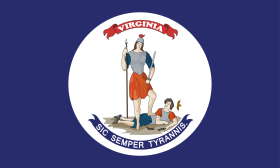 flag of virginia 1861 | |
| Years of existence | 1861-1865 |
| A country |  CSA CSA |
| Enters into | Stone wall brigade |
| Type of | Infantry |
| Number of | 320 people (1862) 333 people (1863) |
| Nickname | "The Innocent Second" |
| Commanders | |
| Famous Commanders |
|
Formation
The 2nd Virginia Regiment was recruited in Charlestown in April 1861. His companies were recruited from Clark , Frederick , Floyd , Jefferson and Berkeley counties. The regiment was immediately sent to Harpers Ferry to capture the federal arsenal. In July, the regiment was recruited into the army of the Confederation. His commander was Colonel James Allen (a graduate of the Virginia Military Institute of 1849), Lieutenant Colonel Francis Lacland, and Major Lawson Botts [1] .
The regiment had the following company composition:
- Company A (Jefferson Guards) - Jefferson County
- Company B (Hamtramck Gurds) - Jefferson County
- Company C (Nelson Rifles) - Clark County
- Company D (Berkeley Border Guards) - Berkeley County
- Company E (Hedgesville Blues) - Berkeley County
- Company F (Winchester Riflemen) - Frederick County
- Rota G (Botts Grays) - Jefferson County
- Company H (Letcher Riflemen) - Jefferson County
- Company I (Clarke Rifles) - Clark County
- Company K (Floyd Guards) - Jefferson County
Battle Path
On June 1, the regiment was formalized as the 2nd Virginia and included in the 1st Brigade of the Shenandoah Army , commanded by Thomas Jackson . On June 8, the regiment was officially accepted to serve in the army of the Confederation.
When the federal army launched the Manas campaign , the regiment left Harpers Ferry (June 15) and retreated to Bunker Hill. July 2, he participated in the battle of Hooks Run (although not introduced into the battle), after which he retreated to Winchester. When it was decided to transfer the Jackson brigade to Manassas, the regiment left Winchester (July 18), on July 19, plunged into the train at Piedmont station and arrived at the army near Manassas at the end of the day.
On July 21, the regiment fought in the first battle of Bull Run , participating in the battle for Henry Hill. In the battle line of Jackson on Henry Hill, he stood second from the left, to the left of the 33rd Virginia. When the 33rd Virginia attacked Griffin's guns and then was thrown back, the Northerners (the 14th Brooklyn) attacked Jenson’s line and overturned the 33rd and 2nd Virginia regiments. The regiment no longer participated in the subsequent counterattack as an organized unit.
After the battle, he stood near Centerville. On September 14, Lt. Col. Lackland died of pneumonia. Major Botts became a colonel, and Jackson's adjutant, Francis Jones, became a major.
On November 7, the regiment was transferred to the Shenandoah Valley; on November 13, he arrived in Wiesterster and camped north of the city at Camp Stevenson. November 14, the command of the brigade took Richard Garnett .
On December 16-21, the regiment took part in the sabotage against the dam No. 5 on the Potomac River.
In January, the regiment participated in the expedition to Romney . He spoke out of Winchester on January 1 at 05:00 and arrived in Bath on January 4. From January 14 to January 19, the regiment was stationed in Romney, then was returned to Winchester and taken to the winter apartments at Camp Seelikopfer. On March 12, when General Banks launched an offensive in the Shenandoah Valley ( Campaign in the Shenandoah Valley ), the regiment retreated to Mont-Jackson.
March 23 the regiment participated in the first battle at Kernstown . By the beginning of the battle in the regiment there were 320 people, of whom 6 were killed, 33 were wounded, and 50 were missing. After the battle, the army retreated to Newton. On April 1, Jackson removed Garnett from the command of the brigade and appointed Charles Winder instead.
On April 21 - 23, the regiment was reorganized. Privates enrolled for 3 years of service and re-elected officers. Colonel Allen was re-elected Colonel.
On May 8 the regiment was on the battlefield of the battle of McDowell, but Jackson kept him in reserve and did not engage in the battle. After the battle, the regiment returned to the Shenandoa Valley and on May 23 participated in the Battle of Front Royal, but again was not actively involved. On May 24, the regiment made the transition to Winchester, and on May 25 participated in the first battle of Winchester . He stood in the center of the brigade during the first attack of the position of the federal troops, but was repelled by artillery fire. The second attack was more successful and turned the federal army to flight. Captain Rayleigh Colston was wounded in this battle.
After the battle, the regiment took part in the attack against Harpers Ferry, and then, due to the threat of encirclement, made a difficult march to the south; On May 30, he walked 35 miles (56 kilometers) without food and rest. On June 9, the regiment participated in the Battle of Port Republic .
Peninsula Campaign
In June 1862, the regiment became part of the Severo-Virginia army and went through almost all the battles of the seven-day battle. June 27, he participated in the battle of Gaines Mill . He was thrown into battle in the evening and managed to break through the position of the federal army, but the darkness prevented him from continuing the battle. In this battle, the regiment lost 27 people. Colonel James Allen was killed in the head when he led the regiment to attack. Major Francis Jones was hit in the leg by a shard and died on July 9th. Captain Rayleigh Colston also received a heavy leg injury. The regiment was headed by Lieutenant Colonel Botts, who was given the rank of colonel.
On June 30, the regiment crossed the Chikahomini River and on July 1 participated in the battle of Malvern Hill. On July 2, he pursued an enemy retreating to Harrison Landing, and an attack was planned for July 3, but in view of the strong fire of the federal fleet, it was canceled. For several days the regiment rested in the camp, and on July 8 he was taken to Richmond to camp at Glenwood on the Mechanicsville Road.
Northern Virginia and Maryland
On July 17, the regiment went to Northern Virginia and July 22 - 29, camped at Gordonsville. On August 8, the regiment passed Rapidan, and on August 9, participated in the battle at Cedar Hill, after which it retreated to the camp in Gordonsville. On August 15, Colonel William Baylor (5th Virginia Regiment) assumed command of the brigade in place of the dead at Cedar Mountain Winder.
On August 25, Jackson began a raid on Manassas station; On August 27, the regiment arrived in Manassas and took up positions north of the city, and on the same day it moved to Groveton. August 28, he participated in the battle with the division of Rufus King (the battle of Brauners Farm). The regiment numbered 140 people by the start of the battle, and lost 15 people killed and 43 wounded. Colonel Botts was seriously wounded by a bullet in the face. Captain Nadenbush took command, but he was also injured and Captain Rayleigh Colston took command.
On August 29 and 30, the regiment, numbering only 80 people, participated in the second battle of Bull Run . The regiment shot almost all the cartridges and by the end of August 30, fought off with bayonets. 3 people were killed and 11 injured. Brigadier Baylor was killed, and Colonel Grigsby (27th Virginia) took command.
On September 1, during the battle of Chantilly, the regiment was kept in reserve. During the Maryland campaign, the regiment passed from Lisberg to Frederick, stood in Frederick on September 6–10, then went to Bunsboro and Martinsburg, and on September 13 was placed in Martinsburg as a rear police officer, because of which he did not participate in the Battle of Entityme. On September 16, Colonel Botts died at the priest’s house in Midllberg.
Shortly after the death of Lawson Botts, the regiment was headed by Captain Ralay Thomas Colston (graduate of the Virginia Military Institute), who commanded the regiment until the fall of 1863, when he was wounded in the Battle of Mine-Ran and soon died of pneumonia. [2]
Under Frederiksberg , 2 killed and 19 wounded were lost, with Chancelorsville 8 killed and 58 wounded. At the time of the surrender of April 9, 1865, there were 9 officers and 62 privates in the regiment. The most famous private of the regiment was John Wesley Culp, who died at Gettysburg, in the battle for Culpes Hill , near his own farm.
The commanders of the regiment were James Allen, Lawson Botts and John Nadenbush; Lieutenant Colonels: Releigh Colston, Francis Laheland and William Randolph. The majors of the regiment were: Francis Jones, Edwin Moore and Charles Stewart.
Notes
Literature
- Dennis E. Frye, 2nd Virginia Infantry, HE Howard, 1984