“Player Happiness” ( Spieler-Glück ) is a framed novel by Hoffmann , first published in 1819. The following year was included in the 3rd volume of the storybook “The Serapion Brothers ”.
According to the “ box tradition ” of the romantic era, the work consists of several stories inside the story, illustrating the tragic fate of certain card players .
Content
Story
- Siegfried Story
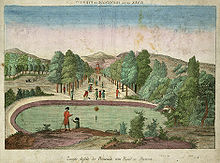
High season on the waters in Pirmont . And old and young spends evenings on cards. Indifferent to them is only the young Baron Siegfried, known since childhood for his phenomenal luck. Fearing to be known as a miser, he finally comes to the gambling house to make a couple of bets. So unnoticed for himself, "he became addicted to the pharaoh , this very simple and, consequently, the most fatal game."
Luck never betrays the young baron, but he is worried about the presence in the hall of an elderly man with a heavy look. The lucky one demands that he move away from the playing table. The next morning in the park, he apologizes to the stranger. In response, he declares that the player’s happiness is nothing but a “deceptive deception of hostile forces,” and urges him to stop before it is too late.
- Menard's story
The story that a stranger told him in the park really made the baron tie up with cards. This is the story of Chevalier Menard, who was once as lucky in cards as Siegfried. Just like him, the Chevalier was drawn into the game against his will and at first even punted for others. Thanks to his luck, he became rich and founded the richest bank in Paris .
Once in the institution of Menard appeared a dry old man, interest-bearing by the name of Vertois. He made bets over and over and over and over again. So he lowered his entire fortune, including a furnished house on Sainte Honore . In vain he asked his daughter to leave at least a tenth of the lost - Menard said that among the players such mercy is considered a bad sign.
- History of Vertois
Then the old man told the creditor the story of his misfortunes. Like Menaru, he was invariably lucky in the game. Living in Genoa , he ravaged among others one Roman who indignantly stabbed him in the heart. Beloved wife died of experiences. Healing the wound, Vertois found the strength to overcome his passion for the game and left Italy for Paris, where he engaged in usury. And only now, having heard about Menard, who repeats his fate in everything, decided to put his player’s happiness against the happiness of a Chevalier.
Upon arrival at the house of Chevalier Menard, won by Vertouis, he fell in love with the owner's daughter, Angela. For her sake, he hastened to give up his winnings. When a noble girl showered him with accusations of cruelty and immorality, Menard closed the gambling house and drastically changed his lifestyle. Angela was imbued with sympathy for him and agreed to become his wife, although she secretly loved her neighbor's son, Duverne, who was called up for war with the British.
- Duvernet History
Old Man Vertois obsessed with maps and died; even in his death throes, he "fingered with trembling fingers, as if shuffling cards and a sword bank." Menard also returned to pernicious passion. True, now his extraordinary luck was explained by cheating , and his gambling house was surrounded by notoriety. After the authorities closed the bank, Menard retired with his wife to her native Genoa, where the richest bank was held by a certain French colonel. Chevalier decided to play with the colonel - and lost everything. In desperation, at the suggestion of the colonel, he put his wife at stake - and again his bet was a bit.
Then the colonel revealed to Chevalier that he was the same Duvernet whom Angela had secretly loved all these years, and that he had taken up the game to instill a "spirit of darkness" in order to regain his beloved. Arriving at Angela’s house, the winner and loser found her dead in her room. “And the colonel threatened the sky with his fist, howled muffledly and ran away; since then no one has seen him again! ” [1]
- Epilogue
A few days after the conversation with Baron Siegfried, the stranger suffered a nerve blow from which he did not recover. After his death, from the papers left after him it turned out that this was none other than the Chevalier Menard, who had recently called himself Bodasson.
Value
Hoffmann's story about the "witchcraft charm" of cards opens up a fundamentally new topic in European literature. Such works as “ The Queen of Spades ” by Pushkin [2] , “ Shagreen Skin ” by Balzac , “ Shtoss ” by Lermontov [3] , and “ The Player ” by Dostoevsky represent a continuation of this Hoffmann tradition [4] . In Hoffmann's luck in the game is presented as something almost mystical:
The outlandish interweaving of accidents alternating in a bizarre round dance appears with particular clarity here, indicating the intervention of some higher power, and this prompts our spirit to irresistibly strive to that dark kingdom, to that forge of Rock, where human destinies are executed, in order to penetrate secrets his crafts.
Hoffman himself was rather indifferent to the cards. The story was probably based on his observations of the players during their stay on the waters in 1798 (as well as the tragic fate of one of the acquaintances of the officers, the husband of the writer Carolina de La Motte Fouquet ).
Notes
- ↑ Wed the ending of The Bronze Horseman .
- ↑ The Queen of Spades // Pushkin Guide. - 1931 (text)
- ↑ The story "Shtoss" in the context of the work of M.Yu. Lermontov
- ↑ Charles E. Passage. The Russian Hoffmannists . The Hague: Mouton, 1963.