Thermotog [1] ( lat. Thermotogaceae ) is the only family of bacteria of the same type and class of thermotog [2] [3] [4] ( Thermotogae ). Gram-negative anaerobic , mainly thermophilic and hyperthermophilic microorganisms [5] . The name of the type genus Thermotoga , from which the names of higher taxa originated, reflects its existence at high temperatures, coupled with a characteristic structure similar to a case called “toga” surrounding the cells of these species [6] .
| Thermal | |||||||||||
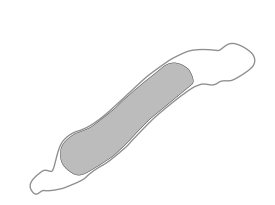 Schematic representation of bacteria of the genus Thermotoga | |||||||||||
| Scientific classification | |||||||||||
|---|---|---|---|---|---|---|---|---|---|---|---|
| |||||||||||
| International scientific name | |||||||||||
Thermotogaceae Reysenbach 2002 | |||||||||||
Despite the fact that Thermotogaceae species are negatively stained according to Gram, they are surrounded by a single lipid membrane, thus being monoderm bacteria [7] [8] . Relatively recently, representatives of Thermotogaceae were discovered that exist at mesophilic temperatures [9] .
Content
Taxonomy
The Thermogood family is the only representative of the Thermotogales order, also the only one in the Thermotogae type and class. As of July 2015, the family includes 10 genera [10] :
- Defluviitoga Ben Hania et al. 2012
- Fervidobacterium Patel et al. 1985
- Geotoga Davey et al. 1993
- Kosmotoga DiPippo et al. 2009 emend. Nunoura et al. 2010 [ syn. Thermococcoides Feng et al. 2010 ]
- Marinitoga Wery et al. 2001
- Mesotoga Nesbø et al. 2013
- Oceanotoga Jayasinghearachchi and Lal 2011
- Petrotoga Davey et al. 1993
- Thermosipho Huber et al. 1989 emend. Ravot et al. 1996
- Thermotoga Stetter and Huber 1986 typus
Another genus is part of the family according to the NCBI : Thermopallium Duckworth et al. 1996 [11] .
It was found that in a phylogenetic tree constructed on the basis of 16S rRNA sequences , Thermotogae branch with Aquificae (another type consisting of hyperthermophilic organisms) near the branching point of bacteria and archaea [5] [6] . However, the deep kinship between Thermotogae and Aquificae , as well as the early branch of the latter, are not confirmed by phylogenetic studies based on a comparison of the sequences of other genes and proteins [12] [13] [14] [15] , as well as conservative taxa-specific indels (inserts and deletions) in several highly conserved ubiquitous proteins [16] . Thermotoga e has also attracted the attention of scientists due to reports of the likely very significant horizontal gene transfer between these bacteria and archaea [17] [18] . However, recent studies based on more reliable methods show that cases of horizontal gene transfer between Thermotogae and other groups, including Archaea , are not as widespread as was suggested in earlier studies [19] [20] [21] [22] .
Characteristic molecular genetic traits
Until recently, no biochemical or molecular genetic markers were known that distinguished species of the Thermotogae type from all other bacteria [5] . However, recent comparative genomic analysis revealed a large number of conserved taxon-specific indels (inserts and deletions) (“preserved signature indel”, CSIs) in important proteins that are specific for either the entire Thermotogae type or some of its subgroups [21] .
Eighteen of these conserved indices in proteins important for life, such as Pol1, RecA, TrpRS and ribosomal proteins L4, L7 / L12, S8, S9, etc., are unique and are present in all Thermotogaceae species whose genome was sequenced . In addition, these studies also revealed 14 conservative indones specific to the clade , including the genera Fervidobacterium and Thermosipho , 12 conservative indones specific to the genus Thermotoga (except Thermotoga lettingae ), and 8 conservative indels that can serve as molecular markers for species of the genus Thermosipho [21] .
Also, the existence of a separate clade, consisting of the species Petrotoga mobilis , Kosmotoga olearia, and Thermotogales bacterium mesG1, early branching from the main trunk of the phylogenetic tree, is justified by the presence of 7 conserved indones common to these species [21] . In addition, the authors report that some CSIs confirm data on horizontal gene transfer between Thermotogae and other groups of prokaryotes [21] .
Phylogeny
The taxonomy adopted today is based on the List of Prokaryotic names with Standing in Nomenclature (LPSN) [10] [23] and phylogeny corresponds to the release of The All-Species Living Tree Project 111 based on 16S rRNA sequences [24] .
| |||||||||||||||||||||||||||||||||||||||||||||||||||||||||||||||||||||||||||||||||||||||||||||||||||||||||||||||||||||||||||||||||||||||||||||||||||||||||||||||||||||||||||||||||||||||||||||||||||||||||||||||||||||||||||||||||||||||||||||||||||||||||||||
Notes:
♠ The strain is found in the National Center for Biotechnology Information NCBI, but is not listed in the List of Prokaryotic names with Standing in Nomenclature (LPSN)
♥ The strain is absent in the National Center for Biotechnology Information NCBI, but is indicated in the List of Prokaryotic names with Standing in Nomenclature (LPSN)
Application
Because of their ability to feel good at high temperatures, some Thermotogaceae species are considered attractive candidates for use in industrial processes [25] . The ability of Thermotogaceae in the process of metabolism to use various complex hydrocarbons , while emitting hydrogen gas, leads to the fact that these species are mentioned as a possible biotechnological energy source, alternative to fossil fuels [26] .
See also
- Eubacteria taxonomy
Notes
- ↑ Shatalkin A.I. On the book "Installation of the Tree of Life" // Journal of General Biology. - 2006. - T. 67 , No. 3 . - S. 227-236 .
- ↑ Trotsenko Yu.A., Doronina N.V., Lee C.D., Reshetnikov A.S. Moderately haloalkalophilic aerobic methylobacteria // Microbiology. - 2007. - T. 76 , No. 3 . - S. 293-305 .
- ↑ Shatalkin A.I. The highest level of division of the classification of organisms. 3. Single-film (Monodermata) and Two-film (Didermata) organisms // Journal of General Biology. - 2004. - T. 65 , No. 3 . - S. 195-210 .
- ↑ Zavarzin G.A. Proteobacteria: ecological principle in the taxonomy of prokaryotes (rus.) // Nature . - Science , 1990. - No. 5 . - S. 11 .
- ↑ 1 2 3 Huber, R. and Hannig, M. (2006) Thermotogales. Prokaryotes 7: 899-922.
- ↑ 1 2 Reysenbach, A.-L. (2001) Phylum BII. Thermotogae phy. nov. In: Bergey's Manual of Systematic Bacteriology, pp. 369-387. Eds DR Boone, RW Castenholz. Springer-Verlag: Berlin.
- ↑ Gupta RS Protein phylogenies and signature sequences: A reappraisal of evolutionary relationships among archaebacteria, eubacteria, and eukaryotes (Eng.) // Microbiol Mol Biol Rev: journal. - 1998. - Vol. 62 . - P. 1435-1491 . - PMID 9841678 .
- ↑ Gupta RS Origin of diderm (Gram-negative) bacteria: antibiotic selection pressure rather than endosymbiosis likely led to the evolution of bacterial cells with two membranes // Antonie van Leeuwenhoek: journal. - 2011 .-- Vol. 100 . - P. 171-182 . - DOI : 10.1007 / s10482-011-9616-8 . - PMID 21717204 .
- ↑ Nesbo CL, Kumaraswamy R., Dlutek M., Doolittle WF, and Foght J. Searching for mesophilic Thermotogales bacteria: “mesotogas” in the wild // Appl Environ Microbiol: journal. - 2010 .-- Vol. 76 . - P. 4896-4900 . - DOI : 10.1128 / AEM.02846-09 . - PMID 20495053 .
- ↑ 1 2 LPSN: Classification of domains and phyla - Hierarchical classification of prokaryotes (bacteria)
- ↑ NCBI: Thermotogaceae
- ↑ Klenk HP, Meier TD, Durovic P., et al. RNA polymerase of Aquifex pyrophilus : Implications for the evolution of the bacterial rpoBC operon and extremely thermophilic bacteria (Eng.) // J Mol Evol: journal. - 1999. - Vol. 48 . - P. 528-541 . - PMID 10198119 .
- ↑ Gupta RS The phylogeny of Proteobacteria: relationships to other eubacterial phyla and eukaryotes (English) // FEMS Microbiol Rev: journal. - 2000. - Vol. 24 . - P. 367-402 . - PMID 10978543 .
- ↑ Ciccarelli FD, Doerks T., von Mering C., Creevey CJ, Snel B., and Bork P. Toward automatic reconstruction of a highly resolved tree of life (Eng.) // Science: journal. - 2006. - Vol. 311 . - P. 1283-1287 . - DOI : 10.1126 / science.1123061 . - PMID 16513982 .
- ↑ Di Giulio M. The universal ancestor was a thermophile or a hyperthermophile: Tests and further evidence (English) // J Theor Biol: journal. - 2003. - Vol. 221 . - P. 425-436 . - PMID 12642117 .
- ↑ Griffiths E. and Gupta RS Signature sequences in diverse proteins provide evidence for the late divergence of the order Aquificales. (English) // International Microbiol: journal. - 2004. - Vol. 7 . - P. 41-52 . - PMID 15179606 .
- ↑ Nelson KE, Clayton R., Gill S. et al. Evidence for lateral gene transfer between Archaea and Bacteria from genome sequence of Thermotoga maritima (English) // Nature: journal. - 1999. - Vol. 399 , no. 6734 . - P. 323—329 . - DOI : 10.1038 / 20601 . - PMID 10360571 .
- ↑ Nesbo CL, L'Haridon S., Stetter KO, and Doolittle WF Phylogenetic analyses of two "Archaeal" genes in Thermotoga maritima reveal multiple transfers between Archaea and Bacteria (Eng.) // Mol Biol Evol: journal. - 2001. - Vol. 18 . - P. 362-375 . - PMID 11230537 .
- ↑ Ochman H., Lawrence JG, and Groisman EA Lateral gene transfer and the nature of bacterial innovation (Eng.) // Nature: journal. - 2000. - Vol. 405 . - P. 299-304 . - PMID 10830951 .
- ↑ Zhaxybayeva O., Swithers KS, Lapierre P., et al. On the chimeric nature, thermophilic origin, and phylogenetic placement of the Thermotogales (English) // Proc Natl Acad Sci USA: journal. - 2009. - Vol. 106 . - P. 5865-5870 . - DOI : 10.1073 / pnas.0901260106 . - PMID 19307556 .
- ↑ 1 2 3 4 5 Gupta RS and Bhandari V. Phylogeny and molecular signatures for the phylum Thermotogae and its subgroups // Antonie Van Leeuwenhoek: journal. - 2011 .-- Vol. 100 . - P. 1–34 . - DOI : 10.1007 / s10482-011-9576-z . - PMID 21503713 .
- ↑ Kunisawa T. Inference of the phylogenetic position of the phylum Deferribacteres from gene order comparison (Eng.) // Antonie van Leeuwenhoek: journal. - 2011 .-- Vol. 99 . - P. 417-422 . - DOI : 10.1007 / s10482-010-9492-7 . - PMID 20706870 .
- ↑ Sayers et al. Thermotogae . National Center for Biotechnology Information (NCBI) taxonomy database [1] . Date of treatment March 20, 2013.
- ↑ All-Species Living Tree Project . 16S rRNA-based LTP release 111 (full tree) . Silva Comprehensive Ribosomal RNA Database [2] . Date of treatment March 20, 2013.
- ↑ Eriksen NT, Riis ML, Holm NK, and Iversen N. H (2) synthesis from pentoses and biomass in Thermotoga spp. (English) // Biotechnol Lett. : journal. - 2010 .-- Vol. 33 , no. 2 . - P. 293-300 . - DOI : 10.1007 / s10529-010-0439-x . - PMID 20960218 .
- ↑ Conners SB, Mongodin EF, Johnson MR, Montero CI, Nelson KE, and Kelly RM Microbial biochemistry, physiology, and biotechnology of hyperthermophilic Thermotoga species (English) // FEMS Microbiol Rev: journal. - 2006. - Vol. 30 . - P. 872–905 . - PMID 17064285 .