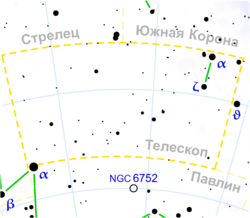
RR Telescope (RR Telescopii) is a symbiotic star in the constellation Telescope . In the period from 1889 to 1944, its photographic magnitude varied in the range from 12 m , 5 to 16 m , 6. At the end of 1944, it broke out, increasing its brightness by 6 magnitudes to about 6 m , 6. However, this outbreak was not noticed until July 1948 , when it was called New in the 1948 Telescope ( Nova Telescopium 1948 ). Only a study of the archive of photographic plates allowed us to establish a more accurate flash time. After the flare, the star slowly decreased brightness, while significant changes occurred in its spectrum . As of August 2013, its apparent magnitude is about 12 m .
| RR Telescope | |||
|---|---|---|---|
| Double star | |||
| Observational data ( Age J2000.0 ) | |||
| Type of | Symbiotic star | ||
| Right ascension | |||
| Declination | |||
| Distance | 8500 St. years (2600 pc ) | ||
| Visible magnitude ( V ) | V max = +6.50 m , V min = +16.50 m [one] | ||
| Constellation | Telescope | ||
| Astrometry | |||
| Radial velocity ( R v ) | -61.8 [1] km / s | ||
| Own movement (μ) | RA: 8.8 ± 4.4 mas per year Dec: −1.7 ± 4.1 mas per year | ||
| Specifications | |||
| Spectral class | |||
| Variability | Symbiotic variable | ||
| |||
| Database Information | |||
| SIMBAD | data | ||
| The star has 2 components Their parameters are presented below: | |||

Content
Observation conditions
In Russia, a star, like the constellation of the Telescope , is not observed. Visibility starts at the 35th north parallel . However, as the precession begins, the star will become visible in the middle latitudes of Russia by about 6000 BC. e.
1944 Observation History and Outbreak
The RR of the Telescope was periodically observed by a research program at the South Station at Harvard College Observatory, starting in 1889, as well as other southern observatories. Williams Fleming in 1908 reported variations in the brightness of the star in the range from 9 m to 11 m , 5 and suggested that the RR of the Telescope could belong to the same type of stars as SS Swan [5] . A review of later records showed a small irregular variability of brightness in the range from 12 m , 5 to 14 m , until about 1930 . At that time, the star began to show slow periodic changes in brightness between 12 m and 16 m ; [6] . The period of these brightness changes was 387 days, and the star was characterized as a peculiar semi-regular variable [7] . Before the outbreak of 1944, there were no spectra of the star, since it was too weak and was not even included in the Henry Draper catalog . At the end of 1944, an explosion occurred on the surface of the star and the RR of the Telescope increased its brightness by about 7 values for about four years: in September-October 1946, its brightness was estimated at 7 m , 4, in March 1948, its brightness was 7 m . 0, and in July 1948 - 6 m , 0 [2] [5] . In July 1949, the star began to slowly dim. The star was initially classified as a new one , but the Soviet astronomer P. N. Kholopov noticed its resemblance to the FU of Orion , which, however, is located, in contrast to the RR of the Telescope, a dark nebula [8] . Further studies showed that the star is not at the initial stage of evolution, but at the final.
The first spectroscopic observations were made in June 1949, and the spectrum turned out to be the pure absorption spectrum characteristic of yellow supergiants (F5 [8] ). The following spectra were recorded in September – October of the same year, and by this time the nature of the spectrum changed to continuous with many emission lines , but without noticeable absorption lines [9] .
Brightness Drop
In visible light, the RR of the Telescope began to steadily (although not at a constant speed) reduce its brightness since 1949 . In 1977, its magnitude was 10 m , 0 [10] , and in mid- 2013 it was about 11 m , 8. Its spectrum has retained its character, although new emission lines appeared in it, including the allowed and forbidden lines of many metals. In 1960, absorption lines due to the presence of titanium oxide (TiO) were noticed, which is a sign of spectral class M stars [10] .
At other wavelengths, the RR of the Telescope began to be observed as appropriate technologies developed. Using infrared photometry, radiation was detected in the range from 1 to 20 μm , which indicates the presence of circumstellar dust with a temperature of several hundred Kelvin . Shorter wavelength observations were even more productive. The RR of the telescope was observed in the ultraviolet range using the IUE , an ultraviolet spectrometer aboard the Voyager 1 and the Hubble Space Telescope , and in the X-ray range using the Einstein Observatory , EXOSAT and ROSAT [3] . Observations in the ultraviolet range , in particular, made it possible to directly detect the white dwarf included in the RR system of the Telescope, which was impossible before the advent of space observatories .
Physical Model of the RR Telescope System
The RR Telescope's symbiotic star consists of a red giant , which is at the last stage of its evolution and revolves around a white dwarf , with a significant amount of hot gas and dust around both stars. The red giants in the final stages of evolution are often called myids , implying the pulsating nature of these giant stars. Observations in the infrared range and studies of the infrared spectrum make it possible to attribute the star to the spectral type M5III [2] . Cold pulsating variables produce a large amount of circumstellar dust carried away by the slow stellar wind flowing down from such stars. No shifts of spectral lines were found in the spectrum , therefore, the distance between the components is probably quite large (several AU ), and the orbital period is estimated at several years or even decades.
In the dormant phase, which precedes the flash phase, the red giant pulsates and loses mass. These ripples were clearly visible from 1930 until the outbreak in 1944 . Part of the substance lost by the red giant falls on the white dwarf by accretion . This hydrogen- enriched substance settles on its surface, forming a layer of hydrogen that becomes dense and hot enough to trigger nuclear fusion reactions . The sudden intense thermonuclear combustion of hydrogen on the surface of a white dwarf leads to an explosion.
The layer of precipitated substance is thick enough to cause a significant expansion of the surface and increase its temperature from 5000 K to 10 000 K , which will lead to the appearance of a spectrum of yellow supergiant , which it was until the summer of 1949 . As energy production continues, the precipitated matter continues to heat up, it becomes more highly ionized and less dense, so that it becomes increasingly difficult for emerging radiation to leave the star’s surface: the spectrum becomes like a blackbody spectrum, gradually shifting the emission peak to a range of ever shorter wavelengths due to with increasing gas temperature. In the visible part of the spectrum, the radiation intensity decreases, but hot ionized gas gives a rich variety of emission lines for many metals. The brightness of the system remains constant, so that the observed radiation comes from a gradually decreasing, but constantly increasing temperature region of space around the white dwarf . An analysis of the data in the optical , ultraviolet, and X-ray ranges in the early 1990s showed that the effective temperature of the white dwarf is about 142,000 K , and the luminosity is 3,500 L ☉ (bolometric), the gravity on its surface is about 100 times more than solar, and its mass is about 0.9 M ☉ . There is also a small gas region with a temperature of several million K , which is the product of the collision of stellar winds from two stars. Hot white dwarfs often blow stellar winds at higher speeds than winds from the red giants : the stellar wind from the white dwarf of the RR Telescope system has a speed of about 500 km / s and heats the gas to millions of degrees [3] .
Notes
- ↑ 1 2 NOVA Tel 1948 - Nova , SIMBAD Astronomical Object Database , < http://simbad.u-strasbg.fr/simbad/sim-id?Ident=RR+Tel >
- ↑ 1 2 3 Robinson, EL Preeruption light curves of novae (unknown) // The Astronomical Journal . - IOP Publishing . - T. 80 . - S. 515 . - DOI : 10.1086 / 111774 . - .
- ↑ 1 2 3 4 5 Jordan, S .; Murset, U .; Werner, K. A model for the X-ray spectrum of the symbiotic nova RR Telescopii (Eng.) // Astronomy and Astrophysics : journal. - EDP Sciences 1994. - Vol. 283 . - P. 475-482 . - .
- ↑ SIMBAD Astronomical Database
- ↑ 1 2 de Kock, RP RR Tel. (195656) (unknown) // Monthly Notes of the Astronomical Society of South Africa. - T. 7 . - S. 74 . - .
- ↑ Mayall, Margaret W. Recent Variations of RR Telescopii (unknown) // Harvard Observatory Bulletin. - 1949. - February. - S. 15-17 . - .
- ↑ Gaposchkin, Sergei. Variable Stars in Milton Field 53 (unknown) // Harvard Annals. - 1952. - T. 115 . - S. 11-23 . - .
- ↑ 1 2 Yu. N. Efremov. CHUGAYNOV STAR (HTML) (inaccessible link) . UNUSUAL VARIABLE STARS . Archived October 12, 2007.
- ↑ Thackeray, AD Five southern stars with emission-line spectra (unknown) // Monthly Notices of the Royal Astronomical Society. - 1950 .-- T. 110 . - S. 45 . - .
- ↑ 1 2 Thackeray, AD The evolution of the nebular spectrum of the slow nova RR Telescopii (Eng.) // Memoirs of the Royal Astronomical Society: journal. - 1977. - Vol. 83 . - P. 1-68 . - .