Arsinoterium ( Latin Arsinoitheriidae ) is a family of extinct mammals from the order of the embrytopods . These animals lived in the Eocene - Oligocene of Africa , Asia and Europe . Arsinoyuterium fossils in different years [ what? ] found in Southeastern Europe, including Crivadiatherium in Romania, Hypsamasia and Palaeoamasia in Turkey.
| † Arsinoteric |
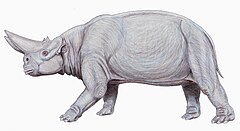
Reconstruction of Arsinoitherium zitteli | 
Reconstruction of Arsinoitherium giganteum |
|
| Scientific classification |
|---|
| No rank : | Bilateral symmetric |
|
| International Scientific Name |
|---|
Arsinoitheriidae , 1904 |
|
Content
Growth representatives of the largest species up to 2.1 m at the withers. On the nose, the representatives of the genus Arsinoyteria had a pair of very large and massive bone horns. Whether maternity horns have such horns is unknown to science, since the corresponding part of their skull has not yet been found.
These sedentary animals kept in swampy places. The structure of the teeth indicates an early stage of adaptation to the diet of hard vegetable food.
According to the Fossilworks website, as of January 2017, the family includes 2 extinct subfamilies and 5 extinct genera [1] :
- The genus Namatherium Pickford et al. , 2008 - Inventory [2]
- Subfamily Arsinoitheriinae Sen & Heintz, 1979
- Genus Arsinoitherium Beadnell, 1902 - Arsinoterium
- Subfamily Palaeoamasiinae Sen & Heintz, 1979
- The genus Crivadiatherium Radulesco et al. , 1976
- Genus Hypsamasia Maas et al. 1998
- Genus Palaeoamasia Ozansoy, 1966
- ↑ † Arsinoitheriidae (English) information on the Fossilworks website. (Checked February 10, 2017) .
- ↑ Pickford M., Senut B., Morales J., Mein P., and Sanchez IM 2008. Mammalia from the Lutetian of Namibia. Memoir of the Geological Survey of Namibia 20 : 465-514.
