Patagosaurus ( Latin Patagosaurus fariasi ) is a species of large dinosaurs belonging to the monotypic genus from the Eusauropoda group of the larger group of sauropods . Known from remains from Middle Jurassic sediments found in what is now Argentina. Like other sauropods, the pathagosaur was a large four-legged herbivorous animal with a long neck and tail , with a dense, overweight body [1] .
| † Patagosaurus | |||||||||||||||||||||||||||||||||||||||||||||
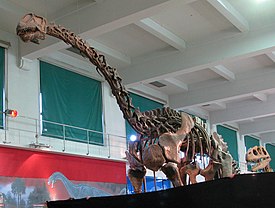 Skeleton of a patagosaurus | |||||||||||||||||||||||||||||||||||||||||||||
| Scientific classification | |||||||||||||||||||||||||||||||||||||||||||||
|---|---|---|---|---|---|---|---|---|---|---|---|---|---|---|---|---|---|---|---|---|---|---|---|---|---|---|---|---|---|---|---|---|---|---|---|---|---|---|---|---|---|---|---|---|---|
| |||||||||||||||||||||||||||||||||||||||||||||
| International Scientific Name | |||||||||||||||||||||||||||||||||||||||||||||
Patagosaurus fariasi Bonaparte , 1979 | |||||||||||||||||||||||||||||||||||||||||||||
| Geochronology Callovian Age 166.1-163.5 Ma
◄ Nowadays◄ Cretaceous-Paleogene extinction◄ Triassic extinction◄ Perm mass extinction◄ Devonian extinction◄ Ordovician-Silurian extinction◄ Cambrian explosion | |||||||||||||||||||||||||||||||||||||||||||||
This species is known from fragments of skeletons of at least twelve individuals. , which made him one of the most well-studied Jurassic sauropod of South America [2] . Among the discovered skeletons of pathagosaurs, there were both adult individuals and cubs, which made it possible to put forward various hypotheses about the individual development of these animals . Like other large sauropods, the pathagosaur led a herd lifestyle . Initially, the pathososaurus was classified as a representative of the cetiosaurids group, but subsequently its location on the phylogenetic sauropod tree became the subject of debate. . The first scientific description of the only known species to date, Patagosaurus fariasi , was completed by paleontologist Jose Bonaparte in 1979 [3] .
Name etymology
The generic name of this dinosaur was given to him in honor of the geographical region in which he was found - Patagonia . The exact origin of the word patagón , which Magellan used and which served as the basis for the name "Patagonia", remained unclear [4] .
The species name of this dinosaur, fariasi was given to him in honor of Ricardo Farias ( Spanish: Ricardo Farias ), a local resident who was the first to discover the remains of a pathagosaur and allowed researchers to excavate in his territory [3] .
Description
The description of the pathagosaur and its reconstruction were carried out using an almost complete skeleton [5] of an adult and the scattered remains of 11 more animals [6] . The type specimen has identification number PVL 4170 and includes some vertebrae of the neck, back and tail, as well as the sacrum, ribs, several hemal arches, and in addition to the ischial bones, pelvic bones, and some limb bones [7] .
In other words, the detailed description of this dinosaur was mainly based on postcranial elements, and the cranial part of the lizard was described on isolated isolated parts of the skull [8] , among which were found: the incisal bone of a very large specimen, both jaws of a smaller specimen (MACN identification number -CH 933 [9] ) and the lower jaw of an immature (juvenile) individual [10] (MACN-CH 933, from the northern zone of the formation [9] ).
From the available factual material, it can be concluded that the pathagosaur was rather tall and large animal, whose total body length reached 14 meters [2] . The largest recorded length of the femur of the pathagosaurus (a parameter suggesting the total size of the animal) was 52 centimeters [11] . According to alternative reconstruction methods, the total length of the pathagosaur could reach 18 meters, and weight up to 5-10 tons [1] (in some sources the value is 15 meters, 9 tons [12] ). Even taking into account the minimal estimate of the size of the pathagosaur, it is on a par with the largest representatives of the Middle Jurassic fauna [13] . He exceeded the size of his contemporary and phylogenetically close species - the herbivorous lizard, Volkmeriya , also known from the fossilized remains of the Cañadon Asfalto Formation [2] , along with which they are the only South American sauropods of the Middle Jurassic era discovered to date [5] . At the same time, the pathagosaur was inferior to the sauropods of the late Jurassic both in the development of the skeleton and in size [13] .
The main difficulty in reconstructing the appearance of the pathagosaur is the lack of a full, intact skull. Based on the available data, it can be assumed that the skull of the pathagosaur was small, about 60 cm in length [2] , but at the same time deep. The nostrils were extended to the very end of the muzzle. The crowns of the maxillary teeth had the shape of scapulae, were narrowed from below, and had notches. The teeth themselves had a spoon-shaped shape [12] , resembling the teeth of representatives of the euchelopodidae family (Euhelopodidae) [14] , in particular, the camarasaurus , as well as the brachiosaurus , a representative of the brachiosaurus family. Tooth enamel abounded with various grooves and roughnesses [15] . The vertebral column of the most complete specimen of the pathagosaur has been preserved, although not completely, but in sufficient volume to perform a detailed description [15] . It is known that the cervical vertebrae were enlarged and similar in shape and structure to the cervical vertebrae of the cetiosaurus , while the spinal vertebrae were relatively short. In the bodies of the cervical vertebrae there were significant lateral cavities, and in the dorsal they did not reach such a size. The patagosaurus sacrum consisted of five fused vertebrae. The thigh of the lizard was almost straightened and had a pronounced “fourth trochanter” (one of two processes located under the neck of the femur); on a relatively short tibia there was a large bulge [2] .
The fossilized bones, which included a typical specimen of the pathagosaurus, PVL 4170, had the following properties: the length of the coracoid (coracoid process) was 560.0 millimeters, the length of the femur was 1550.0 millimeters, the size of the scapula was 1240.0 × 205.0 millimeters [16] . The ratio of the lengths of the femur and tibia in a juvenile individual is 1: 1.5; in an adult - 1: 1.65; and in the instance of PVL 4076 - 1: 1.72 [17] .
In addition to its close relative, the cetiosaurus, the pathagosaur also resembled a haplocanthosaurus from North America, but was more primitive [5] .
Systematics
The pathagosaur was classified as a basal representative of the Eusauropoda group [18] , which included almost all sauropods. However, its exact systematic position among this group is a matter of debate. According to one hypothesis, the pathagosaur was combined with the cetiosaur and barapasaur into the family of cetiosaurids . This hypothesis was supported by the paleontologist Paul Apcherch, who recognized the monophilia of cetiosaurids, and his colleagues [6] . Additional findings cast doubt on the monophilia of this family, and as an alternative hypothesis in 2009, Fernando Novas suggested that the genus pathagosaur is a “sister” taxon neosauropod [2] . Researcher Oliver Rauhut holds a similar position on the basis of the structure of the teeth of the pathososaurus [19] .
Location and age of finds
The fossilized remains of the pathagosaur were found in the Argentinean province of Chubut , 5 kilometers north of the village of Cerro Condor ( Spanish Cerro Cóndor ) and 100 meters west of the path that connects this village with the department of Paso de Indios [20] . The deposits in which the bones were found belong to the Cañadón-Asfalto Formation. Initially, this formation was considered to be confined to the Callovian stage (the upper part of the Middle Jurassic era), in particular, paleontologists Tidwell and Carpenter adhered to this opinion [21] . However, paleontologists are currently concluding that this deposit is much older and belongs to the time interval between the Toar and Bati tiers. From this we can conclude that the age of the deposits in which the remains of the pathagosaurus were found exceeds the similar deposits for the North American sauropod by 15 million years [5] .
According to some sources, the pathososaurus was the last of the cetiosaurids and became extinct at the end of the Callovian tier, just before the appearance of the Jensenia [22] .
As for the time period of the habitat of the pathagosaur, it is estimated at 166.1-163.5 million years ago [23] .
Finds that can be attributed to the pathagosaur are the most common among dinosaurs in this formation [11] . Among other dinosaurs whose fossils were found in these sediments, mention should be made of the sauropod wolumeria, the theropod of the Eoabelisaurus , Pyatnitskizavra and condorraptor , as well as heterodontosauride of mandense [11] . It is known that Jurassic dinosaurs in South America have not reached such a variety as on other continents. However, paleontological excavations in these places were started recently, and therefore it is possible that their list will expand over time [24] ).
To date, there are 3 collections of the remains of a pathagosaur from one deposit, which are stored in museums in Argentina [23] .
Paleobiology and paleoecology
Modern theories about the biology and evolution of the sauropod of the Middle Jurassic era rely mainly on factual material related to the fossils of the cetiosaurus and the pathagosaurus. The remains of the latter found by paleontologists belonged to both adults and young animals, which allowed us to study the individual development ( ontogenesis ) of these animals. In particular, it can be concluded that in young individuals of the pathososaurus, the vertebrae had spinous processes and small lateral cavities. In adults, these parts of the skeleton were proportionally higher, but their remains were more blurred [2] .
In 1994, the Argentinean paleontologist Rodolfo Coria noted the fact that the remains of five of the known specimens of pathagosaurs were found on one site with an area of 15 × 4 meters. Such sites are usually called the "bone bed" ( Eng. Bone bed ). The discovered Korya site contains exclusively the remains of pathagosaurs, while the skeletons of any other animals are absent (such accumulations of fossils are called monospecific). According to the Argentinean specialist, this unusual phenomenon is due to the fact that the pathagosaurs lived in groups. He believes that this herd was flooded with a storm wave. The scientist also noted that among the members of the herd were two adult animals and three cubs of different ages. This fact may indicate that pathagosaurs had rather complex social behavior, and adult individuals could take care of their offspring [25] .
The discovery of the remains of the herbivorous pathagosaur and the carnivorous Friday Kizaurus in the same formation gave reason to believe that the first had to encounter this predator [26] . Pyatnitskizavr is described as a large representative of the theropod group, which, according to some sources, could even be compared to an allosaurus in size and posed a serious threat to herbivores of this ecosystem [5] . Researchers disagree on whether the Pyatnitsizaurus hunted adults of the pathagosaur (which was three times the size of the Pyatnitsaurus) [24] .
Notes
- ↑ 1 2 Bob Strauss. Patagosaurus (English) . About.com Guide . dinosaurs.about.com . Date of treatment October 8, 2013.
- ↑ 1 2 3 4 5 6 7 Fernando E. Novas. The age of dinosaurs in South America. - Indiana University Press. - Bloomington, 2009. - P. 103-107. - ISBN 978-0-253-35289-7 .
- ↑ 1 2 JF Bonaparte. Dinosaurs: a Jurassic assemblage from Patagonia // Science. - 1979. - Vol. 205, No. 4413 . - P. 1377-1379. - DOI : 10.1126 / science.205.4413.1377 .
- ↑ Fondebrider, Jorge. Chapter 1 - Ámbitos y voces // Versiones de la Patagonia: [] . - 1st edition. - Buenos Aires, Argentina: Emecé Editores SA, 2003 .-- P. 29. - ISBN 950-04-2498-3 .
- ↑ 1 2 3 4 5 Patagosaurus: Animal Planet . Discovery Communications, LLC. animal.discovery.com (2013). Date of treatment November 18, 2013. (unavailable link)
- ↑ 1 2 Dodson et al, 2004 , p. 302.
- ↑ Bonaparte, 1986 , p. 2
- ↑ Dodson et al, 2004 , p. 272-273.
- ↑ 1 2 Bonaparte, 1986 , p. five.
- ↑ Bonaparte, 1986 , p. four.
- ↑ 1 2 3 Diego Pol, Oliver WM Rauhut. A Middle Jurassic Abelisaurid from Patagonia and the Early Diversification of Theropod Dinosaurs // Proceedings of the Royal Society B: Biological Sciences. - 2012. - Vol. 279, No. 1741 . - P. 3170-3175. - DOI : 10.1098 / rspb.2012.0660 .
- ↑ 1 2 Davidson S., Turnbull S., Firth R., 2005 , p. 127.
- ↑ 1 2 Patagosaurus . prehistoric-wildlife.com (2013). Date of treatment October 8, 2013.
- ↑ Tidwell et al, 2005 , p. 223.
- ↑ 1 2 Bonaparte, 1986 , p. 6
- ↑ Fossilworks: Patagosaurus fariasi . fossilworks.org . Date of treatment November 18, 2013.
- ↑ Bonaparte, 1986 , p. 23.
- ↑ Dodson et al, 2004 , p. 272.
- ↑ Rauhut, OW (2003). A dentary of Patagosaurus (Sauropoda) from the Middle Jurassic of Patagonia. Ameghiniana, 40 (3), 425-432
- ↑ Bonaparte, 1986 , p. 3
- ↑ Tidwell et al, 2005 , p. 433.
- ↑ Kristina Curry Rogers, Jeffrey A. Wilson. The Sauropods: Evolution and Paleobiology . - University of California Press, 2005. - P. [139] (col. 2). - 349 p.
- ↑ 1 2 Patagosaurus fariasi . Paleobiology Database Classic . (Retrieved October 21, 2016) .
- ↑ 1 2 Davidson S., Turnbull S., Firth R., 2005 , p. 51.
- ↑ Rodolfo A. Coria. On a monospecific assemblage of Sauropod Dinosaurs from Patagonia: Implications for gregarious behavior (English) // GAIA: Journal. - 1994 .-- P. 209-213. - ISSN 08715424 .
- ↑ Lucas, SG Global Jurassic tetrapod biochronology // Volumina Jurassica. - 2008. - Vol. 6, No. 6 . - P. 99-108. Archived January 12, 2014.
Literature
- Davidson S., Turnbull S., Firth R. Big Atlas of Dinosaurs / Ovchinnikova N.N., Talalaeva E.V .. - M .: CJSC ROSMEN-PRESS, 2005. - 144 p. - ISBN 5-353-01605-X .
- Sauropoda // The Dinosauria: Second Edition / David Weishampel, Peter Dodson, Halszka Osmolska. - Berkeley and Los Angeles, California: University of California Press, 2004 .-- ISBN 0-520-24209-2 .
- Thunder-lizards: The Sauropodomorph Dinosaurs / Virginia Tidwell, Kenneth Carpenter. - Bloomington, USA: Indiana University Press, 2005 .-- ISBN 0-253-34542-1 .
- Bonaparte, JF 1986. Les dinosaures (Carnosaures, Allosauridés, Sauropodes, Cétosauridés) du Jurassique Moyen de Cerro Cóndor (Chubut, Argentina) . Annales de Paléontologie (Vert.-Invert.) 72 (4): 325-386. Translated by Matthew Carrano, University of Chicago, October 1995.