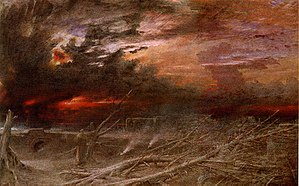
Great tribulation ( dr. Greek θλίψις μεγάλη ) is a concept in Christian eschatology , meaning the time of great grief and cruel suffering of mankind [1] . Great tribulation is described both in the “apocalyptic” chapters of the Gospels ( Matthew 24: 1-51 , Mark 13: 1-37 ), and in the book of Revelation ( Rev. 2:22 , Rev. 7:14 ).
 | When you hear about wars and rumors of war, do not be horrified: for this must be done - but that is not the end. For the people will rise against the people and the kingdom against the kingdom; and there will be earthquakes in places, and there will be smoothness and turmoil. This is the beginning of disease <...> But the brother of the brother will die for death, and the father of children; and the children will rise up on their parents and put them to death <...> Woe to those who are pregnant and nursing in those days <...> For in those days there will be such sorrow that was not from the beginning of the creation that God created, even now, and not will be. ( Mark 13: 7-19 ) |  |
In the Old Testament , presumably, allusions to the Great Tribulation are contained in a number of prophetic books, for example, in chapter 12 of the book of the prophet Daniel [2] . In general, the Great Tribulation is briefly mentioned in the Bible, and the prophecies are symbolic, therefore, in Christian eschatology there are very different opinions on how and when the time of the Great Tribulation will come [1] . Disputes are also underway about whether the Church will escape this period (see the article “The Rapture of the Church ”).
Popular methods for interpreting the prophecies of the Great Tribulation are listed below (many interpreters do not use these methods in pure form, but synthesize with each other [3] ).
Content
Futurism
From the point of view of interpreters holding this view, the time of the Great Tribulation will be a relatively short period when everyone who did not follow Christ until the time of the Rapture of the Church ( according to the unfortunate doctrine ) will suffer from natural disasters, famine, wars, diseases , - resulting in the death of about 75% of the population.
Some Christians holding a dispensationalist view of history suggest that during the Great Tribulation (or after it) the Second Coming of Jesus Christ and the Last Judgment will occur.
According to another view, the period of Great Tribulation will last seven years. According to this view, Great Tribulation is the last of the seventy weeks of the book of the prophet Daniel ( Dan. 9: 24-27 ), (a week ( Heb. שבוע ) is seven months, days or years; a week). This view became popular among Protestants in the 19th century thanks to John Nelson Darby . According to this version, each week is seven years. The prophecy of Daniel says that after 7 and 62 (that is, a total of 69), the week will be cut off from the Persian king’s command to restore Jerusalem (in the original text, the Anointed ), “it will be put to death " ).
According to this theory, exactly 483 years have passed since the decree of the Persian king Artaxerxes on the restoration of Jerusalem to the death of Jesus Christ (69 weeks x 7 years).
Then supporters of this theory suggest a break of indefinite length, after which the last, seventieth week will begin.
Some commentators divide the seventieth week in half, while the second 3.5 years are usually considered Great Tribulation. The reason for this is a verse about the abomination of desolation in the second half of the week ( Dan. 9:27 ); a verse about “time and time and half time” ( Dan. 7:25 ), which is interpreted as 1 year + 2 years + half a year; verses about 1260 days ( Rev. 11: 3 , Rev. 12: 6 ) because 1260/30 = 42 months or 3.5 years and about 1290 days ( Dan. 12:11 ), where the difference of 30 days is interpreted as an addition to counting “long months” with 31 days or as extra time to prepare for the beginning of the Millennium .
Events
Among futurists, there are different points of view about what will happen to Christians during the Great Tribulation:
- The pre-tribulists (“miserables”) believe that all Christians (living and risen from the dead) will be bodily raptured (ascended) to heaven (see The Rapture of the Church ) before the Great Tribulation. They believe that every true Christian who has lived throughout the history of the Church, in anticipation of the Great Tribulation, will instantly find a new ideal body and avoid the trials of tribulation ( “I tell you the secret: we will not all die, but everything will change suddenly, in the blink of an eye, at the last to the trumpet: for it shall sound, and the dead will be raised imperishable, and we will be changed. For this perishable one must put on incorruption, and this mortal put on immortality ”( 1 Cor. 15: 51-53 ). After the tribulation, Christ will return with the Church to establish His Millennial Kingdom .
- The “tributaries” tribalists believe that the rapture of the Church will occur during tribulation (in the middle or at the end), but before the outpouring of the seven chalices of God's wrath.
- The Seventh Trump tribalists hope in the Rapture of the Church until the seven chalices of God's wrath are poured out at the sound of the seventh trumpet ( Rev. 11:15 , 1 Cor. 15:52 ).
- Midtributionists (“medium-sorbers”) believe that the Church will be delighted in the middle of the 7-year period of tribulation, which they divide into two halves - “the onset of illness” and “Great tribulation” itself.
- Post-tribulists (“post-sorrows”) believe that Christians will be on earth during the Great Tribulation, and at the end they will be gathered by Christ into the Kingdom of God on earth. ( “And suddenly, after the tribulation of those days ... the sign of the Son of Man will appear ... and they will gather His elect, from the four winds, from the edge of heaven to their edge” Matthew 24: 29-31 ) . Post-tribulists believe that the seventh trumpet mentioned in the Book of Revelation is the same trumpet mentioned in 1 Cor. 15:52 .
Thus, pretributionists and midtributionists believe that the rapture of the Church and the Second Coming of Christ for judgment in the world are different events, separated by a time interval. Post-tribulists believe that these two events will occur simultaneously or one after another.
Preterism
From a preterist point of view, the Great Tribulation took place in the past, when in the year 70 according to R.H. , at the final stage of the First Judean War, the Roman legions after a long siege destroyed Jerusalem and its Temple . These events, in their opinion, influenced not so much on world history as on the history of the Jewish people.
Preterists believe that the Great Tribulation was God's judgment upon the Jews for their sins, including the rejection of Jesus as the promised Messiah .
The preterist interpretation of Sorrow focuses on the prophetic passages of the Gospels — the 24th chapter of Matthew , 13th chapter of Mark and 21th chapter of Luke , and not on the Book of Revelation . (However, the preterists attribute a large part of the symbols of the book of Revelation to the Roman Empire , Caesars and their persecution of Christians, not Jews).
The words of Jesus that “before this tribulation comes ” “this generation shall not pass” ( Matthew 24:34 ) are attached by the preterists to Jesus warning the scribes and Pharisees that “the righteous blood ... will come to this generation” ( Matthew 23:35 -36 ). That is, we are talking about the first century, and not in the future tense.
Jesus' words about the “abomination of desolation spoken through the prophet Daniel” ( Matthew 24:15 ) are tied by the preterists to the facts of destruction and enormous losses among Jews during the First Jewish War.
The prophecy of Jesus about the destruction of the Temple of Jerusalem “there will be no stone unturned here, that not everything will be destroyed” ( Matthew 24: 3 ), the Preterists consider it to be true, because the Temple was really destroyed to the ground, and nowhere in the Bible is it said a new temple will be erected.
The author of the popular commentary on the Bible, William Barkley, takes the preterist approach. So, commenting on the passage of Rev. 7: 13-14 , Barkley writes: “Today we read this passage as a statement about sorrow and adversity in general, and therefore attach great importance to it; we have a right to it, because the promises of God are given forever. But at the same time it will be right to remember that initially he referred to specific circumstances ” [4] .
Historicism
Another common method of interpreting the time and meaning of the Great Tribulation is historicism . As a rule, historians believe that the Great Tribulation has already passed, they bind it to certain historical events, and the characters of the Book of Revelation to certain historical figures.
Thus, the hero of Leo Tolstoy ’s novel “War and Peace” adhered to a typical historicist method when Pierre Bezukhov , when, after calculating the numerical expression of the French phrase “ Emperor Napoleon ” (with minor corrections, it turned out 666 - “the number of the beast” from the Book of Revelation), he came to the conclusion that Napoleon is the antichrist and tried to arrange an attempt on him.
Some historians interpret the Great Tribulation as a period of “persecution of the saints” (according to the prophecies of chapter 7 of the Book of the Prophet Daniel and chapter 13 of the Book of Revelation ) from the authority of the Pope . Moreover, the leaders of Protestantism during the Reformation - Martin Luther , Jean Calvin , Ulrich Zwingli - considered the Pope to be Antichrist [5] .
Historians have found their "antichrist" and signs of the fulfillment of the prophecies of the Great Tribulation in almost every historical era, including some who see them in the present tense.
Relativism (idealism)
Representatives of this school of interpretation believe that the Book of Revelation does not describe specific events of the past, present, or future, but "trends and ideals." The emergence of this method of interpretation occurs in the III – IV centuries A.D. e., this method in the interpretation of the Book of Revelation was used by Augustine [3] . Raymond Culkins very accurately conveyed the essence of the views of the school of idealists:
“Now we understand what the word revelation means. It does not mean the revelation of future secrets of the end of the world, the millennial kingdom or the Day of Judgment. Nor does it mean the revelation of the glory of heaven or the bliss of the redeemed. It means the revelation of an infinite God who can save; a revelation for the comfort and inspiration of God's people and a reminder of the all-conquering power of the omnipotent Savior ” [6] .
Relativists see the fulfillment of prophecies specifically about the Great Tribulation in various tragedies and catastrophes occurring in the world - natural disasters, wars, famines, epidemics, pain and suffering of a large number of people. Some believe that the number of different disasters in the world is growing steadily against the background of relative comfort, prosperity and peace in some countries.
Orthodox Church Position
In Orthodoxy, as in other faiths, there is no single, clear, accepted by all believers, theology regarding the Great Tribulation and, in general, the events of the Last Time . So, the famous Orthodox author [7] , Hieromonk Seraphim Rose wrote: “there are many different degrees of interpretation of the Apocalypse, so its various explanations may well be true,” for “there is no unambiguous correspondence of the images of reality” [8] .
See also
- The rapture of the church
- The Second Coming of Jesus Christ
- False Christ
- Antichrist
- Sailing
- Chiliasm
- Eschatology
- Revelation of John the Theologian (Apocalypse)
- Armageddon
- The Last Judgment
- End of the world
- Left Behind (book series)
Notes
- ↑ 1 2 Thematic Bible with comments (by The Zondervan Corporation, Editor Dirk R. Buursma, M. Div), Russian translation, Minsk, Belarusian Press House, 1997. ISBN 985-6357-01-2 P.1260
- ↑ Henry Halley Bible Reference, St. Petersburg, Bible for All Christian Society, 1998. ISBN 5-7454-0212-1 P.352
- ↑ 1 2 Gontar D. B. - Understanding the Millennium in Rev. 20: 1-6
- ↑ Barkley Comments on the New Testament - Revelation of John Chapter 7
- ↑ Article "Antichrist" - Christianity. Encyclopedic Dictionary, vols. 1-3. M., 1993-1995
- ↑ Quoted from Tenny M.S. (Tenny MC) (1998) New Testament Review. SPb. "The Bible for All." S. 432.
- ↑ According to the assessment of the Orthodoxy and Peace portal, Seraphim Rose “had a tremendous impact on the Orthodox life in America” - Orthodoxy and the world. Archive Hieromonk Seraphim (Rose)
- ↑ Hieromonk Seraphim (Rose). Signs of the Times: Secrets of the Book of the Apocalypse. M., 2000.S. 58-59.
Literature
Thyssen, Henry Clarence - Lectures on Systematic Theology. SPb. Logo. 1994. ISBN 5-7454-0001-3 448 pp.
Kargel, Ivan Veniaminovich - Lectures on the Second Coming of the Lord Jesus Christ
Links
Seminar on the book "Revelation" by Doctor of Theology (PhD, University of Wales), teacher of the Moscow Theological Seminary of the ECB A.V. Popov.