San Cristován Palace ( port. Paço de São Cristóvão , also known as the Imperial Palace ) is a palace located in the Quinta da Boa Vista park in the city of Rio de Janeiro ( Brazil ). San Cristován Palace is the former residence of the emperors of Brazil , the seat of the National Museum of Brazil . Burned out in September 2018 .
| Palace | |
| San Cristovan Palace | |
|---|---|
| port. Paço de São Cristóvão | |
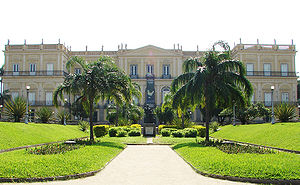 The main facade of the palace. | |
| A country |  Brazil Brazil |
| Location | |
| Architectural style | late classicism |
| Established | 1803 |
| Status | Heavily damaged by fire due to fire on September 2, 2018 |

History
At the beginning of the 19th century, the territory known as Quinta da Boa Vista belonged to Elias Antonio Lopez, a wealthy Portuguese merchant who built the estate on the top of the hill in 1803 . When the royal Portuguese court moved to Brazil in 1808 , Elias Antonio Lopez donated his estate to Prince Regent Juan VI . Juan VI appreciated the gift and stayed in it for a long time.
The Portuguese royal family has lived in the Imperial Palace since their arrival in Rio de Janeiro in 1808. To better accommodate them in 1819, Juan VI ordered to rebuild the estate, turning it into a royal palace. The reconstruction was carried out by the English architect John Johnston, which ended in 1821 . In front of the palace, Johnston installed a decorative portico , which was donated on behalf of England to Brazil by Hugh Percy, 2nd Duke of Northumberland .
After the independence of Brazil in 1822 , the palace became the residence of the Emperor of Brazil, Pedro I. The reconstruction and expansion of the palace was carried out by the Portuguese architect Manuel da Costa (1822-1826), continued by the French architect Pedro Jose Peserat (1826-1831), who is considered the author of the final appearance of the building. He installed a new tower on the left side of the main facade, and also completed the third floor of the palace. Work on the palace was continued after 1847 by the Brazilian artist Manuel de Araujo Porto Alegre , which gave harmony to the facade of the building, then the German Theodore Marx (1857-1868) worked on the San Cristovan Palace. Italian artist Mario Bragaldi decorated many rooms of the palace, including the Throne Room and the Room for the reception of ambassadors, with paintings with the reception of a blende .
After the wedding of Pedro I and Princess Maria Leopoldini of Austria in 1817, the imperial couple lived in the palace. Here the future Queen of Portugal Maria II was born, as well as the future Emperor of Brazil Pedro II . Empress Maria Leopoldina died in the walls of the palace in 1826.
Pedro II, the future emperor, grew up and was educated in the palace, and in 1869 ordered the reconstruction of his gardens. French garden designer Augustus Francois Marie Glaziu was entrusted with this project, which included the creation of picturesque lakes, bridges, caves and imitating antiquities, following the romantic fashion of the time. Children of Pedro II were also born in the palace of San Cristovan, including Isabella of Brazil , who abolished slavery in Brazil in 1888.
After the proclamation of the republic in 1889, the imperial family left the country and the palace with its gardens was empty.
In 1891, the palace building was used by Brazilian politicians as the place of writing of the First Constitution of Brazil.
In 1892, the director of the National Museum in Rio de Janeiro made his move from the Campo di Santana building to the palace of San Cristovan. The former interior of the palace ceased to exist, but its recreated details can be seen in various museums in Brazil, for example, the recreated Throne Room in the Imperial Museum in the city of Petropolis .
See also
- Quinta da Boa Vista
- National Museum of Brazil
Links
- museunacional.ufrj.br - official site of the National Museum of Brazil
- Quinta da Boa Vista e Paço de São Cristóvão Rio de Janeiro Aqui. Retrieved on 2009-07-04. (port.)