At the Battle of Al-Bukay in 1163, the crusaders and their allies inflicted one of the few defeats on Nur ad-Din Zangi , the emir of Aleppo and Damascus . King Amory I led the army of the Kingdom of Jerusalem along with contingents from the northern states of the crusaders, a significant number of pilgrims who had just arrived from France, and the army brought by the Byzantine governor of Cilicia . For Christians, this victory gave only a brief reprieve against the backdrop of a steady Muslim offensive.
| Battle of al-Bukaye | |||
|---|---|---|---|
| Main Conflict: Crusades | |||
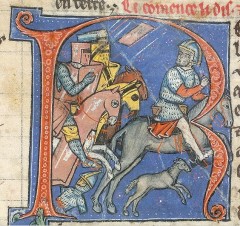 A 13th-century miniature depicting the flight of Nur al-Din Mahmoud from the battlefield. From the book of William of Tire, “Histoire d'Outremer” ( British Museum ). | |||
| date of | 1163 | ||
| A place | Bekaa Valley | ||
| Total | Victory of the crusaders | ||
| Opponents | |||
| |||
| Commanders | |||
| |||


Content
- 1 Context
- 2 battle
- 3 Consequences
- 4 notes
Context
Nur ad-Din turned out to be one of the most dangerous enemies that the Frankish kingdom has ever encountered. Starting his activity as the emir of Aleppo , he constantly increased the territory subordinate to him at the expense of his Muslim and Christian neighbors, until he occupied Damascus in 1154 . He utterly defeated the crusaders in the battle at Lake Hula in 1157 , but fell seriously ill immediately after that. This accident allowed the Franks to recover after the defeat and, with the help of Thierry of Alsace and the army of pilgrims, capture the fortress of Harim later that same year. However, the attack on Shaizar failed when Renault de Chatillon , Prince of Antioch, quarreled with other Franks. As expected, Shayzar soon became the property of Nur al-Din. In 1158, Thierry and King Baldwin III fought Nur al-Din in Butayhe, northeast of Tiberias [1] . In 1160, Renault was captured by Nur al-Din, where he remained for the next 16 years. In December 1161, the Byzantine Emperor Manuel I Komnin married Mary of Antioch, and this event gave Antioch a strong defender in the person of the emperor [2] .
Both Amory I and Nur al-Din soon became aware of the weaknesses of the Fatimids of Egypt , whose government was in decline. After the assassination of Caliph al-Zafir and a series of palace coups, Shawar seized power in 1162 , but was soon overthrown and turned to Nur al-Din for help. Neither the Latin king nor the Muslim emir could allow others to seize the wealth of Egypt. Accordingly, Nur al-Din sent his governor Shirkuh with an army in support of the Egyptian vizier [3] .
Battle
Although Shirkuh fought in Egypt, Nur ad-Din went on the offensive in Lebanon. In accordance with the traditional policy of the Latins, King Amory I took an army to support his northern vassals, Boemund III of Antioch and Raimund III of Tripoli . Just at that time, a large group of French pilgrims, led by Hugo VIII Lusignan and Joffrey Martell, brother of Guillaume VI of Angouleme, joined the King of Jerusalem. In addition, Konstantin Koloman , governor of Cilicia , brought his Greek warriors to help the crusaders. Nur ad-Din could not compete with such a formidable combination of enemies, and his army was defeated. Both Muslims and Franks were impressed by the fighting qualities of the Byzantine soldiers [4] . The negative result of the victory was the desire of Nur al-Din to take revenge and take revenge [5] .
Consequences
Believing that his northern front was safe, Amory I took his army to Egypt. He was drawn into a trilateral conflict between his Franks, Shirkuh and Shavar, the latter trying to maintain the independence of Egypt. Amory I ousted Shirkuh from Egypt in 1164 , but was soon forced to leave Egypt, since a threat was brewing in the north. A new important battle took place at Harim .
Notes
- Oldenbourg, Zoé. The crusades . New York: Pantheon Books, 1966.
- Smail, RC Crusading Warfare 1097-1193. New York: Barnes & Noble Books, (1956) 1995. ISBN 1-56619-769-4
- ↑ Oldenbourg, p 353–354
- ↑ Oldenbourg, p 358–359
- ↑ Oldenbourg, p 362
- ↑ Oldenbourg, p 363
- ↑ Smail, p 136