The bald nototonia-stargazer , or Atlantic nototania-stargazer [1] ( lat. Lindbergichthys nudifrons ) is a marine, Antarctic, bottom fish from the family of Nototheniidae suborder of Notothenioid ( Perciformes ) order. One of two species in the genus stargazer-stargazer ( Lindbergichthys ). Included in the subfamily Nototheniina (Nototheniinae) [2] [3] .
| Bald notothenia stargazer |
|---|

Male Lindbergichthys nudifrons : about. King George , South Shetland Islands |
|
| No rank : | Bilateral symmetrical |
| View: | Bald notothenia stargazer |
|
|
Lindbergichthys nudifrons (Lönnberg, 1905) |
|
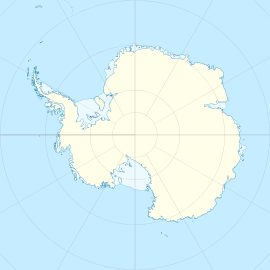
Antarctica: places to catch bald notothenia-stargazer
The species was first described as Notothenia mizops var. nudifrons in 1905 by the Swedish zoologist and ichthyologist Einar Lönnberg ( Swede. Einar Lönnberg , 1865–1942) [4] according to syntypes caught in April – May 1902 at depths of 12–250 m off the island of South Georgia . The scientific (Latin) name “nudifrons” meaning “blue-headed” was given to the species due to the absence of scales on the back of the head and interorbital space, in contrast to the previously closely related species from the Kerguelen islands , the Kerguelen notothenia- stargazer ( Lindbergichthys mizops ), which has the top the head is scratched. In the Russian name, the definition of "stargazer" is given because of the high-set (as if looking up) fish eyes.
Typically bottom, shallow, coastal species, inhabiting depths in the range of 5-350 m and living in the Atlantic sector of the Southern Ocean in the Antarctic Peninsula and islands of the South Antilles island arc to the north to South Georgia . Small fish not exceeding 19 cm in total length. According to the zoogeographic zoning scheme for Antarctic bottom fish proposed by A. P. Andriyashev and A. V. Neyelov [5] [6] , the species range is within the boundaries of the South Georgia province and the West Antarctic province of the glacial subregion of the Antarctic region.
It can be found on the shallow continental and island shelf in the catches of bottom trawls , fixed gill nets and traps, as well as fishing. It is an object of nutrition for predatory fish and seabirds .
In the first dorsal fin there are 4-6 flexible spiny rays, the last of which is connected by the fin fold with the first ray of the second dorsal fin; in the second dorsal fin, 36–40 segmented rays; in the anal fin 33-36 segmented rays; in the pectoral fin 21-24 rays. The stamens in both rows of the first branchial arch are smooth, not serrated, moderately elongated and flattened in the outer row, conical in the inner row: the total number of stamens in the outer row of the first branchial arch is 16–22, of which 11–14 in the lower part, in the upper part - 5-6 gill stamens. There is only one - the dorsal lateral line with tubular scales, the number of which is 33–42; in the medial lateral line, all scales are perforated. The total number of vertebrae is 50–53, of which 15–16 are trunk and 34–38 are caudal [7] .
The body is covered mainly with ctenoid scales. Cycloid scales are present on the cheeks and gill cover. The head is partially scratched: the back of the head, interorbital space, snout, preorbital region and lower surface of the head are naked [7] .
The body is relatively short, laterally compressed, low; its height is about 18-23% of the standard body length. The head is moderate in length, about 28–33% of the standard length. The snout is short — 26–29% of the length of the head, less than the horizontal diameter of the orbit. The top of the snout is located below the lower edge of the orbit. The mouth is finite, small, with an oblique mouth gap. The upper jaw is retractable. The teeth are small, conical, arranged in two rows at the tops of both jaws. The eye is large - 28-35% of the length of the head. The interorbital space is very narrow - 14-19% of the length of the head. The pectoral fins are longer than the ventral fins: the length of the pectoral fin is 79–100% of the length of the head, and the length of the ventral fin is 71–83% of the length of the head. Caudal fin slightly rounded or truncated [7] [8] .
The general body color of living fish is yellowish or yellow, with dark transverse stripes on the sides, the number of which can be from 2 to 5. The chest and bases of the ventral fins are silver-white. The general background of the fins is yellowish, yellow, or grayish. The first dorsal fin with a contrasting black spot in the upper part, the second dorsal fin and anal fin with dark oblique stripes. Pelvic fins with more or less noticeable dark transverse stripes. On the caudal fin there are up to 4 narrow dark vertical stripes. Sexual dimorphism is noted in the coloration, mainly manifested in a brighter orangeish or orange general coloration in adult males, the bands on the fins of which also become orange or brownish-orange [4] [7] [8] .
The species range covers the coastal shelf waters of the northern tip of the Antarctic Peninsula and the coastal waters of the islands of the underwater South Antilles Range - the South Shetland , South Orkney and South Sandwich Islands , as well as the South Georgia Islands. It occurs in the shallow coastal zone of the shelf at depths of 5 to 350 m [4] [8] [7] .
A small species, the maximum total length of which does not exceed 19 cm [7] .
Bottom species, constantly living on the surface of the soil. Strictly territorial species, the males of which for a long period protect their habitats and nesting territory. It feeds on benthos , mainly epifauna - polychaetes , gammarids and isopods [9] [10] .
Fish become sexually mature with a total length of about 12-14 cm (standard length 9-10 cm) [10] [11] . Spawning can occur between April and May to October. The bottom caviar, the diameter of the eggs is about 2.5 mm [11] . Absolute fertility in females with a total length of 11–18 cm ranges from 1646 to 6886 eggs [12] [10] . Nests in which the embryo is incubated for 4 months under the protection of a male are located on rocky ground under the cover of stones or in caverns [10] . Larvae of about 7 mm in size hatch in the region of the Antarctic Peninsula and islands of the South Antilles Arc from September to April [13] [14] .
The bald notothenia-stargazer (together with the Kerguelen nototenia-stargazer) is often considered as a member of the genus Lepidonotothen (subgenus Nototheniops ), as Lepidonotothen nudifrons [7] [15] , and sometimes as a member of the genus Nototheniops , as Nototheniops nudifrons [16] [8] [10] . At the same time, according to a revision of the subfamily Nototheniinae [17] , both of the above species are placed in a separate genus Lindbergichthys .