
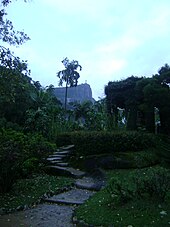
The Botanical Garden of Rio de Janeiro ( port. Jardim Botânico do Rio de Janeiro ) is located in the Jardin Botanico area in the southern zone of Rio de Janeiro ( Brazil ).
The Botanical Garden demonstrates the diversity of Brazilian and foreign flora . On an area of 54 hectares, about 6500 plant species grow, some of them endangered, some of them are found in several greenhouses. There are also historical, cultural and archaeological sites in the garden. It also has an important research center, which has the largest library in Brazil specializing in botany, with about 32,000 storage units.
The Botanical Garden was founded in 1808 by the Portuguese King Juan VI . It was originally intended for the acclimatization of Brazilian exotic plants from which spices such as nutmeg , black pepper and cinnamon were imported from the West Indies . The Botanical Garden was opened to visitors in 1822 , and now it is open daily in the daytime except December 25 and January 1 .
A 140-hectare park lies at the foot of Mount Corcovado , located on the right hand of the statue of Christ the Redeemer and has about 6,000 different species of tropical and subtropical plants, including 900 different types of palm trees . The 750-meter line of 134 palm trees forms the “Royal Palm Avenue” leading from the entrance to the gardens. All of these trees came from a single “Palma Mater,” who died long ago from a lightning strike. Only about 40% of the park’s territory is cultivated, the rest is the Atlantic forest , climbing the slopes of Corcovado [1] .
The park is protected by the Institute of National Historical and Artistic Heritage of Brazil and was designated as a UNESCO Biosphere Reserve in 1992 .
Notes
- ↑ Michelin Travel Guide Rio de Janeiro 2009: 177; Illustration .