Victor Sigismundovich Toot (July 16, 1893 , Budapest - July 28, 1963 , Moscow ) - painter, graphic artist, designer, artist of decorative art, teacher.
| Victor Sigismundovich Toot | |
|---|---|
| Viktor Toth | |
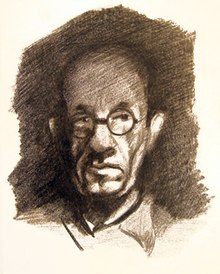 Victor Toot. Self portrait. 1946 | |
| Date of Birth | July 16, 1893 |
| Place of Birth | Budapest , Austria-Hungary |
| Date of death | July 28, 1963 (aged 70) |
| Place of death | Moscow , USSR |
| Citizenship |  Austria-Hungary Austria-Hungary the USSR the USSR |
| Study | VKHUTEMAS |
Content
Biography
He graduated from high school and military school in Budapest. During the year he attended classes at the Academy of Fine Arts in Budapest (1913-1914). Member of the First World War ; He was seriously wounded in Galicia, was captured by Russian (1915). After treatment at a Moscow hospital, he was sent along with a train of prisoners of war to Siberia; I visited the camps and prisons of Tomsk, Omsk, Irkutsk, Krasnoyarsk, Chita, Verkhneudinsk, Khabarovsk, Vladivostok. Member of the Civil War in Siberia on the side of the Red Army: fought in partisan units that fought with the army of Kolchak (1919-20). He worked as an artist in the Political Administration of the East Siberian Military District. In 1920, together with two other Hungarian artists, he was sent by the East Siberian District to study at the State Free Art Workshops in Moscow.
He studied at VKhUTEMAS in Moscow (1920-1924) at the graphic department with V. A. Favorsky , D. N. Kardovsky , N. A. Udaltsova , R. R. Falk . He passed his thesis and received the title of artist in 1926. During his studies at VKHUTEMAS, he met Vera Sergeevna Kizevalter (also a student of VKHUTEMAS), and in 1921 married her.
He lived and worked in Moscow. Three children were born in the family: Elena (1922-2001), Andrey (1925-2012) and Vera (born 1932). Member of the CPSU (b) since 1925. In 1925 (according to other sources, 1926) he accepted Soviet citizenship. From 1924 to 1927 (inclusively) he worked at VKHUTEMAS as a teacher, clerk and dean of the main department (from 1926). In 1924, together with G. G. Klutsis , A. A. Labas , S. Alekseev, worked in the physical laboratory of VKhUTEMAS. From 1928 to March 1930 he worked at VKhUTEIN as vice-rector for academic affairs, deputy director and associate professor. Then, an artist-designer in the Architectural and Planning Directorate of the Moscow Soviet (1930-1937). Rector of the Institute of Architecture and Civil Engineering ( MARCH ) (1930). The main artist-designer of Moscow (1937-1938). Participated in the festive decoration of Moscow, in particular, the Central Park of Culture and Rest named after Gorky , Red Square , etc.
Engaged in easel graphics; He performed mainly landscapes and portraits, worked in the techniques of watercolor, gouache, ink drawing with a pen or brush. Member of exhibitions since 1927. Member of the Union of Artists. Member of the association "October" (1928-1932), MCCX (1932-1937). Participated in the 1st All-Ukrainian exhibition of the Association of Revolutionary Art of Ukraine (ARMU) in Kharkov (1927); exhibitions of Soviet art in Amsterdam, Riga, Winterthur (Switzerland) (all - 1929), a traveling exhibition in the USA (1929); works of Moscow artists in Moscow (1936).
On August 23, 1937, he was dismissed from work and expelled from the party. February 20, 1938 restored. March 23, 1938 was arrested on charges of counter-revolutionary activity, in June of that year was sentenced to 8 years in forced labor camps with subsequent loss of rights. He served his term in the camp of Davydovo (Yertsevo, Davydovsky village council) of the Arkhangelsk region (Kargopolag) and ITL of Udmurtia; worked in a club, taught drawing for juvenile delinquents. Created a cycle of camp drawings. In 1946, released.
First he settled on the “101st kilometer”, in Alexandrov , where he lived for several months. Since it was impossible to find work, and staying in the city was unsafe, he left for the village of Proletary, Novgorod Region. There he got a job at a local porcelain factory, but literally a few weeks later he was transferred to an artist, and then for many years, until 1956, he acted as chief artist. He taught at the Art and Craft School at the Proletary Plant in the Novgorod Region.
By the decision of the Supreme Court of the USSR of May 7, 1955, he was completely rehabilitated. In 1956 he was reinstated in the membership of MOSSX . In 1960, he traveled to Hungary , where he met with relatives.
He died on July 28, 1963 in Moscow, was buried at the Vvedensky cemetery .
Creativity
Literary heritage
Memories of camp life: Toot V. S. Counting the days and hours // Our Heritage , 1988. No. 5. P. 44-51.
Meetings
Creativity is represented in a number of museum collections, including the Alexander and Marina Anastasia Tsvetaevs Alexander Museum of Literature and Art , the Museum Collection of the Memorial Society in Moscow.
Literature
- Exhibitions of Soviet Fine Art: A Guide. T. 1 - M., 1965. - S. 532 (decree); In the same place. T. 2. - M., 1967 - S. 551 (decree);
- Samizdat century. - Minsk; M .: Polyfact, 1997 .-- S. 996, 1000: ill .;
- Creativity and Life of the Gulag: Catalog of the Museum Collection of the Memorial Island - M.: Links, 1998. - P. 107-109;
- B. Toot. Counting the days and hours // Our heritage. - 1988. - No. 5. - S. 44-52;
- The book of memory of victims of political repressions in the Nizhny Novgorod region. - Nizhny Novgorod: Nizhny Novgorod printer;
- The book of memory of victims of political repressions of the Novgorod region. - Novgorod: Cyrillic;