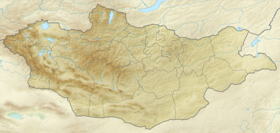
The Nemagetinsky Basin ( Mong. Nemagtin Hotgor ) is an extensive intermountain depression located in the south of the Gobi Desert , on the territory of the somon Dalanzadgad [1] (aimak Umnegov ) in Mongolia , north of the border with China .
| Namagati Basin | |
|---|---|
| mong. Namagthyn Hotgore | |
| Location | |
| A country |
|
| Aimak | Smart |


Content
Geography and geology
On the topographic maps, the hollow itself is often not indicated, however, it is under this name that it is known among paleontologists . From the north, the Nemagati Mountains border the hollow with the peaks of Khover-Ula (2769 m) and Altan-Ula (2273 m); in the south rises the peak of Toast Ula (2517 m).
In geological terms, the Namegatinsky Depression is the bottom of an ancient water basin that existed 65-70 million years ago. In the west and east, the basin is open to through winds. Every year, gigantic masses of sand formed in the western part of the basin during the destruction of mountains migrate to the east, driven by powerful spring storms. The strength of local winds reaches 9-point values between March and May. The hollow reaches 200 kilometers in length, about 50 in width. It is completely occupied by sand dunes overgrown with saxaul . There is almost no water in the cavity itself; there are separate wells in the foothills. Near the mountains, where there are wells, there are yurt camps of semi-nomadic Mongols. The nearest permanent settlement is the somon center of Noyon , located 120 kilometers from the edge of the basin. In the center of the basin itself, it is quite difficult to navigate with the naked eye, since due to its rather large size, the surrounding ridges are not visible. The distance to Ulaanbaatar is about 900 km [2] .
Paleontological significance
This hollow, along with Patagonia, African and New Mexico , became world famous thanks to three large locations of dinosaur fossil bones. As a result of centuries-old water and wind erosion, the fossil fauna of the region was almost on its surface.
In 1925, an American expedition found numerous dinosaur skeletons and their fossilized eggs in an area of about 20 km² in the red sandstones of Bayanzag . In 1946, the paleontological expedition of the USSR Academy of Sciences, led by professor I. A. Efremov, discovered two other locations of giant dinosaurs in the hollow. Among the animals found in the basin there are bones of tarbosaurs , therizinosaurs , saurolophus, and velociraptors [3] .
See also
- Namagat (formation)
- Mongolian paleontological expedition of the USSR Academy of Sciences .